Which Schema Markup Actually Matters in Google Search?
Choose schema by the page’s visible job and a documented search feature, then separate rich-result eligibility, machine understanding, validation, and ranking claims.
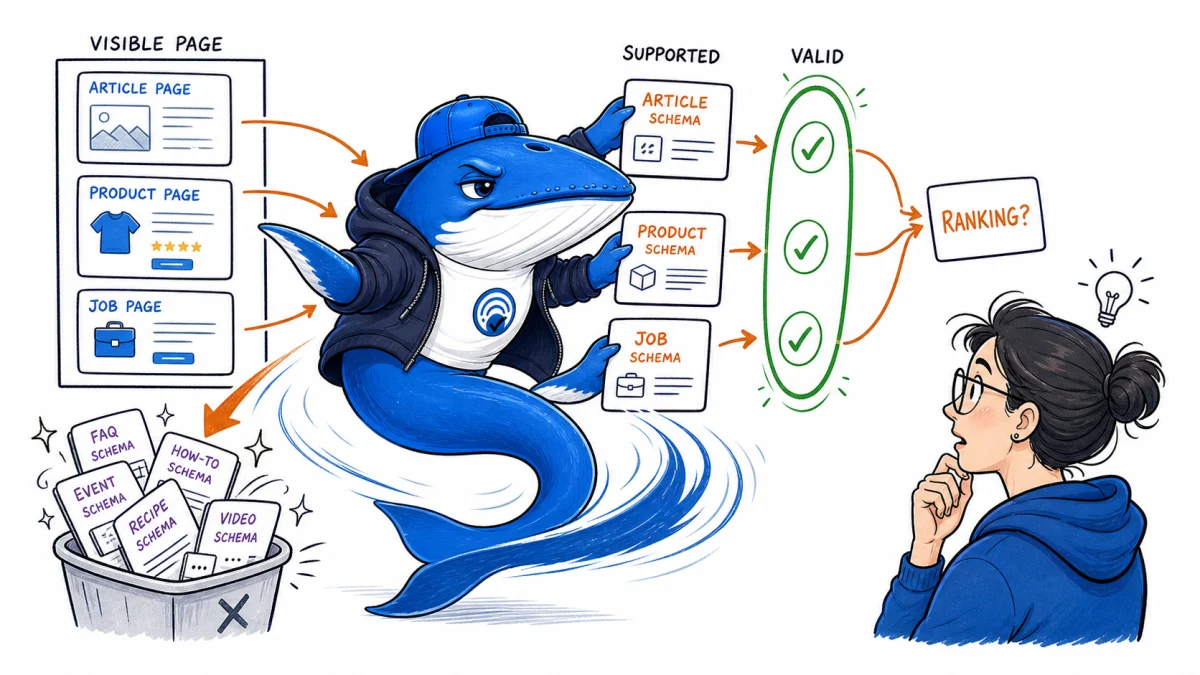
Direct answer: the schema markup that matters is the markup that accurately describes the page’s visible primary content and supports a search feature or machine-readable relationship you can maintain. A type being available at Schema.org does not mean Google has a corresponding rich result. Passing a syntax test does not guarantee display, indexing or ranking.
Use a decision sequence: identify the page job, check Google’s current Search Gallery, apply the most specific supported type, keep the markup consistent with visible content, validate it, and monitor the relevant Search Console report.
Separate four different claims
| Claim | What can support it | What it does not prove |
|---|---|---|
| Syntax is valid | Parser or validator result | Policy compliance or display |
| Rich-result eligible | Supported type, required properties and Google policies | The feature will appear |
| Content is described | Accurate structured representation of visible content | Ranking improvement |
| Search performance changed | Dated Search Console observations | Structured data caused the change |
Google says a structured-data manual action removes eligibility for a rich result but does not affect how the page ranks in ordinary web search. That boundary is useful: rich-result eligibility and web ranking are different systems.
Choose markup from the page outward
- Name the primary page object. Is it an article, product, recipe, event, job, local business, video, profile or another visible entity?
- Check current Google support. Use the Search Gallery and the feature-specific documentation, not an old plugin list.
- Use the most specific applicable type. Add required properties and useful recommended properties that are actually present.
- Connect related items only when real. A visible video can relate to an article; a genuine author profile can identify an author. Do not create fictional entities to make the graph look richer.
- Preserve one source of truth. Titles, dates, prices, availability, ratings and authorship should agree across visible HTML, feeds, metadata and JSON-LD.
The article Schema.org 30.0 is not a Google rich-result update explains the vocabulary-versus-product boundary. The Schema.org usage study shows what publishers use across the web without turning popularity into a recommendation.
Use a page-type decision table
| Visible page job | Likely primary type | Critical verification |
|---|---|---|
| News or editorial article | Article, NewsArticle or a suitable subtype | Headline, dates, author and images match |
| Single purchasable product | Product with appropriate offer data | Price, currency, availability and reviews are real |
| Step-by-step recipe | Recipe | Ingredients and instructions are visible and complete |
| Job detail | JobPosting | Open role, location, dates and policy compliance |
| Author profile | ProfilePage with a person as the main entity | Identity is consistent and supported on-site |
This table is a starting point, not a permanent compatibility registry. Google adds, changes and removes features. Recheck the live documentation before implementation and after template changes.
Audit and maintain the markup
- Validate representative templates with the Rich Results Test and a general schema validator.
- Inspect rendered HTML when JavaScript generates or modifies JSON-LD.
- Confirm every marked property is visible or legitimately describes the visible item.
- Test canonical, mobile and regional variants.
- Monitor enhancement reports, unparsable structured data and manual actions.
- Revalidate after theme, plugin, commerce, author or date-template changes.
Do not add every possible type to every page. Extra markup increases the surface for contradictions and stale fields. The useful minimum is accurate, specific and maintained.
Limit: structured data can help systems understand content and can create eligibility for supported features. It cannot compensate for inaccessible pages, weak content, false claims, broken canonicals or missing reader value.
Keep learning
Continue this topic
Next in this topic
Discovered—Currently Not Indexed: New-Page Guide
Earlier in this topic
“Near Me” Business Names on Google Maps: A 20-Field Evidence Audit
SEO
Ask a question or join the discussion