“Near Me” Business Names on Google Maps: A 20-Field Evidence Audit
Apply Google’s real-world-name rule to a legally registered “near me” brand with a 20-field evidence audit and a keep, correct or escalate decision.
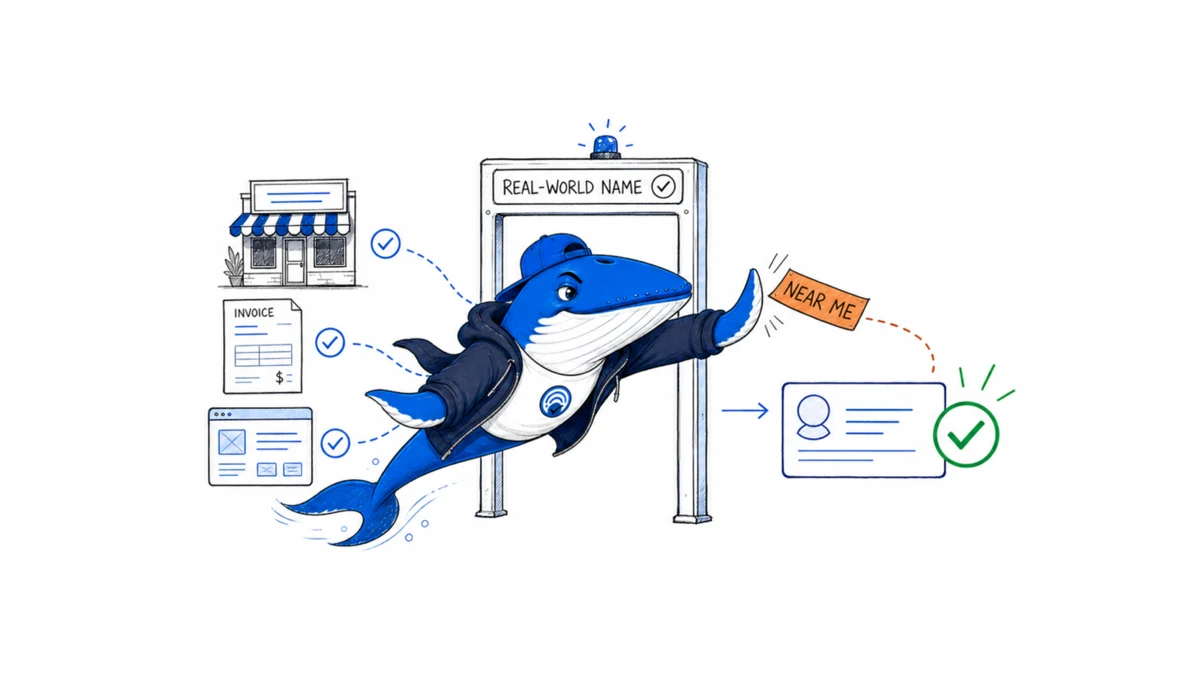
Direct answer: a legally registered business name containing “near me” is not automatically entitled to appear unchanged on Google Maps. Google Business Profile policy asks whether the profile name matches the name used consistently on the storefront, website, stationery and by customers. A registration document can support the evidence file, but it does not replace that real-world-name test.
This guide turns that policy into a 20-field business-name evidence audit. It helps an owner decide whether to keep, correct or escalate a profile name without promising a ranking gain or giving jurisdiction-specific legal advice.
Separate legal registration from profile policy
A corporate filing, assumed-name registration, trade-name certificate or DBA answers a legal identity question under a particular jurisdiction. Google Business Profile answers a platform representation question. These systems can use related evidence, but neither controls the other.
Google’s current guidelines for representing a business say the profile name should reflect the real-world name used consistently on the storefront, website, stationery and as known to customers. The same page says unnecessary information in the name is not permitted and could result in profile suspension. It directs businesses to put the address, service area, hours and category in their own fields.
| Evidence layer | Question it can answer | What it cannot prove alone |
|---|---|---|
| Government record | Is this name registered in the stated jurisdiction? | Customers commonly know the business by it |
| Permanent signage | What name is presented at a customer-facing location? | That every online reference is consistent |
| Website and stationery | What name appears in routine customer communications? | That the profile will rank for a query |
| Business Profile | What name currently appears on Google? | That the name complies or is permanently accepted |
Apply the real-world-name test
Start with the name a customer encounters during an ordinary transaction. Photograph permanent exterior and interior signage where applicable. Check the website header, invoice, estimate, receipt, appointment confirmation, business card, phone greeting and branded vehicle. Record the date and whether each item existed before the profile dispute.
Temporary evidence is weak. A paper sign printed after a suspension, a footer added only for verification or a directory listing created yesterday does not demonstrate established public use. The worksheet therefore asks for the source date, public visibility and consistency result instead of collecting a pile of undifferentiated screenshots.
Use redacted copies. The audit does not need customer names, phone numbers, signatures, tax numbers, bank details or private correspondence. Preserve the original confidential record in the appropriate business system and export only the minimum evidence needed for the review.
Test whether “near me” is brand identity or query text
The phrase can be part of a genuine brand. The difficult case is a name that reads like a search instruction: “Emergency Plumber Near Me Open Now”. Ask four concrete questions:
- Did the business use the complete name before the Google profile decision?
- Is the complete name prominent across permanent, customer-facing materials?
- Do customers use the name to identify this specific business rather than a service category?
- Would removing the location-intent phrase make the profile match the established brand more closely?
A “yes” to the first three does not guarantee Google acceptance. It creates a stronger, dated evidence file. A “no” to several questions is a warning that the profile name may contain search terms rather than the established name.
| Scenario | Evidence state | Bounded action |
|---|---|---|
| Longstanding public brand contains “Near Me” | Consistent signage, website and customer documents | Preserve evidence and request a policy review if challenged |
| Legal filing only | No established public use | Do not treat the filing as automatic profile permission |
| Keywords added only on Google | Profile differs from ordinary branding | Correct the profile to the real-world name |
| Business is genuinely rebranding | Public surfaces are changing over time | Complete the real rebrand, then document the transition |
Do not turn distance into a name claim
Google’s local ranking guidance says local results are mainly based on relevance, distance and prominence. Distance is the relationship between the business and the searcher’s location. Putting “near me” in a name does not move the business, correct an inaccurate address, extend the service area or prove proximity.
Relevance and prominence also are not controlled by one phrase. Accurate categories, complete profile information, legitimate reviews, links and the underlying business identity matter in different ways. Google does not publish a rule promising that a search phrase in the registered name will create a ranking advantage.
If you test a real rebrand, measure branded retrieval, correct-profile discovery, calls, bookings and customer confusion. Do not label an isolated map position change as proof that the wording caused a ranking improvement. Location, competitors, personalization and interface state can change the result.
Audit every customer surface
Google explains that Business Profile information can come from owner contributions, public web content, licensed data, user contributions and Google’s interactions with a place. Its business-information source guide is a reminder that editing one field does not erase conflicting evidence elsewhere.
Create a source map before a name change. Include the official website, major directories, booking tools, social profiles used as business identities, payment receipts, marketplace profiles, call tracking, email templates and local licenses. Mark which sources you control, which accept corrections and which may lag.
| Surface | Check | Failure to avoid |
|---|---|---|
| Profile name | Matches ordinary real-world use | Extra services, hours, location or slogans |
| Address/service area | Stored in the correct field | Location text inserted into the name |
| Website | Brand and contact information agree | Metadata-only name with different visible brand |
| Directories and bookings | Authorized identity is consistent | Uncontrolled bulk edits with no rollback list |
Use the 20-field evidence audit
Download the Google business-name evidence audit. One row represents one evidence item or controlled surface. Remove the EXAMPLE-REMOVE rows and replace them with redacted facts from the business under review.
The audit records the candidate profile name, the observed name, evidence type, public-use start date, control status, consistency result, privacy action, policy risk, decision, owner and recheck date. A reviewer can therefore see not only that a screenshot exists, but why it supports or weakens the proposed name.
Do not upload the public CSV to a support case. Keep the support package in a private workspace and attach only the evidence requested through an official Google channel. The downloadable file is a decision template, not a container for identity documents.
Choose keep, correct or escalate
Keep the current name when the evidence is consistent, the wording is the established public identity and there is no active policy conflict. Set a recheck date because ownership, signage and customer surfaces change.
Correct the profile when services, city names, hours, slogans or query phrases were added beyond the real-world name. Record the before state, correction date and affected destinations. Avoid changing several unrelated profile fields at the same time.
Escalate through an official support or appeal path when a genuine public name is rejected or a profile is suspended. Submit a concise explanation and the smallest coherent evidence set. A legal filing may belong in that set, but frame it alongside established public use rather than as a document that overrides the platform policy.
Plan a real rebrand before editing Google
If the company is adopting a new name for business reasons, treat the profile edit as one step in a larger migration. Confirm the new legal or trade-name state where required, update permanent branding, customer documents and owned destinations, preserve the old-to-new relationship, and train staff to use the new name.
Schedule the profile edit only when the public identity is supportable. Capture the current profile, featured media, categories, URLs and verification state first. Maintain a rollback record and watch for duplicate profiles or third-party edits. Use the bounded SEO experiment method to document observations without turning one local result into a universal claim.
Sources and limitations
- Google: Guidelines for representing your business
- Google: Tips to improve your local ranking
- Google: How business information is sourced and used
- SearchEngineAnswer editorial policy
Sources were rechecked on August 29, 2026. Google policy does not determine whether a name is legally registrable in a particular country, state or province. This article is an editorial compliance framework, not legal advice, a profile-acceptance guarantee or a ranking promise.
Keep learning
Continue this topic
Next in this topic
Which Schema Markup Actually Matters in Google Search?
Earlier in this topic
How to Measure Google Business Profile Post Actions
SEO
Ask a question or join the discussion