Which Schema.org Types Are Actually Used Across the Web? July 2026 Data
Official May–July data shows Product and Offer entering the 10M+ domain bucket in June and Article entering it in July, with important coverage limits.
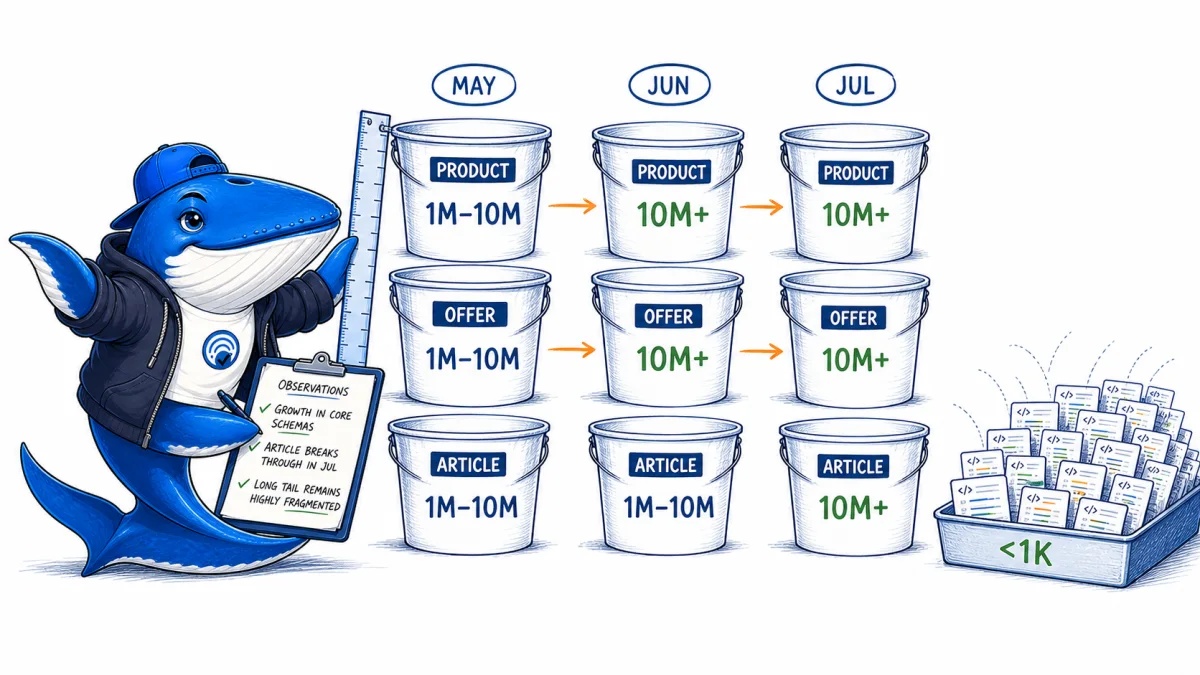
Data analysis, August 10, 2026: SearchEngineAnswer compared the official Google-contributed Schema.org usage files for May, June, and July 2026. In the published domain-count buckets, Product and Offer moved from 1M - 10M in May to 10M+ in June. Article moved from 1M - 10M in June to 10M+ in July.
Those crossings describe adoption in Google’s indexed-web dataset, not eligibility for a Google search feature and not a reason to add irrelevant markup. The data combines JSON-LD, Microdata, and RDFa and reports domain ranges rather than exact counts.
Method: what the dataset measures
Schema.org and Google publish monthly files with three core fields: term class, term URI, and a bucket representing how many unique domains use the term. Schema.org says buckets reduce crawl noise and protect privacy. The files reflect the web as indexed by Google, exclude sites unavailable to that crawl such as robots-blocked sites, and do not distinguish markup formats.
We downloaded the official JSON files named 2026_05.json, 2026_06.json, and 2026_07.json on August 10. We matched exact Schema.org URIs and compared the published bucket strings. No interpolation was used, and a bucket change is reported only when the official label changed.
Results: selected publishing and commerce types
| Type | May 2026 | June 2026 | July 2026 |
|---|---|---|---|
| Article | 1M – 10M | 1M – 10M | 10M+ |
| BlogPosting | 1M – 10M | 1M – 10M | 1M – 10M |
| NewsArticle | 100K – 1M | 100K – 1M | 100K – 1M |
| Product | 1M – 10M | 10M+ | 10M+ |
| Offer | 1M – 10M | 10M+ | 10M+ |
| FAQPage | 1M – 10M | 1M – 10M | 1M – 10M |
| DiscussionForumPosting | 10K – 100K | 10K – 100K | 10K – 100K |
| QAPage | 10K – 100K | 10K – 100K | 10K – 100K |
The table shows ranges, not the magnitude of the movement inside a range. A term at 9.9 million and a term at 1.1 million would share one bucket. A crossing into 10M+ proves only that the release assigned the term to the higher range.
The long tail dominates the vocabulary
Each monthly file contained 958 item types and 4,587 predicates. In July, 470 item types and 3,747 predicates were in the < 1K bucket. Only 16 item types and 36 predicates were in 10M+.
That imbalance is expected in a broad vocabulary. Specialized medical, government, scientific, and workflow terms address smaller populations of sites. Schema.org explicitly warns that a low bucket does not mean search engines ignore a term.
| Term class | Total terms | < 1K | 10M+ |
|---|---|---|---|
| Itemtype | 958 | 470 | 16 |
| Predicate | 4,587 | 3,747 | 36 |
Limits and responsible use
- Choose types by visible meaning. Mark up the entity and content actually present, not the most popular term.
- Separate vocabulary adoption from search features. Google’s feature documentation defines additional requirements and supported properties.
- Watch stable changes. A bucket crossing is useful for ecosystem research, but monthly noise and crawl coverage still constrain the finding.
- Keep exact versions. Save the raw file, retrieval date, query, selected URIs, and derived table.
- Do not infer format. The data combines JSON-LD, Microdata, and RDFa at the domain level.
The site’s article comments and discussion schema guide shows why meaning and page structure matter more than a popularity contest. Use the evidence-led publishing guide to keep the raw dataset beside every derived claim.
Primary data and method
- Schema.org: Announcing the usage statistics dataset
- Schema.org: About usage statistics
- Official Google-contributed monthly files
Reproducibility note: the three raw JSON files and exact selected-term output were retained with this publication package. The analysis compares official bucket labels and does not estimate hidden counts.
Vocabulary versus feature
Schema.org adoption does not tell you which markup earns a Google feature
Schema.org describes a shared vocabulary used across the web. Google documents a smaller set of structured-data features with its own eligibility and property requirements. Those are different questions.
- Vocabulary question
- Is a type or property used in published markup?
- Search-feature question
- Does Google document a supported feature for this page type?
- Implementation question
- Does the rendered page contain valid markup that matches visible content?
- Outcome question
- Did Search Console or the live result show an eligible appearance?
My takeaway: Choose markup because it accurately describes the page and supports a real consumer. Do not select a type only because a usage chart makes it look popular.
Keep learning
Continue this topic
Next in this topic
Kagi AI-On vs AI-Off: A Reproducible Search Test Protocol
Earlier in this topic
How to Test Whether a Public ChatGPT Site Is Indexable
Research
Ask a question or join the discussion