How to Test Whether a Public ChatGPT Site Is Indexable
OpenAI allows eligible users to publish ChatGPT Sites publicly, but public access is not proof of indexability. Use this controlled technical audit before reporting results.
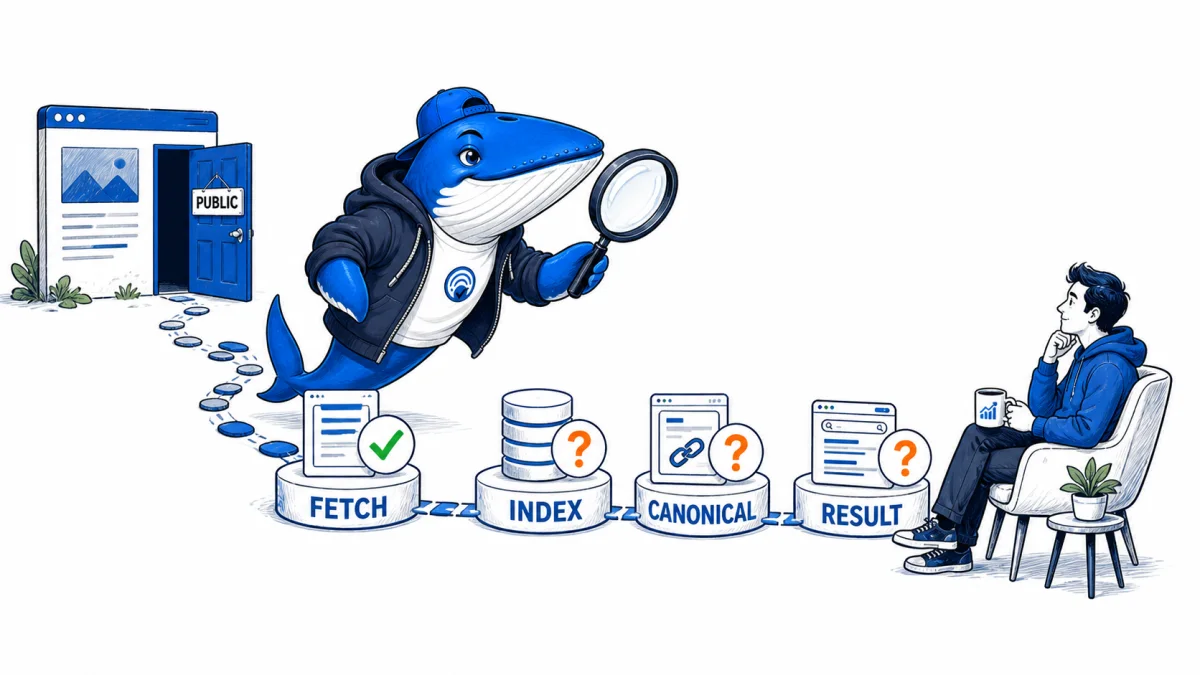
Protocol published August 10, 2026: OpenAI says eligible ChatGPT customers can publish Sites publicly and share them through a URL. Its launch note does not say that every public Site is crawlable, indexable, canonicalized in a particular way, or guaranteed to appear in Google or Bing.
This article provides a bounded audit for one public Site. It does not report an indexation result because SearchEngineAnswer has not completed the required observation window on a controlled Site. “Publicly reachable” is the first condition to test, not the conclusion.
Confirm the product and access state
OpenAI introduced ChatGPT Sites in public beta. The release notes say Business and Enterprise customers can publish Sites publicly; Enterprise public publishing is off by default until an administrator enables it. The expanded beta also names Pro, Pro Lite, and Edu, with Plus following, while Free and Go are excluded. At launch, public publishing and the expanded beta are unavailable in the EEA, Switzerland, and the United Kingdom.
Record plan, workspace type, admin setting, region, publish time, Site URL, and the exact product surface used. A private preview, workspace-only share, and public URL are different states. Test while signed out and in a clean browser before involving a search engine.
Run the technical eligibility audit
| Layer | Record | Failure interpretation |
|---|---|---|
| Public access | Signed-out status, redirect chain, login wall, challenge | A public share setting may still deliver an inaccessible response |
| Robots | robots.txt, meta robots, X-Robots-Tag | A block or noindex can prevent normal crawling or indexing |
| Canonical | Rendered canonical URL and redirect destination | The inspected URL may consolidate elsewhere |
| Main content | Initial HTML, rendered DOM, headings, links, text | Client rendering or access state may hide the useful page |
| Discovery | Internal links, public listing, sitemap where available | An isolated URL may not be discovered without a submitted or crawlable path |
| Search observation | Inspection, index query, search performance, dates | Absence at one time is not proof of permanent exclusion |
Save raw headers and initial HTML before running a rendered-browser capture. If the public URL changes after editing or republishing, record the redirect and canonical relationship rather than treating it as the same stable page automatically.
Create a controlled test Site
- Publish one original page with a distinctive, non-sensitive phrase and a clear page title.
- Record the publish timestamp, exact URL, public settings, plan, region, and screenshots.
- Fetch the page while signed out and save status, headers, HTML, rendered text, canonical, and robots directives.
- Add one crawlable link from an owned, indexable page if the test allows it; record the link and release time.
- Submit or inspect only through tools legitimately available for the destination property. Do not claim ownership of a host you cannot verify.
- Check on a declared schedule without editing the Site during the first observation window.
- Record discovery, crawl, canonical selection, indexation, result appearance, and referral as separate states.
A clean protocol needs a negative control, such as an unpublished or access-restricted Site whose URL is not linked. Do not expose private content simply to create the control.
Report the result with the right boundary
A valid result might say: “The controlled public Site returned HTTP 200 to a signed-out client, exposed indexable HTML, and appeared in one named search engine on a stated date.” It should not become “ChatGPT Sites rank” or “all public Sites are SEO-ready.” Product state, host behavior, search-engine coverage, and individual page quality can change.
If the Site does not appear, report the deepest observed state. A URL can be public but undiscovered, crawled but excluded, canonicalized elsewhere, or indexed without receiving impressions. Use the citation-ready passage test for the visible answer and the small SEO experiment method for the observation card.
Do not add special schema, an AI-specific file, or a large set of artificial links merely because the host is new. Begin with normal technical eligibility and readable, original content.
Keep learning
Continue this topic
Next in this topic
Which Schema.org Types Are Actually Used Across the Web? July 2026 Data
Earlier in this topic
How to Read Brave’s 1,500-Query AI Search Benchmark
Research
Ask a question or join the discussion