How to make content easier to cite in AI search
No page can force an AI citation. This guide shows how to meet ordinary eligibility requirements, build evidence passages that travel, and measure retrieval without ranking promises.
Updated August 9, 2026: Re-edited for a faster direct answer, closer primary-source links, and clearer measurement limits.
No publisher can force an AI answer engine to cite a page. The useful goal is narrower: make a page eligible to be found, easy to interpret, and safe to use as evidence.
That work is not a secret branch of SEO. Google says its AI features require no additional technical optimization or special schema; a page still needs to be indexed and eligible to appear with a snippet. Bing’s webmaster guidance likewise starts with the fundamentals that help search systems discover and understand content.
The difference is editorial. A citation candidate needs a claim that can survive outside the paragraph around it.
Start with eligibility
Before polishing prose for quotation, confirm that the page can be crawled, indexed, rendered, and shown with a snippet. Check the final status, robots controls, canonical URL, visible main content, and crawlable internal links. For pages intended to appear in ChatGPT search summaries and snippets, OpenAI’s publisher guidance says not to block OAI-SearchBot.
Eligibility is necessary, not sufficient. It creates an opportunity to be considered; it does not promise inclusion, ranking, or a citation.
Build a citation-ready passage
A strong evidence passage usually contains five parts:
- A direct answer. State the conclusion in the first sentence.
- A defined boundary. Say which product, date, population, or scenario the claim covers.
- Visible support. Link to the primary source or show the underlying calculation.
- A useful distinction. Explain what readers often confuse with the claim.
- An honest limit. State what the evidence does not prove.
For example, “AI Overviews require a special schema” is not citation-ready because the premise is false. A better passage is: “Google does not require special schema for AI Overviews or AI Mode. Pages must meet the ordinary technical requirements for Search and be eligible for a snippet; appearance is not guaranteed.” That answer is bounded, attributable, and resistant to being stripped of context.
Put source links next to the claims they support
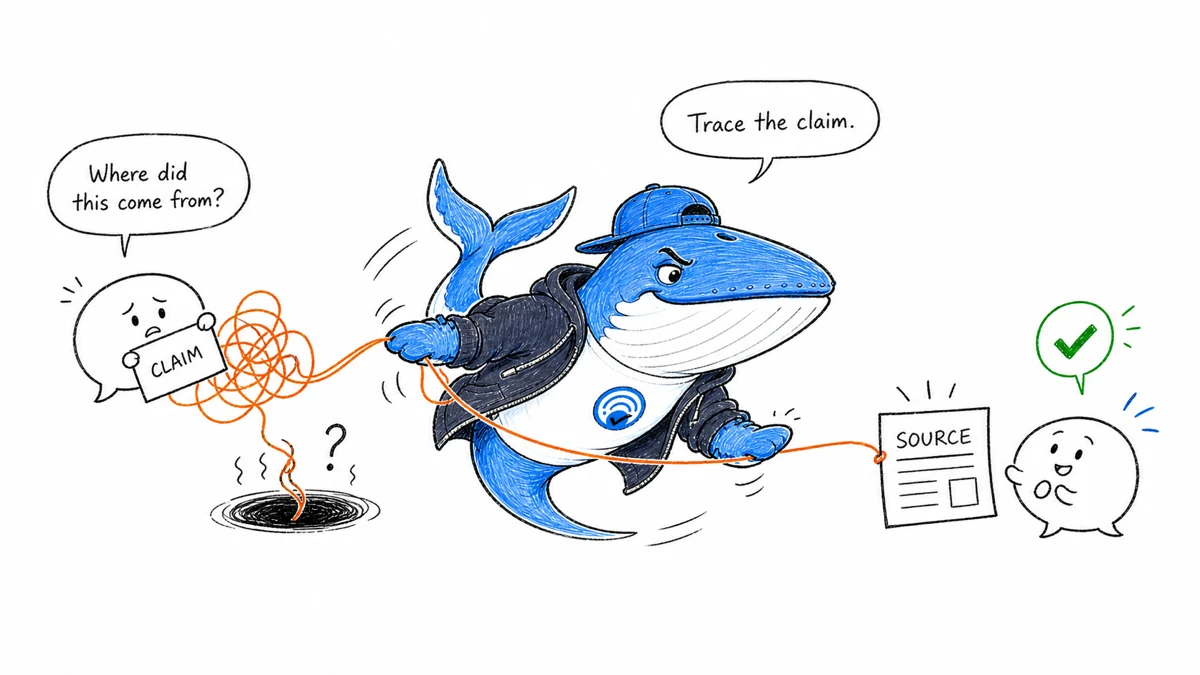
A source list at the bottom is useful, but it should not force readers to guess which source supports which statement. Link the product name, data point, or policy claim where it appears. Prefer official product documentation, standards, original research, public datasets, regulatory filings, and first-hand evidence.
Secondary reporting can add context. It should not quietly replace the source that actually owns the fact.
Create information worth retrieving
Reformatting the same public facts into smoother prose produces little information gain. Add something a reader can use:
- a tested procedure with inputs, failure states, and a stopping rule;
- a comparison built around a real decision rather than a feature inventory;
- an original template, calculator, checklist, or annotated example;
- first-hand observations with dates and reproducible evidence;
- a careful synthesis that reconciles conflicting primary sources.
This article’s five-part passage test is one such layer. It gives an editor a review method, not merely another instruction to “write clearly.”
Use structure to expose the answer
Write headings that name the reader’s question. Keep one main idea per section. Define acronyms before using them. Use tables for exact comparisons, numbered steps for a sequence, and bullets for genuinely parallel items.
Do not manufacture dozens of tiny FAQ sections to imitate a search result. The page should remain coherent when read from top to bottom. A concise answer near the relevant heading is more useful than a page full of disconnected snippets.
Make authorship and maintenance visible
Show who wrote or reviewed the page, what qualifies that person to cover the subject, when the page was published, and when a material update occurred. Link to an editorial policy and a corrections process. These signals help a human evaluate the work and make stale claims easier to repair.
For time-sensitive product features, include an “as of” date in the sentence itself. An updated timestamp alone does not reveal which claim changed.
Measure without pretending citations are rankings
Google includes traffic from its AI features in the Web search type in Search Console. OpenAI says ChatGPT referral URLs include utm_source=chatgpt.com, which can help analytics attribution. Bing Webmaster Tools’ AI Performance report can show citations, cited pages, and grounding queries.
These are useful observation points, but they do not establish causation. Track the page version, the date of a material change, referral traffic, cited-page reports where available, and normal search performance. Treat a citation as evidence of retrieval in a particular response;not as a stable position you own.
The editor’s final test
Before publishing, copy the strongest answer paragraph into a blank document. A reader should be able to identify the subject, scope, evidence, and limitation without the rest of the article. If any one is missing, revise the passage before publication.
Use the source-bounded AI brief workflow before drafting and the evidence-led publishing guide before release.
Passage rewrite
Make the qualification travel with the answer
A passage is easier to cite when the main claim is explicit and its important condition is in the same unit.
- Vague: “AI search changes traffic a lot.”
- Clearer: “In this fixed query sample, visible publisher citations fell between the two recorded dates.”
- Complete: add the sample, dates, measured values and the source or downloadable evidence beside the statement.
My takeaway: The goal is not to write for a machine. It is to let a reader lift one sentence without losing the context that keeps it accurate.
Primary documentation
Keep learning
Continue this topic
Next in this topic
Google Search Console Generative AI Report: How Impressions Are Counted
AEO & AI Search
Ask a question or join the discussion