Google ranking volatility: diagnose a traffic drop with evidence
Compare queries, pages and CTR before changing content. Use a downloadable traffic worksheet and keep the confirmed August update separate from earlier movement.
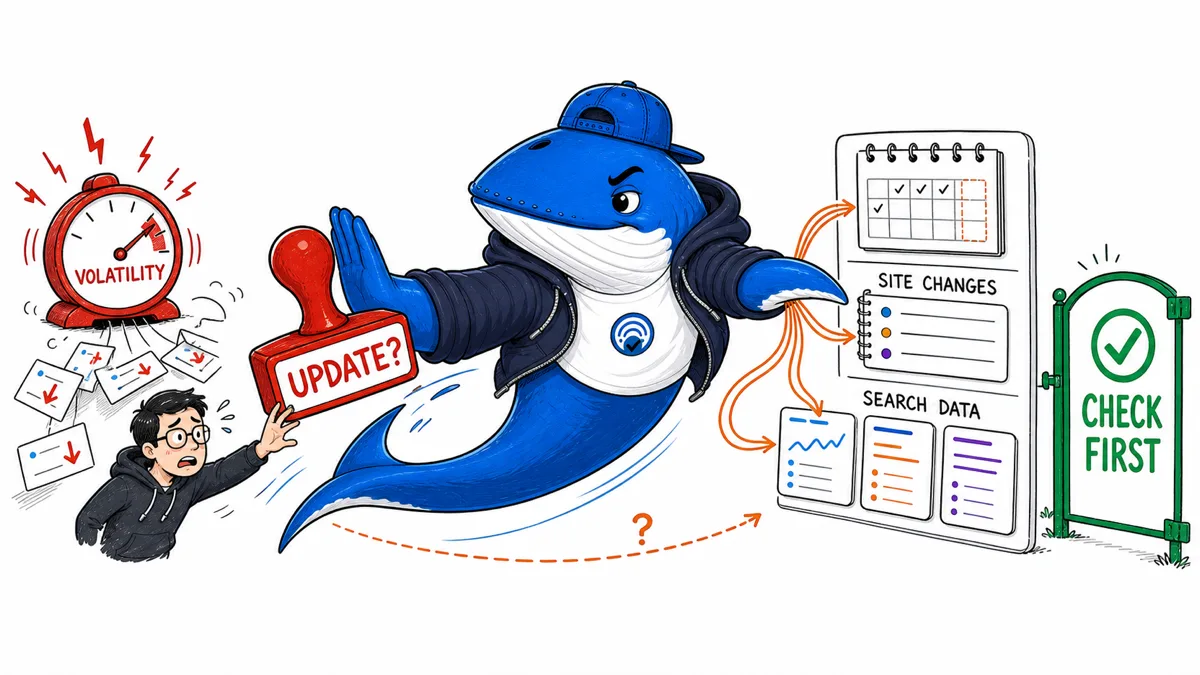
Updated August 29, 2026: When this analysis was first published on August 11, Google had not listed an August ranking update. Google later confirmed a separate global spam update that ran from August 18 at 09:27 PDT through August 21 at 01:49 PDT, a duration of 2 days, 16 hours, and 22 minutes. That confirmed window should not be retroactively used to explain volatility observed before August 18.
The practical response remains the same: preserve the evidence before changing the site. Record affected pages and queries, separate the before, during, and after windows, check releases and technical controls, compare demand, and define what result would support or weaken each explanation. Update timing can guide an investigation; it cannot identify the cause by itself.
What Google confirmed later
Google’s Search Status Dashboard now records an August 2026 spam update. Google lists the rollout as global and applying to all languages, beginning August 18 and completing August 21. The earlier August 1–11 volatility discussed in the original article remains outside that confirmed rollout window.
The date match is a boundary, not proof of causation. A decline during the official window still needs page-, query-, country-, device-, and technical evidence. A decline before the window cannot be attributed to this confirmed update merely because the same month later received an update annotation.
| Window | Confirmed status | Diagnostic treatment |
|---|---|---|
| Before August 18, 09:27 PDT | No confirmed spam-update rollout | Keep algorithm change as an unconfirmed hypothesis |
| August 18–21 | Official global spam-update window | Compare affected segments and controls without assuming causation |
| After August 21, 01:49 PDT | Rollout marked complete | Watch stabilization and preserve post-update observations |
Capture a volatility incident card
Before editing content, save one compact incident record. This is the article’s original contribution: a shared minimum record that keeps diagnosis separate from reaction. It also makes later comparisons reproducible.
| Field | Record | Why it matters |
|---|---|---|
| Observation window | First visible change, timezone, comparison dates | Prevents a vague “this week” timeline |
| Affected scope | Site, directory, template, page, query group | Separates local failures from broad movement |
| Search dimensions | Country, device, search type, appearance | Exposes changes hidden by an aggregate chart |
| Site releases | Deploys, migrations, internal links, canonicals, robots, content edits | Tests causes the publisher controls |
| Search evidence | Clicks, impressions, average position, indexed pages, crawl errors | Distinguishes demand, ranking, and technical loss |
| External context | Status dashboard, demand trend, SERP competitors, community reports | Adds context without treating correlation as proof |
| Decision rule | What result triggers action, monitoring, or rollback | Stops the diagnosis from changing after the result is known |
Attach exports, screenshots, and release identifiers where they exist. Do not overwrite the baseline with a later export. The small SEO experiment method provides a fuller observation card when you need to test a specific change.
Segment the drop before you explain it
Google’s traffic-drop guidance recommends using Search Console to compare periods and review pages, queries, countries, devices, search appearances, and search types. It also recommends looking at 16 months of data when seasonality may be involved.
Start with the smallest stable segment that still shows the change. A site-wide chart can hide a lost directory, a device-specific rendering failure, a fall in one country, or declining demand for a small set of queries. Use the pattern to choose the next check.
| Observed pattern | Check next | Do not conclude yet |
|---|---|---|
| Clicks fall; impressions remain stable | Queries, title and snippet changes, search appearance, competitor presentation | That rankings collapsed |
| Clicks and impressions fall for one template | Release log, canonicals, noindex, rendering, internal links, server responses | That a broad update targeted the site |
| Position falls across many unrelated sections | Status timeline, content assessment, manual actions, security, major site changes | That one page edit caused the loss |
| One country or device changes | Locale, mobile rendering, regional demand, SERP composition | That the global site moved equally |
| Queries lose impressions across competing sites | Google Trends and market demand | That the site alone has a ranking problem |
| URLs changed before the decline | Redirect map, canonicals, internal links, sitemaps, indexed URL variants | That timing alone proves a migration failure |
Clear site-controlled causes first
A release that coincides with volatility deserves inspection before an unannounced algorithm theory. Check the final status code, robots controls, canonical target, rendered main content, internal links, sitemap membership, structured data, and analytics instrumentation for representative winners and losers.
When the change follows a migration, use the priority-first SEO audit and inspect exact URL mappings. When a prefix change has produced “Crawled – currently not indexed” patterns, use the URL-prefix migration protocol. For a wider new-site review, the priority-first SEO audit starts with blockers that can affect discovery or measurement.
Absence from Google’s dashboard is not evidence that a site is technically sound. Google says an unlisted problem may be isolated to particular pages or a limited number of sites. A clean site-level check is still required.
Use community chatter as a lead
An August 1–3 r/SEO discussion contains reports of movement and frustration across several niches. It is useful for vocabulary, timing, and possible failure cases. It is not a shared dataset: commenters do not use one query sample, country, device, baseline, or verification method.
Record such reports in the incident card under external context. Do not convert them into “Google rolled out an update” unless Google confirms the update or a transparent study establishes a narrower observation. Even agreement across several trackers proves simultaneous movement in their samples, not the mechanism that caused it.
Decide whether to monitor, test, or change
Monitor when the movement is small, recent, or inconsistent across comparison windows. Google recommends avoiding radical changes for small position fluctuations. Preserve the baseline and set a review date.
Test when one bounded explanation has observable evidence and a reversible change. State the prediction before release, change one material variable where practical, and retain a control or comparison group.
Change when you can verify a problem that harms users or technical eligibility regardless of rankings: broken redirects, incorrect canonicals, blocked content, missing main content, security issues, inaccurate information, or a page that no longer completes its reader job. Do not wait for an update label to repair a known defect.
For a confirmed broad core update, Google recommends waiting at least a full week after the rollout completes before comparing post-update Search Console data. That instruction does not apply to an unconfirmed event with no published start or end date. In this case, define your own observation window and keep the conclusion bounded to the evidence you collected.
Check the measuring instrument before the ranking story
A September 18 disruption provides a current example. SISTRIX reported slower Google data collection, and a Nozzle representative said the amount of retrievable data had fallen by roughly 80%. A rank-tracking graph built from incomplete collection can look like a market-wide ranking event even when the underlying pages did not move by the same amount.
Add four instrument-health fields to the incident card: provider collection status, completed keyword share, missing-result share and cross-customer breadth. Then compare the same fixed pages in Search Console and a small manual panel.
- If the tracker falls but first-party impressions and manual positions remain stable, treat the event as a collection incident.
- If tracker and Search Console fall in the same countries, devices and query families, continue the site and ranking diagnosis.
- If all sites in the provider sample show a synchronized cliff, wait for completion-rate evidence before changing content.
This evidence does not identify the mechanism behind Google’s anti-automation changes and does not prove an algorithm update. It changes the order of operations: validate the instrument before explaining the site. Sources: Search Engine Watch’s provider report and SISTRIX status.
The diagnosis boundary
The updated evidence supports two different conclusions. Reports from early August remain unconfirmed as a Google update. A later, separate global spam update is confirmed for August 18–21. Smaller unannounced changes, technical faults, migrations, demand shifts, competitor changes, security or spam issues, and ordinary result movement still require their own evidence.
Publish the incident card before the explanation and preserve the original timeline. If later evidence changes the conclusion, readers should be able to see what was known at publication, what Google later confirmed, and why the diagnosis moved.
Compare fixed segments before rewriting or removing pages
Added September 5, 2026: A fall in total clicks does not tell you which page needs rewriting. Use the same dates, country, device, search type and query group before interpreting a change. Google’s traffic-drop documentation recommends comparing periods and dimensions; community reports provide questions to investigate, not a diagnosis for your property.
Download the traffic-drop comparison CSV. Each row pairs one fixed segment across two windows. It includes clicks, impressions, calculated CTR, evidence, concurrent releases, the next check, an owner and a review date. Replace every EXAMPLE-REMOVE row with a compatible export before making a site decision.
| Segment | Before | After | Next check |
|---|---|---|---|
| A: fixed query group | 100 clicks / 2,000 impressions: 5% | 60 / 2,000: 3% | Presentation, position and result mix |
| B: fixed query group | 100 clicks / 2,000 impressions: 5% | 60 / 1,200: 5% | Demand, visibility and indexing |
Both examples lose 40% of clicks. Only A loses click-through rate: two percentage points, or 40% relative to its starting CTR. We recalculated these values from the fixture; they are not SearchEngineAnswer performance data. Neither example establishes a cause. A fixed group can still contain changing query shares, so inspect important individual queries before using its average position as an explanation.
Choose a reversible repair when you can name the defect. Correct an inaccurate passage; fix a wrong redirect; restore missing main content. Do not delete, redirect or noindex an article merely because it has low clicks. Before consolidation, confirm overlapping reader jobs, a suitable destination and the effect on links and users.
If the changed element is the brand label, use the site-name diagnostic. If a sitemap change is the suspected cause, use the two-snapshot sitemap audit. Record the prediction and next review date before implementing a change; then compare the same segment rather than replacing the baseline.
Diagnosis ladder
Do not name an update until the site-level alternatives are checked
Volatility trackers and community reports can identify a time window, but they do not diagnose your site.
- Verify
- Confirm analytics, Search Console coverage and deployment history.
- Segment
- Compare page type, query class, country, device and search appearance.
- Inspect
- Check indexing, canonical selection, templates and changed internal links.
- Compare
- Use known update dates only after the site evidence is assembled.
My takeaway: I describe an unconfirmed update as context, not cause. The diagnosis must explain the affected pages better than a market-wide chart does.
Primary documentation
Keep learning
Continue this topic
Next in this topic
Accessibility Tree, HTML, or Screenshot? What 10 Fixed Tasks Preserved
Earlier in this topic
chat-latest Is a Moving Target: Freeze Model IDs for Reproducible Tests
Research
Ask a question or join the discussion