Why Google shows your domain instead of your site name
Check the site name, title link and homepage signals before editing schema. Use a worked JSON-LD example and download the name-consistency audit worksheet.
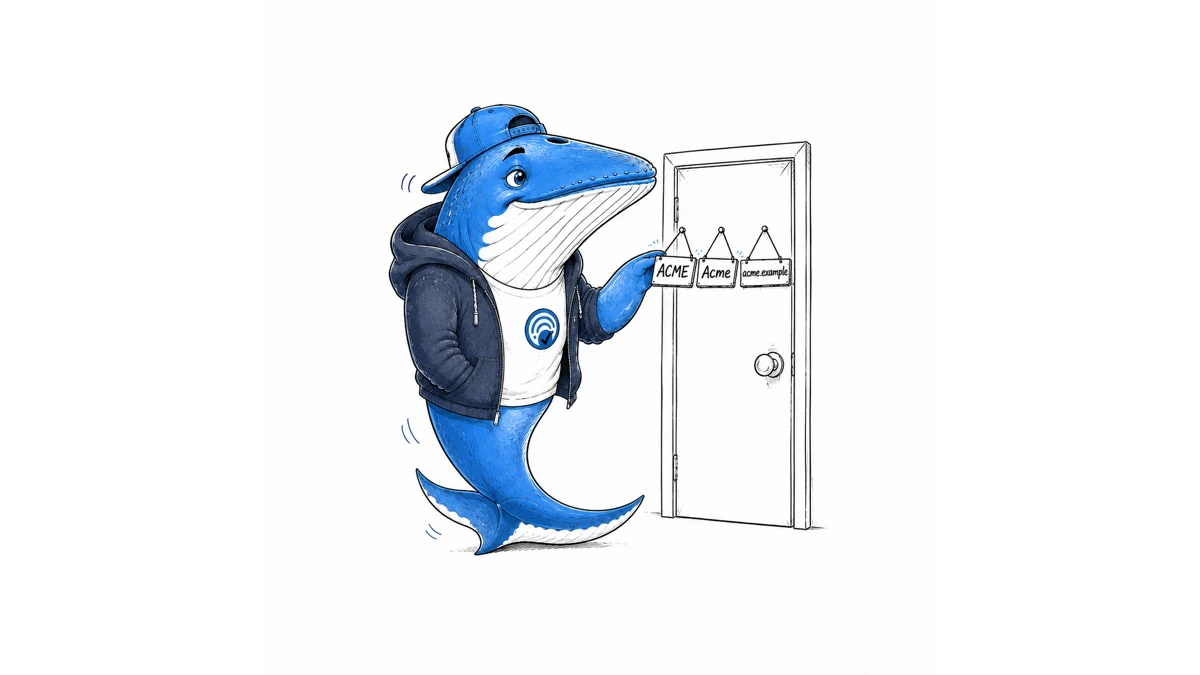
If Google shows your domain where you expected your brand, first confirm that you are looking at the site name—not the clickable page title. Then compare the homepage’s naming signals and the version Google has crawled. Adding another schema block is not automatically the right fix.
Identify the label that is wrong
A recent r/TechSEO question describes this frustration: a site owner says adding structured data has not produced the desired name. That is a useful troubleshooting question, not evidence of a platform-wide defect. We have not inspected that site or verified its implementation.
Use this anatomy check before opening the CMS. The entries below are descriptive examples, not a reproduction of a Google result.
| Element | Example | First question |
|---|---|---|
| Site name | Acme | Is this the publication or organization name? |
| Title link | How to inspect a sitemap | Does this describe the individual page? |
| Displayed URL | acme.example / guides | Is the complaint about the address or path? |
Google’s title-link documentation explains that the clickable headline is generated from several sources, including the title element and prominent page text. Changing that headline is a different task from expressing a preferred site name. Do not rewrite every article title merely to address the label above it.
What Google supports for site names
Google’s site-name documentation describes automated selection. Homepage WebSite structured data is the main way to express a preference; other homepage text and metadata can contribute. Names are supported at domain or subdomain level, not separately for a subdirectory. A preferred name is not guaranteed.
Google recommends a concise, recognizable, non-generic name used consistently. It supports alternateName for a genuine alternative. The homepage must be crawlable; duplicate homepage versions should carry consistent information. Update the existing WebSite node rather than adding a second competing one.
Build one homepage inventory before editing
Open the public homepage without an editor session. Save its final URL and response, visible masthead, title element, og:site_name, and every WebSite object in its JSON-LD. Repeat for any homepage variant that actually returns content. Record redirects instead of assuming the www and non-www versions behave identically.
Then identify who owns each value: the theme, SEO plugin, CMS setting, or custom code. This ownership step is our recommendation for avoiding a common maintenance problem: one person corrects a plugin field while an old hard-coded object survives elsewhere.
For example, an invented publisher might display “Acme” in its masthead, “Acme Digital” in one schema object, and an old company name in another. That is a documented inconsistency in this fixture—not proof that it caused Google’s selection. Choose the real brand with the owner, change the responsible source, and inspect the public output again.
Use a consistent example, not a magic snippet
This fictional JSON-LD object illustrates a short brand and its longer genuine alternative. Adapt the values within your existing homepage graph; do not paste it alongside another WebSite entity.
{
  "@context": "https://schema.org",
  "@type": "WebSite",
  "@id": "https://acme.example/#website",
  "url": "https://acme.example/",
  "name": "Acme",
  "alternateName": "Acme Digital"
}
We checked this fixture for valid JSON and the presence of its declared fields. That verifies syntax and example consistency only. It does not test Google’s selection, establish that Acme is a real publisher, or validate another website’s complete schema graph. Google recommends a schema validator for site-name markup; its Rich Results Test does not support site names.
Download the name-consistency worksheet
Download the site-name consistency audit CSV. One row records one homepage observation. The fields cover preferred name, masthead, metadata, schema ownership, conflicting entities, public access, last crawl if available, evidence location, decision, and next review. All supplied observations are marked EXAMPLE-REMOVE.
Save a dated search-result capture with query, country, language and device. After an approved change, record its release time and inspect the homepage again. Keep “we fixed inconsistent output” separate from “Google displayed the requested name.” Do not mark the latter complete from a schema test.
Avoid unrelated changes while you wait
A site-name discrepancy alone is not a reason to change domains, remove articles, or set pages to noindex. If Google has selected an unexpected homepage URL, investigate that separately with the canonical recovery guide. If only clicks changed, use the segmented traffic-drop checks.
Ask for a recrawl after a meaningful correction, then preserve the evidence and allow reprocessing. Repeatedly swapping names makes the investigation harder to interpret. If the preferred name still does not appear, bring the public URL, structured-data output and dated captures to the next review—not another untested snippet.
Method: Documentation checked September 5, 2026. This guide contributes a reproducible inventory and fictional fixtures. It does not report a successful site-name change or claim that Reddit discussions measure the prevalence of the problem.
Keep learning
Continue this topic
Next in this topic
Google Search Regional Features: Eligibility by Country, Query and Provider
Earlier in this topic
Google’s Mueller advises against daily sitemap URL changes
SEO
Ask a question or join the discussion