Google canonical recovery: compare crawl and country-page evidence
Track canonical changes with observation and country-pair worksheets. Compare release, crawl, locale signals and Google’s selected URL without promising recovery.
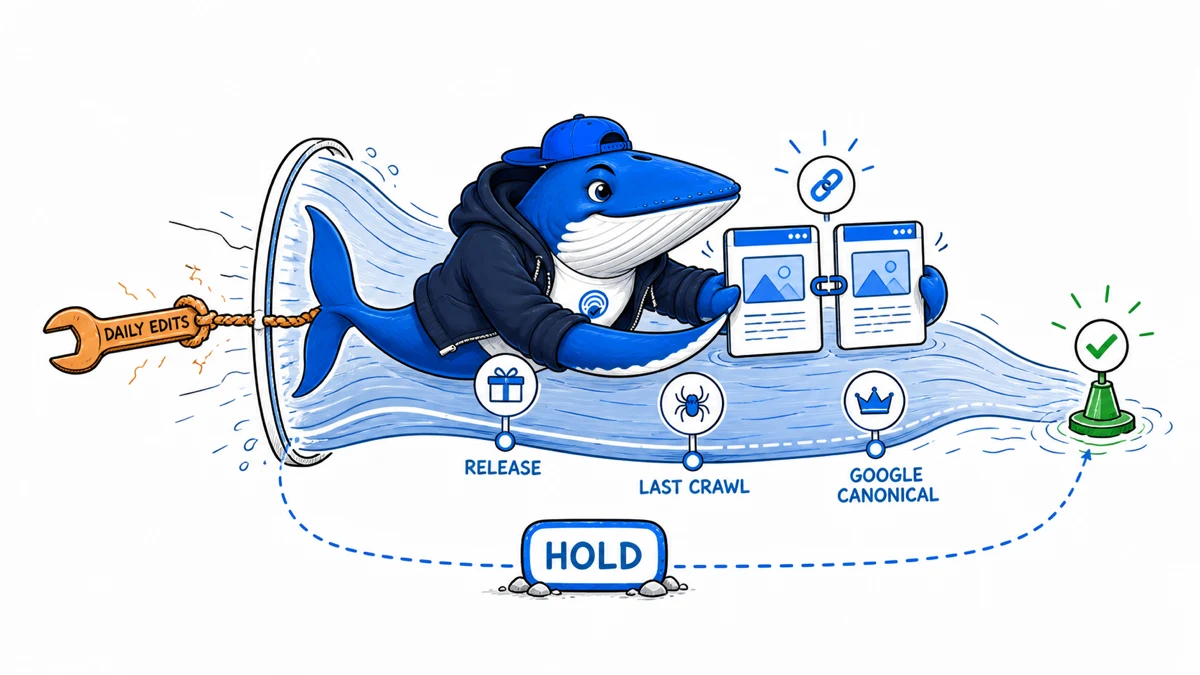
Direct answer: Google’s two-week duplicate-cluster note is an upper observation window for one specific situation: pages that were accidentally too similar and were then made meaningfully different. It is not a promise that a canonical will switch in fourteen days. Preserve the release, watch delivery and indexed-state evidence separately, and change the site again only when a named signal is still wrong.
This rebuilt guide turns that advice into a dated 24-field canonical recovery ledger. Every sample row is marked EXAMPLE-REMOVE. The worksheet records what changed, what Google has recrawled, which canonical Google reports, and which next action the evidence justifies.
Scope the two-week note before starting a timer
Google’s canonicalization troubleshooting documentation, rechecked September 5, 2026, says Google may keep pages in a duplicate cluster for up to two weeks after content issues are fixed. It also says pages generally split faster when the difference is clear and significant.
That statement does not establish a universal canonical-processing service level. It does not say the clock begins when an editor publishes, when a sitemap changes, or when Request Indexing is clicked. Google first has to fetch and process the relevant pages. A delivery failure, conflicting signal, or still-duplicated main body can prevent the intended recovery from entering that observation phase.
| Date | What it establishes | What it does not establish |
|---|---|---|
| Release time | The site served the intended change | Google fetched or processed it |
| Last crawl | Google reports a crawl at that time | The selected canonical has changed |
| Inspection time | The recorded index state returned by the tool | A live test or future ranking outcome |
Define the URL pair and the intended page jobs
Start with one preferred URL and one competing URL. Name the reader job for each. If both pages answer the same question with the same useful detail, the right decision may be consolidation rather than separation. A canonical tag cannot manufacture a distinct reason for two pages to exist.
When the jobs are genuinely different, make the main content express that difference. Titles, headings, examples, product or location details, source evidence, structured data, and internal-link context should support the intended job. Swapping a few adjectives around an otherwise identical body is not a meaningful repair.
Record a content fingerprint or saved text comparison at release. The purpose is not to reverse-engineer Google’s clustering system. It gives your team a stable baseline so the next reviewer can tell whether the supposedly corrected pages are still nearly the same.
Freeze the release baseline before observing
Save the final response status, redirect chain, HTML canonical, rendered main content, sitemap membership, robots directives, hreflang annotations, and representative internal links for both URLs. Record the deployment time and the person who approved the change. This is the evidence you will compare with later observations.
Separate site facts from Google facts. A browser request can prove the current status and canonical annotation. A rendered capture can prove what the page exposes after JavaScript. Search Console can report Google’s recorded indexed state. None of those observations, alone, proves ranking recovery.
| Evidence layer | Useful fields | Stop condition |
|---|---|---|
| Origin and CDN | Status, final URL, response canonical, robots header | Wrong content or redirect must be repaired |
| Rendered page | Main content, DOM canonical, robots meta, links | Old or conflicting output must be repaired |
| Sitemap and links | Preferred URL present and consistently linked | Contradictory discovery signals must be aligned |
| URL Inspection | Coverage verdict, last crawl, user and Google canonicals | Use as recorded index evidence, not a live verdict |
Observe without resetting the test every day
Check delivery early, then reduce the observation frequency. Repeated cosmetic edits create new versions without fixing a known conflict. They also make it hard to associate a later canonical change with the original repair. Hold the release while the evidence remains consistent and Google has not yet recrawled or reprocessed both pages.
- On day 0, capture the release baseline and confirm both page jobs.
- During days 1 to 3, verify status, rendering, robots, canonicals, sitemap entries, and crawl access.
- During days 4 to 7, inspect representative URLs and record any new crawl date or selected-canonical change.
- During days 8 to 14, compare the same fields without introducing unrelated content edits.
- After day 14, reopen the structural diagnosis if the conflict persists.
These checkpoints are an operational schedule, not a Google requirement. Use fewer inspections on a small site with slow crawling, and sample URL families rather than exhausting quotas on every duplicate.
Use URL Inspection as recorded index evidence
The URL Inspection API returns the status of the version in Google’s index. Its reference explicitly says it cannot test the indexability of a live URL. Preserve the inspection time, property, inspected URL, coverage verdict, last crawl, user-declared canonical, and Google-selected canonical.
A changed Google canonical is useful evidence, but it does not prove visibility or traffic recovery. An unchanged canonical shortly after release is also not proof the repair failed. Compare the inspection result with live delivery and crawl evidence before deciding.
For a few important URLs, Google’s recrawl guidance allows an owner or full user to request indexing through URL Inspection. Requests are quota-limited, repeated requests do not speed crawling, and crawling can take days to weeks. For large sets, Google recommends sitemaps as the discovery route.
Use the 24-field observation ledger
Download the canonical recovery observation ledger. Its unit of analysis is one inspected URL at one checkpoint. Remove or replace rows labeled EXAMPLE-REMOVE; they illustrate field use and are not observations from SearchEngineAnswer.
The ledger keeps the release baseline beside Google’s later recorded state. It includes the intended page job, competing URL, release time, last crawl, canonical values, sitemap and internal-link checks, reviewer decision, reason, owner, and next review date.
| Decision | Use when | Next move |
|---|---|---|
| Hold | Signals are correct and processing remains plausible | Keep the release stable until the next checkpoint |
| Repair delivery | Status, rendering, robots, redirect, or canonical output is wrong | Fix the named defect and create a new baseline |
| Strengthen separation | The pages still perform substantially the same job | Make the difference material or consolidate |
| Consolidate | One page should own the shared job | Plan redirect, links, sitemap, and canonical alignment |
Intervene early only for a named failure
Do not wait two weeks when the preferred URL returns an error, redirects to the wrong destination, is blocked from crawling, serves stale rendered content, declares the wrong canonical, drops from the sitemap, or loses all relevant internal links. Those are active defects. Repair them and record that the observation baseline changed.
Escalate carefully when hreflang and canonical annotations conflict, a staging host remains crawlable, a faceted URL receives stronger internal linking than the preferred page, or an external copy is being selected. The canonical troubleshooting page also names server misconfiguration, identical soft-404 output, hacking, and syndicated or copied content as distinct causes. They require different owners and fixes.
For a domain migration, use the domain-variant migration matrix rather than treating every old/new pair as an accidental duplicate. The migration introduces redirect, host, and protocol questions that this two-page observation ledger does not replace.
Keep canonical selection separate from performance recovery
A selected-canonical change can consolidate signals and reporting, but it does not promise the position, impressions, clicks, or conversions that existed before the duplicate problem. Search demand, relevance, competitive pages, internal prominence, and other site changes can move during the same period.
Annotate the release in Search Console and analytics, then compare compatible periods only after the selected canonical and crawl state are understood. Use the small SEO experiment method to define the primary metric, guardrails, confounders, and stopping rule. Do not call temporal overlap a causal recovery.
Add a country-pair comparison after a migration
Added September 5, 2026: When Google selects a different country’s URL, expand the two-page ledger before changing redirects. A practitioner’s Austrian/Swiss ecommerce report raises this question, but we have not inspected the affected pages or verified the cause. It is not proof of a Google defect.
Google’s canonical guidance treats redirects and canonical annotations as strong signals, and sitemap inclusion as weaker. Its localized-page guidance calls for appropriate reciprocal language/region annotations. A currency difference alone is not a documented guarantee that each URL will remain separately selected.
Download the country-canonical pair audit CSV. One row captures one locale URL in a named pair. Alongside the original ledger, save source and rendered canonicals, redirects, locale annotations, language, currency, availability, shipping terms, sitemap membership, internal-link destinations, Google’s selected canonical, last crawl and inspection time.
Use the two fictional EXAMPLE-REMOVE rows to understand the fields, not to infer results. In this example, both locale URLs return HTTP 200 and declare themselves canonical, but one rendered page inherits the other market’s delivery text. That is an observable content mismatch to correct. It does not, by itself, establish why Google chose one URL.
Compare anonymous public responses as well as the browser’s rendered output. Record locale, cookies and any geolocation behavior in your private evidence. A reviewer seeing the intended market after choosing a country is not proof that a crawler received that same version.
Fix a wrong response or conflicting annotation first, then save a new baseline. If both pages are genuinely near-identical, review their separate reader purposes before attempting technical separation. Do not introduce cross-country redirects or noindex as an experiment without considering which shoppers would lose their local destination.
Keep the revised sitemap’s location stable while correcting its contents; the sitemap freshness audit separates those changes. Check the next recorded crawl against your release time. A later inspection with an older crawl is not evidence that Google processed the repair and rejected it.
Recovery evidence
Canonical recovery needs three aligned observations
A declared canonical is only one signal. Recovery is more credible when crawling, Google’s selected canonical and country-page visibility move in the same direction.
- Site
- Confirm redirects, canonical tags, hreflang and internal links.
- Compare inspection results and indexing reports for representative variants.
- Search
- Track affected country pages and queries without treating daily movement as proof.
- Time
- Preserve dated captures so the sequence can be reconstructed.
My takeaway: I would not call recovery from a single green inspection result. The pattern must hold across representative URLs and enough time to rule out a temporary fluctuation.
Sources and method
- Google: fix canonicalization issues
- Google: what canonicalization is
- Google: specify a canonical URL
- Google: URL Inspection API method
- Google: ask Google to recrawl URLs
- SearchEngineAnswer editorial policy
The core observation method was checked August 29, 2026; canonical and localization guidance was rechecked for the September 5 country-pair addition. This article provides an observation method and an example ledger. It does not report a completed canonical recovery experiment, access a reader’s Search Console property, or predict ranking restoration.
Keep learning
Continue this topic
Next in this topic
Google AMP Direct Hosting: Run a 28-Field Publisher Audit
Earlier in this topic
Cloudflare AI Crawler Controls and Googlebot 403s: What to Verify
SEO
Ask a question or join the discussion