Google Subscription Labels: A Publisher Verification Method
Verify Google news subscription labels with separate onboarding and display states, authorized paired observations, destination checks, bounded metrics and a reusable ledger.
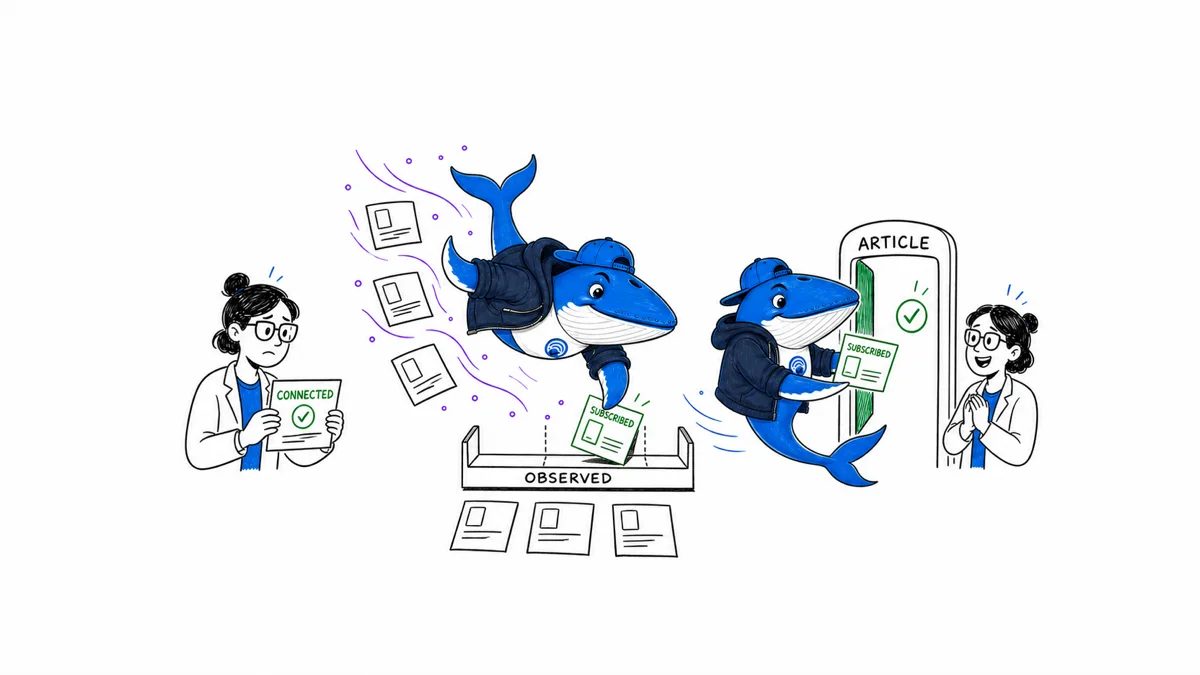
Direct answer: Google says links from a person’s news subscriptions can receive a subscription label in AI Mode and AI Overviews. Publishers can verify onboarding, observed labels, subscriber recognition and destination behavior, but Google’s announcements do not provide a universal display rate, ranking boost or traffic guarantee.
Treat “invited,” “connected,” “observed” and “clicked” as separate evidence states. This guide is a publisher observation method, not a claim that every eligible article or query receives a label.
Separate what Google confirmed from what remains unknown
Google’s May 6 announcement says it was rolling out highlighted links from news subscriptions in AI Mode and AI Overviews and invited publishers to learn about linking subscriptions with Google. It reported that labelled links received significantly more clicks in early testing. Google did not publish the sample, effect size, query coverage, market coverage or a publisher-level prediction in that announcement.
| Statement | Status | Publisher treatment |
|---|---|---|
| Subscription labels exist in AI Mode and AI Overviews | Confirmed by Google | Verify the current rollout and interface |
| Publishers can express interest in connecting subscriptions | Confirmed | Use only the current Google-owned path |
| Every connected article receives a label | Not documented | Measure observations, including absences |
| Labels improve organic ranking | Not documented | Do not make the claim |
| A specific publisher will gain traffic | Not established | Use bounded first-party measurement |
Verify the onboarding surface
Begin with Google’s current developer documentation or the publisher form linked from the announcement. Record the verified publication domain, subscription provider, account owner, market, date, form URL and response. Do not send credentials, subscriber lists or payment data through a form merely because a screenshot resembles Google branding.
An expression of interest is not approval, and approval is not proof of display. Save the exact notification that moves the publisher from one state to another.
Model four evidence states
| State | Minimum evidence | Does not prove |
|---|---|---|
| Invited | Google-owned form or publisher notice | Acceptance |
| Connected | Confirmed domain and subscription system | Label display |
| Observed | Saved query, account state and capture | Universal coverage |
| Clicked | Destination and analytics observation | Incremental traffic or ranking effect |
Define the reader job
The label helps a signed-in reader recognize content connected to a subscription. The practical test is whether the publication is correctly identified and whether the click reaches an appropriate article or subscriber access flow. A visible label that sends an existing subscriber to a generic acquisition page can still fail the reader job.
Keep the feature distinct from Preferred Sources. A user preference and a paid or registered subscription are different relationships even if both can influence what the reader notices.
Build a versioned query set
Include brand queries, article-title queries, current-topic queries, evergreen-topic queries and queries where the publication is relevant but not dominant. Fix the wording and version the set before observing results. Convenient examples selected after seeing a label cannot estimate even a bounded observation rate.
Store the expected destination and article access state for each row. Exclude queries only under a written rule, and preserve errors or missing AI features rather than silently replacing them.
Record the observation environment
For every run, capture date, time, country, language, device, browser, Search surface, signed-in state, consented subscription state and whether AI Mode or an AI Overview appeared. Search interfaces change quickly; an undated screenshot cannot distinguish a product change from a publisher-side release.
| Layer | Fields | Reason |
|---|---|---|
| Environment | Market, language, device, browser, time | Interface availability varies |
| Account | Signed-in and authorized subscription state | The feature is personalized |
| Query | Exact text and query-set version | Paraphrases are not identical tests |
| Display | Surface, label, placement and linked URL | Appearance and destination are separate |
| Outcome | Click, recognition and access result | A label can still lead to friction |
Use authorized paired observations
- Run the fixed query in a consented subscriber account.
- Record the feature, publication link, label wording and destination.
- Run the same query in a clean non-subscriber state where policy and privacy permit.
- Preserve both results, including absent labels and absent AI features.
- Repeat on a declared schedule rather than until the desired result appears.
Do not borrow a personal subscription without permission or publish subscriber identifiers. Disclose a publisher-owned or staff-owned test relationship because it affects the observation.
Test the complete destination path
Check the displayed publication name, canonical domain, resolved URL, redirect chain, sign-in recognition, paywall behavior, article access and return path. Record whether an authorized subscriber is recognized immediately, prompted to sign in, shown an acquisition offer or blocked unexpectedly.
Coordinate editorial, product, analytics and subscription teams. The search team may see a correct label while the subscription platform sees a failed entitlement check.
Download the observation ledger
Use the Google subscription-label observation ledger to preserve onboarding state, query versions, environments, labels, destinations and limitations. Delete the example row before collecting live observations.
Raw captures should remain access-controlled when they contain account state. The shareable ledger can use a pseudonymous account code and a consent reference instead of an email address or subscriber ID.
Report observation and click metrics separately
Useful counts include eligible queries attempted, AI-feature appearances, publication-link appearances, label appearances, clicks, successful subscriber recognitions and access failures. Each needs its own denominator. A label rate among AI-feature appearances answers a different question from a click rate among labelled links.
Search Console or analytics may not expose subscription labels as a dedicated acquisition dimension. If a publisher infers clicks from tagged URLs or controlled sessions, describe the method and acknowledge unclassified traffic.
Avoid ranking and causation claims
A referral change can coincide with news demand, article prominence, query mix, AI-feature availability, Preferred Sources, ranking changes, browser state and Google experiments. The feature announcement does not isolate those causes. Report what the publisher directly observed and the boundaries of the sample.
Google’s early-test statement is directional product evidence, not a forecast for an individual site. Do not convert it into an invented percentage or guaranteed uplift.
Monitor interface and onboarding changes
Save the documentation version, observation dates and label wording. Recheck after changes to the subscription provider, canonical domain, paywall, account-linking flow or Google documentation. A missing label after a release should open an investigation, not an immediate conclusion that the publisher was removed.
Use the Preferred Sources guide to keep preference separate from subscription and the AI visibility crosswalk to separate appearance, citation, click and audience outcome.
Primary announcements
- Google: Five new ways to explore the web with generative AI in Search
- Google: New opportunities, control and insights for website owners
Source review: August 31, 2026. Rollout, onboarding and interface behavior are time-sensitive; verify the current Google-owned surfaces before acting.
Keep learning
Continue this topic
Next in this topic
How to Measure AI Citations and Recommendations Separately
Earlier in this topic
Google Community Perspectives: What 8 AI Mode Queries Showed
AEO & AI Search
Ask a question or join the discussion