AI SEO: What It Is, How It Works, and What to Measure
Learn what AI SEO means, how it differs from AEO and GEO, what Google documents, and how to measure rankings, citations, referrals, and conversions.
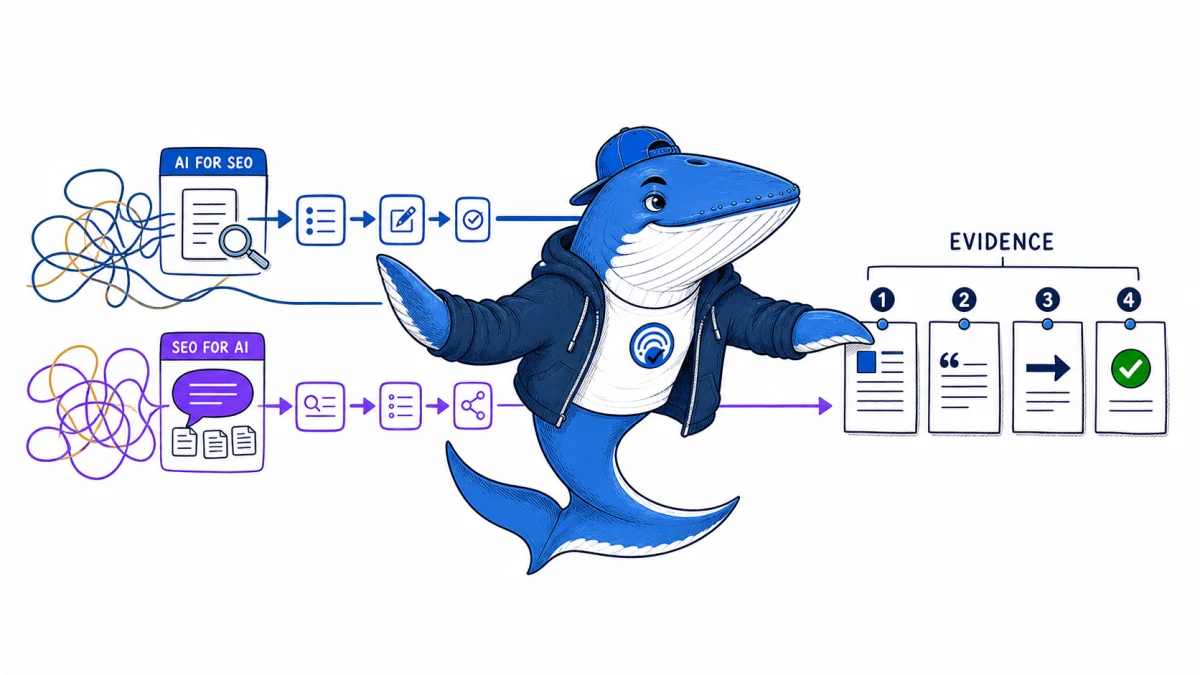
Direct answer: AI SEO is two related jobs that should not be confused. The first is using AI to research, analyze, draft, or quality-check SEO work. The second is making a site technically eligible, genuinely useful, and measurable across AI-mediated discovery surfaces such as Google AI Overviews, Google AI Mode, Microsoft Copilot, Bing AI answers, and ChatGPT search.
The foundation is still SEO: crawlable and indexable pages, clear internal routes, original evidence, accurate claims, and a useful experience. What changes is the number of outcomes you may need to observe. A traditional ranking, a visible AI citation, a brand mention, a referral visit, and a conversion are different events. Treating them as one “AI visibility” score hides the work that actually needs attention.
Choose your AI SEO task
This guide owns the broad definition, operating model, and measurement boundaries. Use the focused guides below when you have a specific job to complete; each one returns here so the cluster stays navigable instead of becoming a pile of competing definitions.
| Task | Start here | What you will produce |
|---|---|---|
| Learn the foundations | Learn AI SEO with a 30-day practice plan | An audit, evidence ledger, rewrite, observation sample, and retrospective |
| Find the highest-priority gaps | Run the AI SEO audit checklist | A prioritized, evidence-backed repair queue |
| Plan demand and page ownership | Map AI keyword research to real decisions and separate documented ranking systems from hypotheses | A query-to-page map and a living evidence register |
| Improve a WordPress site | Use the plugin-neutral WordPress setup and add human-reviewed n8n automation | One owner per technical output and a reversible workflow |
| Create and revise content | Run the page-level rewrite workflow and use auditable AI SEO prompts | A reviewed page revision with sources, limits, and rollback evidence |
| Work on a named answer surface | ChatGPT SEO, Google AI Overviews, Google AI Mode, or Perplexity SEO | A surface-specific access, citation, and outcome record |
| Measure and report | Connect mentions, citations, referrals, and revenue | Four separate ledgers joined only by transparent identifiers |
| Choose an operating model | Build a small-business plan or evaluate an AI SEO agency | A 90-day owner plan or an evidence-based vendor scorecard |
The routes are intentionally narrower than this pillar. If two pages begin answering the same reader job, consolidate the evidence instead of publishing another variation.
What AI SEO actually means
The phrase is ambiguous because it names both a production method and a discovery problem. One team may use “AI SEO” to mean automating keyword clustering. Another may mean earning citations in AI-generated answers. Both uses are common, but they have different inputs, risks, and evidence.
| Job | Typical work | Useful output | Evidence that belongs to it |
|---|---|---|---|
| Use AI for SEO | Extract entities, cluster queries, inspect templates, find internal-link candidates, compare revisions, or draft test cases | A reviewed analysis or production aid | Accuracy checks, time saved, accepted recommendations, defect rate, and human approval |
| Optimize for AI-mediated discovery | Improve crawl eligibility, answer a reader job, publish original evidence, clarify entities, and measure citations and visits by surface | A useful, attributable page that can participate in relevant answers | Index state, answer observation, visible citation, referral session, and conversion |
Answer engine optimization and generative engine optimization are narrower labels for parts of the second job. Google’s current guidance says that, from its perspective, optimizing for generative features in Google Search remains SEO. That platform-specific statement does not make every engine identical. ChatGPT, Bing, and other systems have their own crawlers, indexes, interfaces, controls, and reporting boundaries.
If you need a deeper comparison of those labels, use the answer engine optimization guide. The practical rule here is simpler: name the surface, name the outcome, and name the evidence before calling a task AI SEO.
AI SEO does not replace SEO
Google’s July 2026 generative-AI optimization guide says its AI features are rooted in core Search ranking and quality systems. It describes retrieval-augmented generation and query fan-out, while still requiring a page to be indexed and eligible to appear with a snippet. Google also says eligibility does not guarantee crawling, indexing, or serving.
That makes technical SEO a prerequisite, not a promise. A page blocked by robots rules, hidden behind a login, assigned a conflicting canonical, or excluded from the relevant index cannot be rescued by adding a summary box. Internal links, readable text, accurate structured data, page experience, and a clear site structure remain useful because they help both people and search systems find and interpret the page.
The content standard is equally important. Google now advises publishers to create “non-commodity” work with a distinct point of view, first-hand experience, or useful evidence rather than recycling what is already available. That is a sharper test than simply producing a longer article. A page can be comprehensive and still add nothing.
For other platforms, check their own access rules. OpenAI documents separate user agents for search discovery, potential model training, and user-requested page access. Allowing OAI-SearchBot may support inclusion in ChatGPT search, while GPTBot controls are associated with potential training. One robots rule should not be interpreted as proof of another outcome. The AI crawler guide provides a surface-by-surface control worksheet.
The outcomes form an evidence chain
AI SEO is easier to diagnose when you record states in order. This is an evidence chain, not a guaranteed funnel. A page can be crawlable but not indexed, indexed but not retrieved for a particular need, retrieved without a visible citation, cited without a click, or visited without a conversion.
| State | Question | Best available evidence | What it does not prove |
|---|---|---|---|
| Access | Could the named crawler fetch the URL? | Robots policy, CDN logs, verified request, and response | Indexing or use in an answer |
| Index eligibility | Can the page participate in that search system? | Platform webmaster tools, URL inspection, canonical and robots checks | Retrieval for a specific query |
| Answer appearance | Did the tested surface show the page or brand? | Dated observation with country, language, device, account state, and screenshot ID | Stable rank or universal coverage |
| Citation | Was the URL visibly referenced as a source? | Visible source link or platform citation report | A click, endorsement, authority score, or conversion |
| Referral | Did a person arrive from the surface? | Analytics session, referrer, and platform UTM where present | That every cited answer sent traffic |
| Conversion | Did the visit complete the site’s intended action? | Consent-respecting event tied to the session and landing page | That AI exposure alone caused the result |
Microsoft’s AI Performance documentation makes this boundary explicit: citation data shows visible source use across supported AI experiences and does not measure rankings, authority, performance, or importance. Its grounding queries are grouped retrieval phrases, not complete user prompts. OpenAI says ChatGPT referral links include utm_source=chatgpt.com, which can help identify visits, but that still does not reveal every answer that cited a page.
The AI visibility measurement crosswalk maps common claims to the evidence that can actually support them.
How to build an AI SEO strategy
Start with one audience problem and one observable decision. “Increase AI visibility” is too vague to prioritize. “Help independent publishers distinguish citation activity from referral traffic” identifies a reader, a job, and the evidence the page must contain.
- Define the reader job. Write the decision the page helps someone make. List the facts, comparison dimensions, examples, and limitations needed to complete that decision.
- Choose the surfaces. Record the country, language, device, account state, and product surface you will observe. A Google AI Overview test is not a proxy for ChatGPT search or Microsoft Copilot.
- Verify technical eligibility. Check the preferred URL, status code, canonical, index directive, robots policy, important rendered text, internal links, and inclusion in the relevant sitemap. Use the platform’s webmaster tools where available.
- Add information gain. Publish a controlled test, first-hand procedure, original dataset, worked example, decision matrix, or transparent synthesis that saves the reader real work. State which results were observed and which are only expected from documentation.
- Make ownership legible. Identify the publisher, author, update date, correction route, and sources. Keep claims consistent across the article, image, structured data, and supporting downloads.
- Build internal routes. Link from relevant hub and supporting pages using language that describes the destination. Do not manufacture dozens of nearly identical pages for every fan-out phrase.
- Freeze a baseline. Save the eligible URLs, queries, surface conditions, dates, screenshots, analytics definitions, and known limitations before changing content.
- Change one meaningful variable. Examples include adding a comparison table, replacing a generic summary with first-hand evidence, repairing internal links, or clarifying an entity. Preserve the before state.
- Measure each outcome separately. Compare index state, traditional Search performance, platform citation reporting, observed answer samples, referral sessions, and conversions without merging them into a synthetic certainty score.
This method does not guarantee a ranking or citation. It creates a defensible record of what changed, what was observed, and what still cannot be known.
What high-value AI SEO content looks like
High-value content finishes a task that a generic answer leaves open. For a definition page, that may be a precise boundary and measurement model. For a product comparison, it may be a reproducible test with conditions and exclusions. For a technical guide, it may be a fixture, command, expected output, and failure diagnosis.
| Commodity version | Higher-value version | Proof object |
|---|---|---|
| “AI SEO is the future” | Separate AI-assisted production from AI-search discovery and define the evidence for each | Decision table and measurement ledger |
| A list of ranking tips | Show a controlled revision with before-state, changed variable, and observed outcome | Revision diff and dated observation |
| An unsourced tool roundup | Test the same documented task, dataset, locale, and export requirement across tools | Evaluation protocol and raw results |
| A paraphrased product announcement | Explain the operational decision, exact boundary, and failure mode | Primary-source claim map and runbook |
Formatting supports that value but cannot create it. Descriptive headings, tables, concise answer passages, and well-labeled images can make evidence easier to navigate. They should serve the reader’s task, not imitate a rumored extraction template. For a practical editing method, see how to make content easier for AI answer engines to cite.
How to use AI in SEO without publishing generic work
AI can be useful upstream of publication when the task is bounded and the output is reviewed. It can extract headings from a known set of URLs, group a supplied query list, identify inconsistent terminology, propose internal-link candidates, compare two drafts, or generate edge cases for a technical test. In each case, the inputs and acceptance criteria are visible.
The risk rises when the model is asked to invent the evidence. Do not let it manufacture experience, quotes, source conclusions, screenshots, measurements, or product behavior. A fluent draft can conceal a missing test just as easily as it can summarize a real one.
Use a four-part review:
- Source review: open every important citation and confirm the claim in context.
- Originality review: identify the procedure, data, judgment, or artifact that belongs to this publication rather than the model’s general knowledge.
- Reader review: remove paragraphs that restate the same idea without helping the decision.
- Accountability review: assign a human owner for the title, claim boundaries, examples, image, links, and final publication state.
Google’s guidance allows the use of generative tools but requires the finished work to meet Search Essentials and spam policies. The relevant question is not whether AI touched the workflow. It is whether the published page is accurate, original enough to deserve attention, and useful to the person who opened it.
What not to do for AI SEO
Several popular tactics are either unsupported or far narrower than their marketing suggests.
- Do not create an
llms.txtfile to influence Google Search. Google says it does not use these files for ranking or visibility in its AI features. Another service may choose to use one, so evaluate it only for that named service. - Do not break every page into tiny “AI chunks.” Google says no special chunking is required. Use sections because they improve comprehension, not because a fixed paragraph length is believed to unlock retrieval.
- Do not add invented AI schema. There is no special schema.org type required for Google AI Overviews or AI Mode. Existing structured data should accurately match visible content and serve supported search features.
- Do not rewrite the same topic for every prompt variation. Scaled pages that add no distinct value create maintenance and quality problems and can cross into spam.
- Do not buy or plant inauthentic mentions. A manufactured mention is not durable evidence of authority and may introduce spam, disclosure, and reputation risk.
- Do not call a citation a conversion. A visible reference, referral visit, and completed action need separate records.
- Do not trust a universal AI rank. Generated answers vary by surface, time, locale, account, model, and query path. A tool can provide a useful sample, but it cannot expose a platform’s internal score.
Use the AI SEO baseline ledger
Download the AI SEO baseline ledger (CSV). It keeps access, index eligibility, answer observation, citation, referral, and conversion in separate fields. The included rows are marked EXAMPLE-REMOVE; replace them with your own authorized tests before using the file as evidence.
Complete one row per URL, reader job, surface, and observation condition. Record a screenshot or export ID rather than pasting sensitive account data into the file. If a field is not available, write NOT_AVAILABLE or NOT_TESTED instead of guessing.
| Field group | Why it matters | Common error |
|---|---|---|
| Surface conditions | Makes an answer observation reproducible enough to compare | Reporting one result as universal |
| Eligible URL and index state | Separates technical exclusion from content relevance | Optimizing a URL that is not eligible |
| Citation and referral | Distinguishes visible source use from an actual visit | Calling every citation traffic |
| Decision and limitation | Turns an observation into a bounded next action | Hiding uncertainty behind a blended score |
Freeze the file before a meaningful change, then create a new dated copy for the follow-up observation. Never overwrite the baseline. The difference between the two records is more useful than a screenshot without conditions.
A 30-day AI SEO plan
Days 1–5: choose five commercially or editorially important reader jobs. Map each to one preferred URL. Verify status, canonical, robots, index state, rendered text, sitemap inclusion, and internal links. Record the baseline even when the result is “not indexed.”
Days 6–12: audit the five pages for information gain. Mark unsupported claims, repeated generalities, missing comparison dimensions, stale platform statements, and decisions the reader still cannot complete. Select one meaningful revision per page.
Days 13–20: produce the proof objects: a test matrix, worked example, original image, comparison table, source map, or downloadable ledger. Update publisher and author signals where they are unclear. Review the page on mobile and confirm that essential evidence remains text-accessible.
Days 21–25: publish with a preserved before-state. Add relevant internal links from existing pages and the correct topic hub. Request recrawling only through supported platform routes; do not send repeated automated requests to force discovery.
Days 26–30: recheck technical state and capture an early observation. Do not declare success from a single answer. Establish the next review date based on the surface’s reporting delay, your crawl pattern, and the amount of real user demand. Keep traditional Search, citation reporting, observed samples, referral traffic, and conversions in separate views.
AI SEO frequently asked questions
Is AI SEO the same as AEO or GEO?
AI SEO is the broader and more ambiguous term. It can include using AI inside an SEO workflow as well as optimizing for AI-mediated discovery. AEO and GEO usually refer to the discovery side. Google groups optimization for its generative Search features under SEO, but other platforms retain distinct technical and reporting boundaries.
Can AI-generated content rank?
Tool use alone does not determine eligibility or quality. Google asks whether the finished content meets its policies and helps people. Unreviewed, scaled, commodity pages are risky because they add little value and can contain fabricated claims. Human review does not repair a page that still lacks original evidence.
Do I need special schema or an llms.txt file?
Not for Google’s AI Overviews or AI Mode. Google says no special schema or AI text file is required and that it ignores llms.txt for Search. Continue using supported structured data when it accurately matches visible content, and evaluate other files only against documentation from the service expected to use them.
Can a site rank first in ChatGPT?
“First” is usually not a stable or fully defined web ranking in a conversational answer. You can observe whether a page was cited for a controlled sample and track referral visits, but outputs can vary. Record the surface and conditions rather than turning one answer into a universal position.
What is the most important AI SEO metric?
There is no single metric for every job. Use index eligibility for technical access, traditional Search metrics for classic discovery, citation reporting for visible source use, analytics for visits, and business events for outcomes. The decision you are making determines which measure matters.
Primary sources, method, and update policy
Primary sources checked September 1, 2026: Google Search Central’s guide to optimizing for generative AI features and AI features documentation; Microsoft Bing’s AI Performance documentation and public-preview announcement; OpenAI’s crawler documentation and publisher FAQ.
Method: SearchEngineAnswer separated documented platform requirements from our editorial workflow, then mapped each claimed outcome to an observable evidence type. We did not claim a cross-platform ranking factor, run a universal citation study, or convert third-party keyword-volume estimates into fact. The downloadable ledger contains only clearly marked example rows.
Update triggers: Revisit this guide when Google changes its generative Search requirements or reporting, Bing changes AI Performance coverage or metric definitions, OpenAI changes crawler controls or referral parameters, or a supported platform publishes a material new measurement surface.
Five practical paths, one AI SEO system
The five shorter explainers below now live inside this guide because they answer parts of the same job: learn the discipline, improve one page, understand Google AI surfaces, earn citations and measure the outcome. Keeping them together makes the dependencies visible and prevents each platform label from becoming a separate strategy.
| Change | What it affects | Best next check |
|---|---|---|
| Learn AI SEO: A Free 30-Day Evidence-First Practice Plan | Learn AI SEO through seven practical modules and a 30-day portfolio: foundations, crawler controls, claims, citations, referrals, experiments and automation. | Each concept becomes a small auditable artifact before use. |
| Content Optimization for AI Search: A Page-Level Rewrite Workflow | Repair an existing page with a clear claim, primary evidence, worked example and limitation; then measure the result without erasing the baseline. | Measure a fixed window and preserve what the page already did well. |
| Google AI Mode SEO: Map Query Fan-Out Without Publishing Thin Pages | Map related questions around one user problem, then decide which belong in a deep guide and which truly deserve a separate URL. | It helps map supporting questions but does not expose every hidden query. |
| Google AI Overviews SEO: What Makes a Page Eligible for Citations | Google documents ordinary Search eligibility for AI Overview supporting links; not a special schema or guaranteed inclusion. The workflow starts there. | Google documents these ordinary Search requirements for supporting links. |
| ChatGPT SEO: How to Earn Discovery, Citations and Clicks | A practical ChatGPT SEO workflow that separates crawler discovery, answer citations, referral clicks and qualified outcomes instead of hiding them in one score. | A citation matters differently from a referral that produces a useful action. |
Originally reported 2026-09-03
Learn AI SEO: A Free 30-Day Evidence-First Practice Plan
Why it matters: Learn AI SEO through seven practical modules and a 30-day portfolio: foundations, crawler controls, claims, citations, referrals, experiments and automation.
Next check: Each concept becomes a small auditable artifact before use.
You can learn AI SEO by mastering four loops: learn a documented concept, test it on a controlled sample, verify the evidence, and apply only what survives review. The fastest path is not watching more tool demos; it is producing small, auditable work artifacts.
Use Google’s learning paths to check your foundations
Google’s October 6 learning-path announcement groups existing Search Central videos into beginner Search fundamentals and Technical SEO playlists. The first covers crawling, indexing, serving and measurement with Search Console and Trends; the second emphasizes directives, crawl analysis, rendering, duplicates and API or export workflows. It is a curated learning route, not a new ranking requirement.
For this guide’s practice plan, pair each lesson with one observation on your own site. After learning indexing, inspect one URL and distinguish recorded status from a live fetch. After the measurement lessons, save one date-filtered query/page view. After rendering or duplicate-content lessons, compare the user-facing page and canonical record. Keep the result even when it is “no change needed.”
Use the technical path when the blocker is infrastructure. Use the beginner path when the team is still mixing crawling, indexing and serving. Completing a playlist is not evidence of improved rankings. The value is being able to explain a concrete observation and choose the next diagnostic step. Google’s UGC pipeline and ChatGPT’s interactive answers are newer surface changes to evaluate only after those foundations are clear.
Module 1: Learn the search foundations
Study crawling, rendering, indexing, canonicals, snippets, internal links and measurement. Google’s SEO Starter Guide is a primary foundation. Then read its AI optimization guidance, noting which advice is documented and which popular claims are absent.
Exercise: audit ten URLs for status, canonical, index eligibility and clear primary answer. Deliver a one-page finding list with evidence.
Module 2: Learn platform controls
Compare OAI-SearchBot and GPTBot, PerplexityBot and Perplexity-User, and your CDN’s purpose-based controls. Record role, vendor source, robots token, verification method and intended policy. Avoid copying a universal robots.txt template.
Exercise: build a crawler control matrix and verify one authentic log request or mark it unknown. Use our AI crawler guide.
Module 3: Learn claim-level content
Take one existing page and classify sentences as documented fact, first-party observation, interpretation, recommendation or unknown. Replace secondary reporting with primary sources where available. Add one worked example and one meaningful limitation. Do not increase length unless the reader gains decision support.
Exercise: complete the workflow in our AI-search page rewrite guide and keep a before-and-after diff.
Module 4: Learn citation observation
Create 20 prompts from real user jobs. Freeze wording, locale and platform state for a cycle. Save answers, cited URLs and claim-support verdicts. Preserve failures and report numerator plus denominator. Repeat after a defined interval, not until the outcome looks good.
Exercise: produce a citation ledger with at least five manually verified source-claim relationships.
Module 5: Learn referral and outcome measurement
Configure known AI referral rules, campaign parameters, landing-page analysis and conversions. Document dark-traffic limits. Compare observed citations with detected visits without assuming every citation should generate a click or every direct visit came from AI.
Exercise: build a small report separating mention, citation, referral and revenue using our four-ledger framework.
Module 6: Learn controlled experimentation
Select comparable pages, define one treatment, capture a baseline and choose a review window. Prefer treatments that help readers even if no AI effect appears. Record simultaneous changes and avoid causal language when the design cannot isolate them.
Exercise: preregister a page-level test with hypothesis, metric, denominator, exclusion rule and rollback trigger.
Module 7: Learn responsible automation
Automate source collection, formatting and review handoffs before automating publication. Require source IDs, human approval, least-privilege credentials, idempotency and rollback. Test missing-source, duplicate-slug and failed-public-check paths.
Exercise: diagram a draft-only workflow and pass every failure case in staging. Our n8n SEO workflow provides the gates.
Your 30-day practice plan
- Week 1: foundations and crawl/index audit.
- Week 2: claim-led rewrite and source verification.
- Week 3: frozen prompt study and citation validation.
- Week 4: referral report, experiment design and retrospective.
Keep a portfolio containing the audit, evidence ledger, rewritten page, prompt sample, measurement report and test plan. That portfolio demonstrates judgment better than a certificate or tool badge.
Download the 30-day AI SEO practice plan. Replace the examples, attach proof for each exercise and mark a module complete only after the Verify step; not merely after reading it.
Keep the AI SEO guide and task hub as your syllabus index, then follow only the specialist route required by the evidence in your practice portfolio.
Originally reported 2026-09-03
Content Optimization for AI Search: A Page-Level Rewrite Workflow
Why it matters: Repair an existing page with a clear claim, primary evidence, worked example and limitation; then measure the result without erasing the baseline.
Next check: Measure a fixed window and preserve what the page already did well.
Content optimization for AI search means repairing a page so its main claim, evidence, example and limitation are clear; without padding it, flattening expert nuance or pretending a rewrite guarantees citation. The best candidate is an already useful page with a specific decision-support gap.
Select pages by opportunity and risk
Start with pages that already earn relevant impressions, referrals, citations, conversions or support usage. Add pages containing important facts that are outdated or hard to locate. Avoid rewriting everything at once; simultaneous sitewide changes destroy your baseline and can remove content readers already value.
Capture title, canonical, index state, query-page pairs, conversion data, citations and last-updated date before editing.
Write the page’s answer contract
In one sentence, state the question, audience, direct answer and boundary. Example: “For indexed pages, Google says no special AI schema is required for eligibility, but eligibility does not guarantee an AI-feature link.” This contract keeps the rewrite from drifting into a generic topic overview.
Compare the contract with your existing citation-ready content guidance and competing pages on the site.
Repair claims at sentence level
Classify important sentences as fact, first-party observation, interpretation, recommendation or unknown. Link time-sensitive product facts to primary documentation. Add date and scope. Remove citations that merely mention the topic but do not support the claim.
Google’s AI optimization guide recommends accurate, unique and useful content while warning against scaled low-value production. It does not require artificial chunks or a target word count.
Add the missing information gain
| Gap | Useful repair |
|---|---|
| Abstract advice | Worked example with inputs and outcome |
| Vendor claim | Primary-source evidence plus your analysis |
| Unclear choice | Decision table with tradeoffs |
| Unrepeatable result | Test protocol and downloadable ledger |
| Missing constraint | Explicit limitation and failure case |
Information gain is not novelty theater. It can be a clearer synthesis, a verified correction or a reusable tool that saves the reader work.
Improve structure without writing for a robot
Lead with the answer. Use descriptive H2 headings, concise paragraphs, real tables and steps in the order they are performed. Keep definitions near first use. Add internal links only when the next page serves a different job. Delete repetitive summaries and FAQ questions already answered in the body.
Do not replace precise terminology with awkward synonyms to increase keyword variation.
Review the human and evidence risks
Have a subject-aware reviewer check whether the rewrite changed meaning, removed a caveat, exposed confidential data or overstated a result. Verify every external link and promised download. Compare the final draft with the prior version and keep a rollback copy.
Our AI content brief guide includes safeguards for assisted drafting.
Measure through a fixed post-edit window
Record the publication date and changed sections. Watch index status, relevant queries, engagement, conversions, observed citations and support feedback. Do not attribute movement to the rewrite when other major changes occurred. If the page loses useful performance, inspect the query and conversion mix before rolling back.
Download the AI-search page rewrite ledger. Replace the example rows and require an evidence ID, expected reader benefit, reviewer and rollback decision for every substantive change.
Use a claim-level before-and-after test
Consider a weak sentence: “AI search prefers authoritative, well-structured content.” It names no platform, evidence, decision, or limit. A useful revision might say: “Google says pages must be indexed and eligible for a snippet before they can appear as supporting links in its AI features; eligibility still does not guarantee selection.” The revision is not better because it is longer. It is better because the platform, requirement, outcome, and boundary can be checked.
Save the original sentence, revised sentence, supporting primary source, reader benefit, and review date in the ledger. Then inspect the paragraph around it: the source should support the exact claim, the page should explain what the reader does next, and nearby wording should not quietly turn eligibility into a promise. If the claim is based on your own observation, record the sample and conditions instead of presenting it as platform policy.
Repeat this method for the few claims that control the reader’s decision. A page with five precise, actionable claims can be more useful than one with fifty generic tips. For cluster planning and measurement boundaries, return to the AI SEO guide and task hub.
Originally reported 2026-09-03
Google AI Mode SEO: Map Query Fan-Out Without Publishing Thin Pages
Why it matters: Map related questions around one user problem, then decide which belong in a deep guide and which truly deserve a separate URL.
Next check: It helps map supporting questions but does not expose every hidden query.
Google AI Mode SEO is not a license to manufacture one page for every imagined follow-up question. Google says AI features may use query fan-out; issuing related searches across subtopics and data sources; but its guidance still favors useful, non-commodity pages and warns against scaled low-value content.
The practical move is to map related questions, group them by one user problem, and build the smallest set of pages that genuinely resolves those jobs.
What query fan-out changes
Google’s AI search optimization guide says AI features can use query fan-out to find supporting responses. This means a broad prompt may trigger searches for definitions, comparisons, constraints, recent changes and next steps. It does not mean publishers can see the full hidden query set or that each subquery deserves its own URL.
Treat fan-out as a research model: “What must the system and reader understand to answer this task responsibly?”
Build a fan-out map from observable evidence
Start with Search Console queries, site search, support logs, sales objections and repeated prompt patterns. For one core problem, list the likely subjobs: define, diagnose, compare, implement, validate and recover. Mark the source for every branch. Label invented branches as hypotheses until demand or user research supports them.
Our AI keyword research workflow shows how to combine search and grounding data without passing estimates off as measured demand.
Decide when a subtopic earns a separate page
| Signal | Keep on one guide | Create another page |
|---|---|---|
| User job | Same decision and audience | Distinct decision or workflow |
| Evidence | Shares sources and method | Needs a different evidence set |
| Depth | Can answer clearly in one section | Requires a full procedure or tool |
| Search result | Same page types dominate | Different intent and page types dominate |
A separate keyword is not enough. The new URL should earn its maintenance cost and provide information that would make the parent page unwieldy.
Write one useful guide, not a page factory
Lead with the direct answer, then cover prerequisites, method, example, validation and limits. Use a comparison table or worksheet where it saves the reader time. Link out to a narrower implementation page only when the reader needs a different tool or context.
Google’s spam policies prohibit scaled content abuse when many pages are produced primarily to manipulate rankings, regardless of whether automation or humans create them. Review our scaled-content risk guide before automating URL creation.
Test the cluster for cannibalization
Export queries and landing pages for the cluster. Look for multiple URLs swapping positions for the same intent, inconsistent canonicals, near-identical introductions and internal links with ambiguous anchors. Compare conversions too: two URLs can rank without serving the same decision.
When merging pages, preserve genuinely useful sections, redirect retired URLs and update internal links. Do not merge solely because a tool flags keyword overlap.
Measure outcomes fan-out cannot reveal
Google does not expose every hidden subquery used inside an AI response. Separate what is documented from what you infer. Monitor indexation, Search Console page/query trends, observed supporting links, referral behavior and conversions. Add annotations when templates, titles or product availability change.
Do not call an impression change an “AI Mode lift” unless the reporting surface and design support that attribution. Our AI impressions versus traffic guide explains the denominator problem.
A repeatable editorial decision
- Name the user problem.
- Collect observed subquestions and mark hypotheses.
- Group by decision, evidence and workflow.
- Choose one deep page or a small, linked set.
- Add a testable artifact or example.
- Review overlap quarterly and after major product changes.
Download the AI Mode query fan-out map. Replace its example rows, then use the “page decision” column to record why a branch belongs on the guide, deserves a separate URL or should not be published.
Return to the AI SEO guide and task hub to compare this Google AI Mode workflow with other answer surfaces and shared SEO foundations.
Originally reported 2026-09-03
Google AI Overviews SEO: What Makes a Page Eligible for Citations
Why it matters: Google documents ordinary Search eligibility for AI Overview supporting links; not a special schema or guaranteed inclusion. The workflow starts there.
Next check: Google documents these ordinary Search requirements for supporting links.
SEO for Google AI Overviews begins with ordinary Search eligibility: the page must be indexed and eligible to appear with a snippet. Google does not document a special AI schema, an AI text file or a guaranteed optimization recipe. The useful strategy is to remove eligibility blockers, answer a real query well, and measure supporting-link appearances separately from clicks.
Understand what Google actually documents
Google’s AI features and your website documentation says the standard technical requirements for Search apply to supporting links in AI Overviews and AI Mode. A page needs to be indexed and snippet-eligible. It also states that no special schema.org markup, machine-readable file or “AI text file” is required.
That establishes eligibility, not selection. Google explicitly notes that meeting requirements does not guarantee crawling, indexing, serving or appearance. Any provider promising a special tag that forces inclusion is selling beyond the documentation.
Remove the common eligibility blockers
- Confirm the preferred URL returns 200 and is not soft-404 content.
- Check robots.txt, noindex and X-Robots-Tag together.
- Verify the canonical points to the intended page and Google selected it.
- Make the main answer available in rendered HTML.
- Review nosnippet and max-snippet controls deliberately.
- Implement paywalled-content markup correctly where relevant.
Do this at template level, not one URL at a time. Our new-site SEO audit provides the broader technical sequence.
Build a page around the user’s decision
Google’s AI search optimization guidance recommends unique, non-commodity content and warns against scaled pages that add little value. Start with the decision a person must make. Give the direct answer, evidence, method, example and limit in a structure a reader can scan.
If the query asks whether a setting is required, state “required,” “optional,” or “not documented” near the top. If the answer varies, name the variable. Useful precision beats paragraphs filled with synonyms for the target keyword.
Design for supporting claims, not isolated chunks
A self-contained passage should remain part of a coherent page. Define the term, support factual claims with primary sources, add a worked example and connect the reader to the next action. You do not need to fragment a subject into dozens of tiny pages merely because retrieval systems analyze passages.
Use descriptive headings and tables where they reduce comparison effort. Avoid FAQ sections that repeat the article in question form. Our topic-cluster guide explains how to cover adjacent intent without cannibalization.
Measure AI Overview visibility cautiously
Save observations with query, country, device, account state, date, answer type, cited URL and screenshot or HTML evidence where permitted. Google interfaces change, personalization can matter and a single manual check is not a stable rank. Describe the sample and its limits.
In Search Console, analyze page and query performance, but do not infer that every impression or click came from an AI Overview unless the reporting surface explicitly provides that dimension. Use server and analytics evidence for downstream behavior.
Run a page-level improvement test
- Select pages with meaningful demand and weak decision support.
- Capture index, query and conversion baselines.
- Add one substantive asset: original data, a decision table, test procedure or calculator.
- Strengthen primary-source citations and label uncertainty.
- Request recrawl only when appropriate, then observe through a fixed window.
- Report changes without claiming causality the design cannot prove.
Avoid the five expensive myths
There is no documented AI Overview schema. There is no guaranteed word count. There is no evidence that adding “according to experts” creates authority. An AI crawler visit does not prove selection. And a third-party visibility score is not revenue. Each myth collapses a multi-stage system into an easy sales claim.
Download the AI Overviews eligibility and observation log. It keeps technical eligibility, observed source selection and business outcomes in separate columns so your next decision survives product changes.
Use the AI SEO guide and task hub to connect this Google-specific observation log with WordPress, content, reporting, and other platform workflows.
Originally reported 2026-09-03
ChatGPT SEO: How to Earn Discovery, Citations and Clicks
Why it matters: A practical ChatGPT SEO workflow that separates crawler discovery, answer citations, referral clicks and qualified outcomes instead of hiding them in one score.
Next check: A citation matters differently from a referral that produces a useful action.
ChatGPT SEO is the work of making a page discoverable by OpenAI’s search crawler, useful enough to be cited in an answer, and compelling enough to earn a qualified click. Those are three different outcomes. A crawl log can prove discovery; a cited answer can prove selection; analytics can show a referral. Treating them as one “AI visibility” score hides where the real problem sits.
This guide gives publishers a practical workflow for ChatGPT search without pretending that a special schema type, prompt trick, or crawler visit guarantees inclusion.
Start with the three-stage ChatGPT SEO funnel
| Stage | Question | Evidence | Useful action |
|---|---|---|---|
| Discovery | Can OpenAI search systems fetch the URL? | Verified log request, robots response, status code | Fix access and rendering |
| Citation | Is the page named as a source for a relevant answer? | Saved answer, prompt, date, locale and source URL | Improve claim-level usefulness |
| Click | Did a person visit and do something valuable? | Referral session plus landing-page outcome | Improve promise and next step |
OpenAI’s publisher FAQ documents OAI-SearchBot for search discovery and says ChatGPT referrals can carry utm_source=chatgpt.com. GPTBot is a separate control for model training. That distinction matters: allowing search discovery does not require making the same choice about training.
Make the page eligible before chasing citations
Confirm that the canonical URL returns a stable 200 response, is not blocked for OAI-SearchBot, presents the main answer in rendered HTML, and does not contradict itself across title, body and structured data. Then check the page in your normal search-indexing workflow. ChatGPT search is not a substitute for technical SEO hygiene.
Use the server log, not a user-agent screenshot alone. User-agent strings can be spoofed. Save timestamp, requested path, response code and, where possible, verified network identity. Our AI crawler verification guide explains the evidence chain.
Write citation-sized claims inside a useful page
A citation-worthy passage answers one precise question, states the scope, links to its evidence and names the limit. For example, “OpenAI documents OAI-SearchBot as the crawler used to surface websites in ChatGPT search” is testable. “OpenAI loves authoritative content” is vague and attributes an undocumented preference.
Do not split every possible subquestion into a thin URL. Build one page around a real job, then use descriptive headings, short definitions, examples and a decision table. The goal is not artificial “chunking”; it is making claims easy for humans and systems to interpret. See our guide to content answer engines can cite.
Test citations with a reproducible prompt set
Create prompts from customer questions, support tickets, Search Console queries and comparison tasks. Freeze the wording for a test cycle. Record platform, model or mode when visible, date, account state, locale, answer, cited URL, cited claim and whether the source actually supports that claim. Run the same prompts at planned intervals; do not refresh until you get the result you want.
Separate brand mention from citation. A response may name you without linking, cite you without placing the citation near the relevant claim, or link to a third party that mentions you. Those are different observations and should remain separate rows.
Measure clicks without erasing dark traffic
Build a GA4 exploration for explicit ChatGPT referrals and the documented campaign parameter, but keep a second view for landing-page conversions and self-reported discovery. Apps, privacy tools and copy-paste behavior can remove referrer data. Referral sessions are therefore a defensible lower-bound signal, not a complete count of influence.
Report sessions, engaged sessions, conversions and value by landing page. A citation that sends ten qualified trial users may matter more than a hundred answer appearances with no attributable action. Our GA4 AI referral workflow provides the analytics setup.
Use a 30-day ChatGPT SEO operating cycle
- Week 1: resolve crawler, canonical, status and rendering issues.
- Week 2: improve five high-intent pages with sourced claims, examples and explicit limits.
- Week 3: run the frozen prompt set and validate every observed citation.
- Week 4: reconcile citations with referrals and conversion outcomes; choose the next fixes.
Download the ChatGPT SEO discovery–citation–click ledger. Its sample rows are marked EXAMPLE-REMOVE; replace them before drawing conclusions. The useful outcome is not a flattering score. It is knowing whether the next constraint is access, answer usefulness, source selection, click appeal or conversion.
Compare this surface-specific process with the broader AI SEO guide and task hub before generalizing a ChatGPT observation to Google, Bing, or Perplexity.
Diagnostic model
Choose an AI SEO metric only after naming the decision
“AI visibility” combines several different events. Reporting improves when each event has a separate denominator and owner.
- Mention rate
- Did the brand appear in eligible answers?
- Citation rate
- Did a visible source link point to the site?
- Referral rate
- Did a user arrive from the answer product?
- Outcome rate
- Did that visit complete a useful action?
My takeaway: I would never blend these four rates into one score. A page can gain citations while referral traffic stays flat, and that is a materially different diagnosis.
Keep learning
Continue this topic
Next in this topic
Search and AI Changes: September 14-30, 2026
Earlier in this topic
Search and AI Changes: September 7–13, 2026
AEO & AI Search
Ask a question or join the discussion