AI SEO for Small Business: The 90-Day Strategy You Can Run
A seven-gate diagnostic, worked small-SaaS example and 90-day plan for improving search and AI visibility without buying tools before the constraint is known.
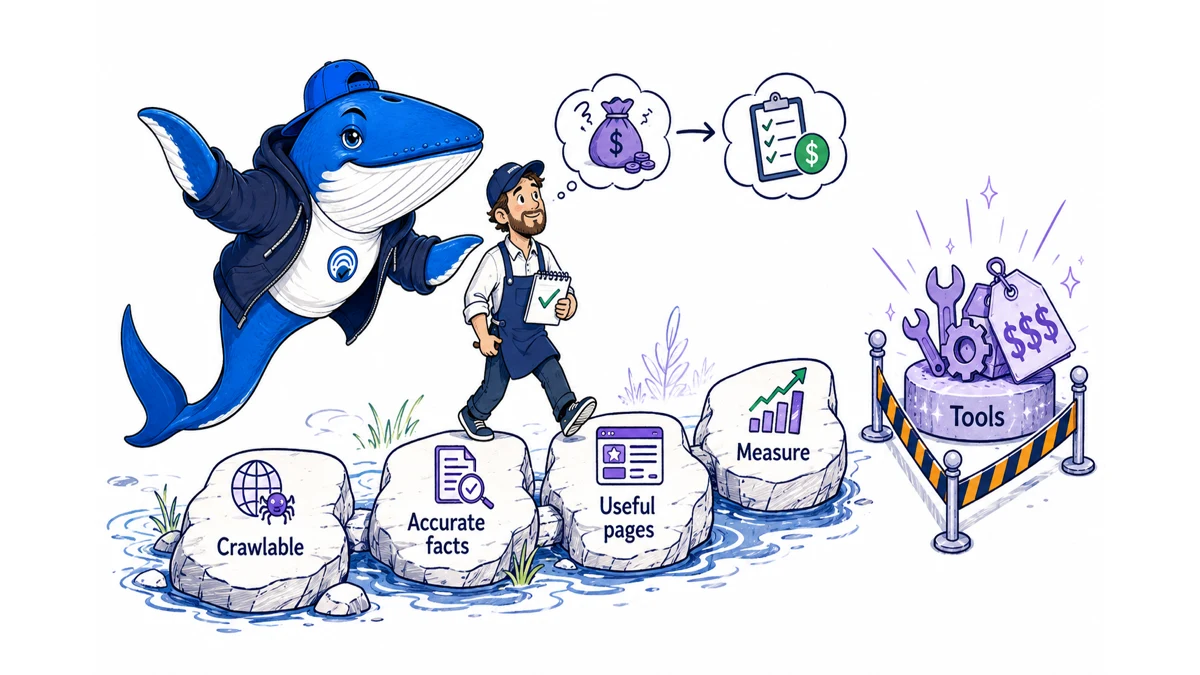
Small businesses do not need an expensive AI SEO stack to begin. First diagnose which of seven gates is blocking growth: demand, crawl eligibility, relevance, evidence, trust, distribution or measurement. Then make the smallest change that can move a qualified business outcome. Tools come after the constraint is known.
This guide combines a seven-gate diagnostic, a worked small-SaaS example and a 90-day implementation plan. It is designed for an owner or small team that cannot afford to confuse more dashboards with more useful visibility.
Stop buying tools until you can name the constraint
An AI-visibility subscription can report mentions and citations. A crawler can expose technical problems. A keyword product can estimate demand. None of them decides whether the real problem is that customers do not search for the offer, the page cannot be indexed, the answer lacks first-party evidence, or visitors do not trust the business.
Before purchasing a tool, write one sentence: “We believe this gate is limiting this business outcome, and the tool will help us make this decision.” If the sentence stays vague, use free evidence first: Search Console queries, a manual crawl, customer conversations, analytics and a small fixed set of AI-answer checks.
Run the seven-gate diagnostic
| Gate | Question | Minimum evidence | Typical next decision |
|---|---|---|---|
| 1. Demand | Are the right people searching for this problem? | Relevant queries, customer questions, sales objections | Keep, reframe or stop the page idea |
| 2. Eligibility | Can search and AI crawlers access the priority page? | Status, robots rules, rendered content, canonical, sitemap | Fix access before adding content |
| 3. Relevance | Does the page answer one distinct decision? | Page map, query-page fit, internal links | Consolidate overlap or close an answer gap |
| 4. Evidence | What can you publish that a summary site cannot copy? | First-party data, examples, photos, methods, constraints | Create one original useful asset |
| 5. Trust | Can a reader verify who, when, how and with what limits? | Author page, policies, sources, dates, methodology | Add missing accountability |
| 6. Distribution | How will the right audience find and reference it? | Newsletter, community, partner or customer route | Add one relevant distribution action |
| 7. Measurement | Which observation changes the next decision? | Search, AI-answer, referral and business outcomes | Continue, revise or stop |
Download the seven-gate diagnostic ledger (CSV). It includes a clearly marked synthetic example plus blank template rows. Delete the EXAMPLE-REMOVE rows before using it for your business.
Choose one commercial problem, not every AI platform
Start with the question customers ask immediately before contacting or buying from you: service area, price basis, compatibility, credentials, availability or comparison. Choose five to ten URLs that support those decisions. This keeps the first cycle small enough to review and gives measurement a real business denominator.
Define the outcome before the visibility metric. Qualified calls, bookings, trials, orders or retained customers matter more than a screenshot showing a brand mention. Track platform visibility as an intermediate observation, not the final result.
Worked example: a small invoicing SaaS with flat traffic
This is an illustrative scenario, not a SearchEngineAnswer client result. A five-person invoicing SaaS sees flat non-brand traffic and considers buying an AI-visibility platform. The team runs the gates first.
- Demand: Search Console shows impressions for free invoice templates but little visibility for migration and integration decisions. Support logs contain 64 anonymized migration questions. The demand is narrower than “AI SEO,” but commercially relevant.
- Eligibility: nine priority pages return valid 200 responses. A comparison page behaves like a soft 404. The team fixes that response before commissioning more content.
- Relevance: three feature articles repeat generic benefits. The team consolidates them into one workflow page and gives every remaining URL a distinct decision.
- Evidence: the 64 support questions reveal five recurring migration failure points. The team publishes an anonymized checklist, screenshots of its own workflow and clear limitations.
- Trust: the author page exists, but the article lacks a method and update history. Those are added before outreach.
- Distribution: customer success sends the checklist to affected customers and two integration partners. This is useful distribution, not bulk link solicitation.
- Measurement: the decision metric becomes qualified organic demo starts from migration and integration pages, with impressions, citations and referrals recorded separately.
The diagnostic changes the purchase decision. The company may still add a visibility product later, but only after the priority pages, evidence asset and outcome tracking exist. The tool then answers a defined question instead of becoming the strategy.
Make business facts and first-party evidence unambiguous
Publish the official business name, locations served, opening hours, contact method, offer boundaries, price or quote logic, refund terms and last-updated date where appropriate. Align those facts across the website and business profiles. Correct contradictions before adding more explanatory copy.
Then add information competitors cannot reproduce by summarizing public pages: photographs you own, real policies, staff credentials, test conditions, anonymized customer questions, compatibility observations and examples with clear boundaries. State what the evidence does not establish. Originality is not a tone or a word-count target; it is useful evidence plus judgment.
Pass crawl and index checks before visibility tracking
Confirm the priority pages return 200, have self-consistent canonicals, render their main content, appear in the intended sitemap and are not blocked accidentally. Google’s AI optimization guidance says the same Search foundations apply to Google’s AI features. OpenAI’s publisher FAQ explains its separate search and training crawler controls.
Use our AI crawlers guide to record deliberate access choices instead of copying a blanket robots.txt file. Crawlability is necessary for discovery but does not guarantee indexing, ranking or citation.
Build one page that removes a buying obstacle
Lead with the answer. Then show how the choice works, what it costs or depends on, a realistic example, evidence and a limitation. A local repair company can explain diagnostic fees with three worked scenarios. A consultant can show which project types they decline. A shop can publish fit measurements and return conditions.
Avoid city-name doorway pages that repeat the same copy. Create a location page only when it contains location-specific service, proof, constraints and contact details. If two pages cannot be given different reader jobs, improve one authoritative page instead of publishing both.
Earn links and mentions through utility
Create an asset people in the market can use: a local compliance calendar, compatibility table, quote worksheet, maintenance checklist, benchmark with transparent methods or original survey. Contact relevant associations, suppliers, customers and local publications with a precise reason the asset helps their audience. Do not buy bulk links or manufacture expert quotes.
The goal is durable evidence of usefulness. A link, citation or newsletter mention is valuable when it introduces the asset to the people it was built to help.
Measure four layers without blending them
| Layer | Weekly observation | Monthly decision |
|---|---|---|
| Search | Priority pages indexed and receiving relevant queries | Improve page-query fit or technical eligibility |
| AI answers | Fixed prompts, response date and validated citations | Improve absent or unsupported source coverage |
| Referral | Known search and AI landing sessions | Improve the landing-page promise |
| Business | Qualified actions, pipeline and revenue | Shift effort toward pages that help customers decide |
Our AI referral tracking guide explains why direct traffic should not automatically be labeled as AI. Prompt results also vary by model, account, location and time, so preserve the prompt and observation context.
A 90-day plan organized around decisions
- Days 1–15 — diagnose: select five to ten priority pages, run the seven gates, preserve baselines and fix access blockers.
- Days 16–45 — create information gain: improve the commercial pages and publish one first-party utility asset with sources, method and limitations.
- Days 46–70 — distribute and observe: send the asset through relevant customer, partner, community and newsletter routes; run a fixed prompt sample and review query-page fit.
- Days 71–90 — decide: compare qualified outcomes with the baseline, update weak pages, stop work that has no evidence, and document what remains unknown.
Download the existing small-business AI SEO 90-day plan and use it with the new seven-gate diagnostic. Every active row needs an owner, evidence source, due date and success measure.
When a paid tool becomes justified
Pay for a tool when manual evidence is too slow, unreliable or narrow for a decision you already make repeatedly. A crawler is justified when a ten-page manual check becomes a 5,000-page monitoring problem. An AI-visibility platform is justified when a fixed prompt sample no longer covers the markets, competitors and models the business must compare. A rank tracker is justified when query and location monitoring informs real page or campaign decisions.
Record the cost, decision supported, owner, usage frequency and cancellation condition. If nobody can name what action changes when the dashboard changes, the subscription is reporting theater.
Sources, assumptions and limits
This framework was updated September 8, 2026 using Google’s AI-feature optimization guidance, OpenAI’s publisher crawler documentation and SearchEngineAnswer’s existing technical and analytics guides. The SaaS case is explicitly synthetic; its numbers demonstrate how a diagnosis changes a decision and are not performance benchmarks. The seven gates are an editorial operating model, not a Google ranking formula.
Use the AI SEO guide and task hub to choose a specialist guide only after the diagnostic identifies a specific constraint. The smallest useful next action is usually clearer than the most comprehensive software stack.
Keep learning
Continue this topic
Next in this topic
Content Optimization for AI Search: A Page-Level Rewrite Workflow
Earlier in this topic
AI Keyword Research: Turn Search and Grounding Data Into Topics
SEO
Ask a question or join the discussion