AI Search Ranking Factors: What Platforms Document—and What They Don’t
Separate documented eligibility and controls from practitioner observations and unknown source-selection mechanics before acting on ranking-factor claims.
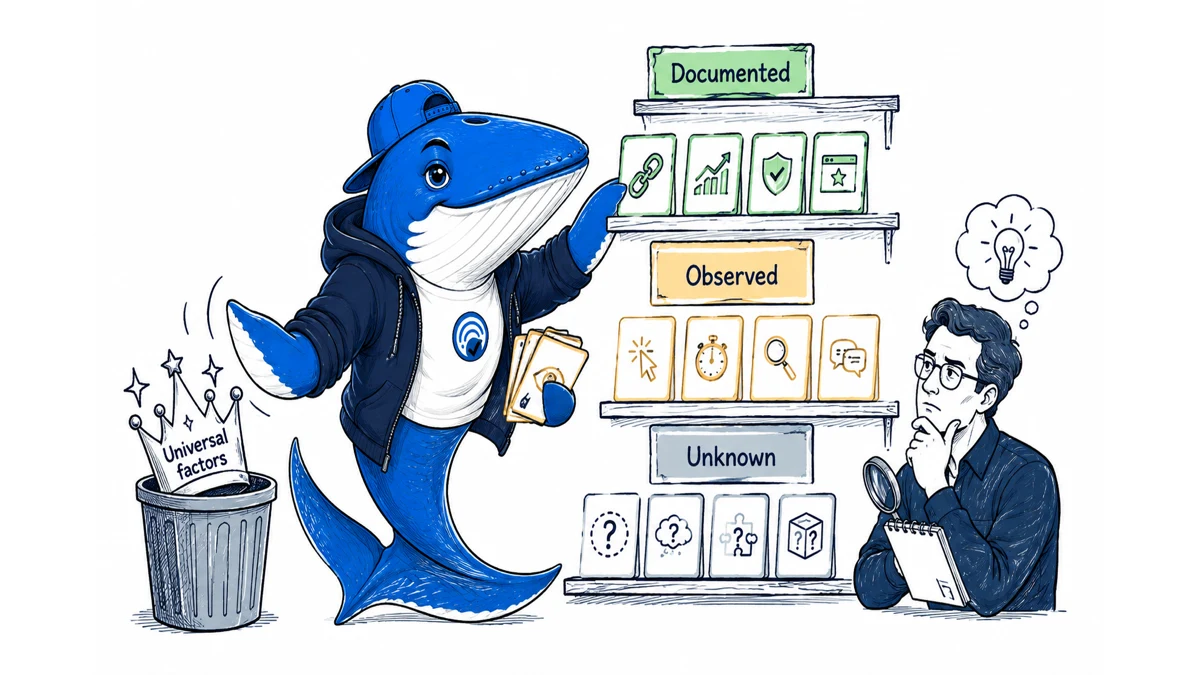
There is no verified universal list of AI search ranking factors. Platforms document eligibility, crawler controls and parts of retrieval or grounding; practitioners can observe citations and referrals; large parts of source selection remain unknown. A trustworthy ranking-factor guide must preserve those boundaries.
Use three evidence classes
| Class | Definition | How to write it |
|---|---|---|
| Documented | Named in official product documentation | State scope and link source |
| Observed | Measured in a disclosed sample | Report method, denominator and limits |
| Unknown | Not exposed or not isolated | Label uncertainty; do not fill with folklore |
This classification is more useful than a numbered list that quietly mixes requirements, correlations and guesses.
What Google documents
Google’s AI features documentation says pages used as supporting links must be indexed and eligible for snippets, and no additional technical requirement or special schema is needed. Its broader guidance says core SEO best practices remain relevant and AI features may use query fan-out.
These statements support eligibility and process claims. They do not reveal a weight for “authority,” guarantee inclusion, or prove that one formatting pattern ranks.
What OpenAI, Bing and Perplexity expose
OpenAI documents OAI-SearchBot and referral parameters in its publisher FAQ. Bing Webmaster Tools’ AI Performance reporting exposes citations, cited pages and grounding queries for supported experiences. Perplexity publishes crawler roles and source-label explanations.
Those are controls and measurements, not a common factor model. A citation count in one platform cannot be compared directly with an impression or mention score from another.
What practitioners can observe
You can test whether pages are crawlable, indexed, cited for fixed prompts and visited through known referrals. You can compare page treatments over time if you preserve prompt sets and confounders. You cannot normally see every candidate source, hidden query, model state or user context involved in selection.
Describe “observed association” unless the design isolates causality. Our visibility-score versus referral test shows why high scores can fail to produce traffic.
Evaluate popular factor claims
- Schema guarantees citations: unsupported; valid structured data can aid understanding where documented, but no general AI-citation schema exists.
- Short answer blocks always win: testable observation, not a universal rule.
- More brand mentions cause selection: possible correlation with real-world prominence, not a published weight.
- llms.txt controls Google: not documented by Google; see our llms.txt analysis.
- Crawler hits mean ranking: false inference; fetching precedes possible use.
Run factor experiments that can teach you something
Choose comparable pages, change one meaningful treatment, record baselines and set a window. Prefer treatments valuable to readers even if no AI effect appears: clearer sourcing, original data, better examples or corrected access. Keep a control group when feasible and report the full denominator.
Do not repeatedly change headings, schema, length and internal links, then attribute movement to one item.
Build a living evidence register
For each claim, record platform, evidence class, source, retrieval date, exact scope, test method, confidence and review date. Downgrade claims when documentation changes or a result fails to replicate. The register should make deletions as easy as additions.
Download the AI search ranking-factor evidence register. It is designed to keep documented facts, local observations and unknowns from collapsing into a persuasive but fictional checklist.
Use the AI SEO guide and task hub to place each documented requirement or hypothesis inside the larger access-to-outcome chain.
Keep learning
Continue this topic
Next in this topic
Perplexity SEO: Audit Crawlers, Citations, Referrals and Source Labels
Earlier in this topic
Google AI Mode SEO: Map Query Fan-Out Without Publishing Thin Pages
AEO & AI Search
Ask a question or join the discussion