Perplexity SEO: Audit Crawlers, Citations, Referrals and Source Labels
Audit PerplexityBot and Perplexity-User separately, validate cited claims, capture source labels and connect detectable referrals to qualified outcomes.
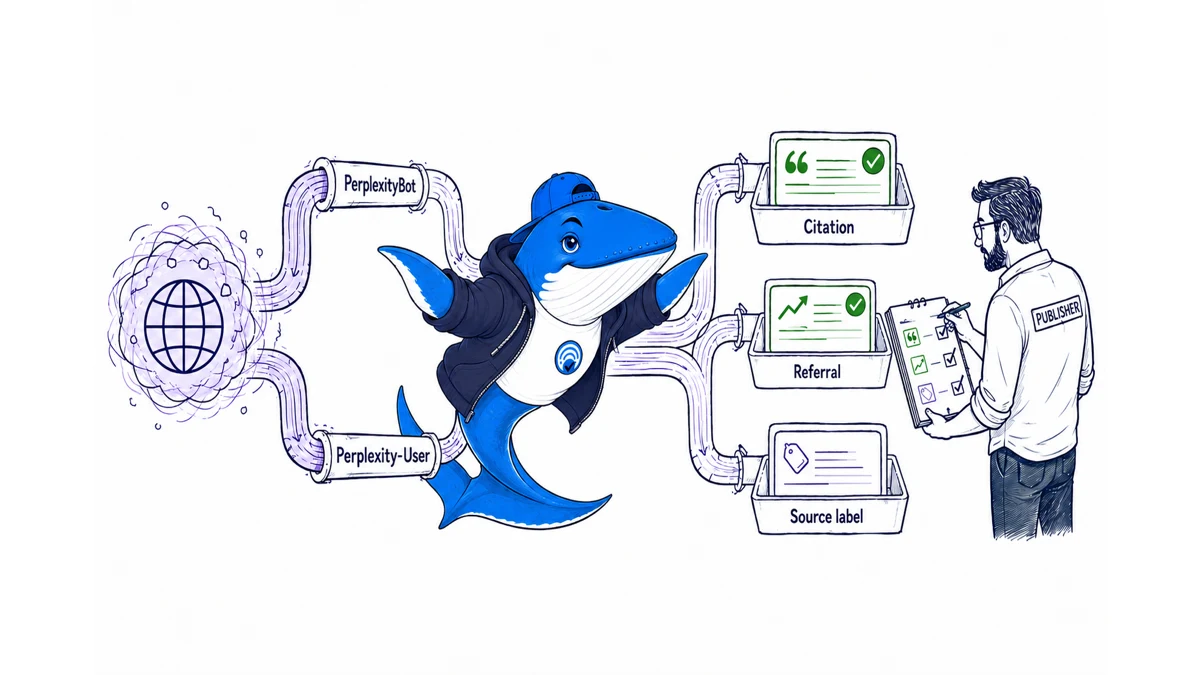
Perplexity SEO should audit crawler access, observed citations, referral sessions and source labels as separate systems. PerplexityBot and Perplexity-User have different documented roles, and a domain-level source category is not a judgment about an individual claim.
Start with the two documented crawler roles
Perplexity’s crawler documentation describes PerplexityBot as a crawler used to surface and link websites in search results, while Perplexity-User supports user-triggered fetching. Record policy decisions for each identity rather than using one “Perplexity allowed” field.
Confirm behavior through logs and vendor-published verification guidance where available. User-agent strings can be copied, so a text match alone does not establish authentic traffic.
Audit access end to end
Check robots.txt, CDN bot controls, WAF rules, rate limits, status codes and rendered content. Test representative canonical URLs, not just the homepage. Record response evidence and the exact rule responsible for a block. If you choose to block a role, document the product and policy reason so a future administrator does not “fix” an intentional control.
Our AI crawler guide provides a cross-platform control matrix.
Build a stable citation sample
Create prompts from real audience decisions and freeze them for a measurement cycle. Save exact wording, date, locale, account state, answer, cited URL and nearby claim. Validate whether the page supports that claim. A source card can exist while the relationship between source and sentence remains weak or ambiguous.
Preserve no-answer, failure and uncited statuses. Report cited prompts divided by valid completed prompts plus the excluded rows.
Read source labels before counting success
Perplexity’s source-label guidance documents three domain-level categories: Government, Academic and Trusted. Capture the label and its explanation, or record that no label appeared. Perplexity says the absence of a label is not a negative judgment.
A label applies to the website as a whole, not the accuracy of an individual page or claim, and it can change after reassessment. Save the date, answer context and source URL, then validate the cited claim by reading the page.
Measure referrals with business context
Segment known Perplexity referrals in analytics, then inspect landing pages, engagement, conversions and value. Referral detection can undercount influence because referrer data may be lost. Keep self-reported discovery or assisted-conversion evidence separate and label it accordingly.
Use our GA4 referral workflow and avoid assigning every direct visit after publication to AI.
Improve pages for claim support
Strengthen accurate definitions, first-party facts, source links, worked examples, dates and limitations. Make the primary content accessible in HTML. Do not add fake author credentials, decorative citations or repetitive FAQ blocks. If the page cannot substantiate the claim for which it is cited, correct the page or stop presenting the citation as a win.
Report three ledgers, not one score
| Ledger | Rows | Decision |
|---|---|---|
| Access | Crawler, URL, status, verified identity | Fix or retain policy |
| Citation | Prompt, answer, URL, claim support, label | Improve evidence |
| Outcome | Referral, landing page, action, value | Prioritize useful pages |
Download the Perplexity SEO access–citation–outcome ledger. Its example rows show the separation; replace them with your logs and observations before calculating any rates.
Calculate one citation rate without hiding failures
Imagine a frozen sample of 30 prompts. Twenty-four produce valid answers, three fail, and three cannot run in the declared account or region. Your domain appears as a source in five valid answers, but only four cited pages support the nearby claim on manual review. Report both rates: 5 of 24 answers included the domain, while 4 of 24 contained a claim-supporting citation. Keep the six incomplete rows visible rather than silently removing evidence about product availability.
Now connect—but do not collapse—the outcome ledger. If analytics detects seven Perplexity referrals and one qualified action during the window, that is a separate observed path. The five answer citations and seven visits do not form a one-to-one funnel unless user-level evidence legitimately connects them. A future sample may change because prompts, answer behavior, source labels, locale, or the product itself changed.
This denominator discipline makes a small observation useful without pretending it measures universal rank. For the wider cross-platform framework, use the AI SEO guide and task hub.
Keep learning
Continue this topic
Next in this topic
ChatGPT Becomes an EU VLOSE: What Publishers Need to Track
Earlier in this topic
AI Search Ranking Factors: What Platforms Document—and What They Don’t
AEO & AI Search
Ask a question or join the discussion