Answer Engine Optimization (AEO): What it is and how to do it
Answer Engine Optimization (AEO) is the work of making content eligible, clear, verifiable, and measurable across systems that generate direct answers. This guide separates durable practices from citation and schema myths.
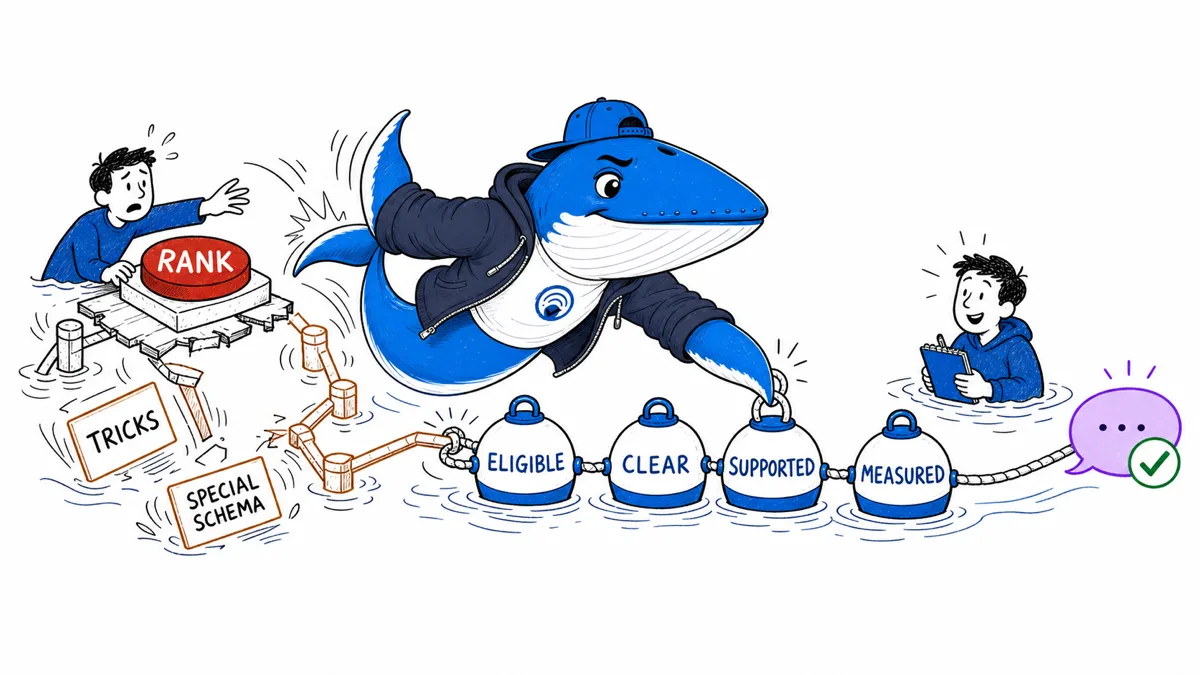
Direct answer: Answer Engine Optimization (AEO) is the work of making a useful answer eligible to be found, clear enough to interpret, supported well enough to reuse, and measurable across systems that generate direct responses. It extends ordinary SEO; it does not replace SEO or unlock a separate ranking system.
AEO cannot guarantee that Google, ChatGPT, Bing, Perplexity, or another system will cite or recommend a page. It gives a publishing team a disciplined way to improve the inputs it controls and record what each platform actually returns.
What is Answer Engine Optimization (AEO)?
Answer engines respond to a question with a synthesized answer, a direct result, a spoken response, a source list, or some combination of them. The industry uses Answer Engine Optimization for the work intended to improve a page or entity’s chances of being understood and used in those responses.
That definition needs a boundary. AEO is not one platform feature, schema type, crawler, or official ranking formula. Google, Microsoft, OpenAI, and other providers document different eligibility rules, controls, result formats, and reports. A defensible AEO program therefore starts with the target surface and the reader’s question, not a universal checklist copied across every system.
| Term | Practical job | Useful outcome | Important limit |
|---|---|---|---|
| SEO | Help search systems crawl, index, understand, and present pages | Search visibility and qualified visits | A rank does not guarantee answer inclusion |
| AEO | Make a bounded answer easy to retrieve, interpret, support, and measure | Direct-answer use, citation, mention, or referral | No shared AEO ranking formula exists |
| GEO | Study and improve visibility inside generative responses | Citation or representation in generated answers | Practitioners often use GEO and AEO interchangeably |
The overlap is larger than the labels suggest. Crawlability, useful content, accurate structured data, internal links, evidence, page experience, and clear authorship can support both search and answer visibility. Treat AEO as a layer in the publishing workflow rather than a replacement department.
Use the four-layer AEO control map
Most AEO advice mixes controllable page work with outcomes a publisher cannot force. Separate the work into four layers. A page moves forward only when the previous layer has enough evidence.
| Layer | Question | Evidence of completion |
|---|---|---|
| Eligible | Can the target system access and consider the page? | Final status, robots controls, canonical, rendered text, index state, crawler access |
| Clear | Can the answer travel without losing its subject or boundary? | Direct answer, defined scope, descriptive heading, stable terminology |
| Supported | Can a reader or system trace material claims to appropriate evidence? | Primary links, dated facts, method, author, limits, correction path |
| Measured | Can the team distinguish exposure from business value? | Separate records for crawl, citation, mention, recommendation, referral, and conversion |
The model is an editorial control map, not a claim about how a vendor’s internal system works. It prevents a common mistake: polishing an answer paragraph while the page is blocked, unsupported, or impossible to evaluate.
How to do Answer Engine Optimization
- Define the answer job. Write the question, affected reader, decision, constraints, and what the page will not cover. One page should have one primary job even when it answers supporting questions.
- Name the target surfaces. Google AI Overviews, AI Mode, ChatGPT search, Bing’s AI experiences, and other systems do not share one publisher contract. Record the exact product, country, account state, and date.
- Pass the eligibility gate. Check the final HTTP status, robots rules, canonical URL, indexability, rendered main text, internal links, and snippet controls. For ChatGPT summaries and snippets, OpenAI says OAI-SearchBot must not be blocked.
- Build a claim ledger. Classify material statements as fact, observation, interpretation, recommendation, or opinion. Link facts to the source that owns them and show dates and scope beside unstable claims.
- Write the portable answer first. State the answer near the relevant heading, then add the boundary, evidence, useful distinction, and honest limit. The citation-ready passage test provides a detailed review method.
- Add information worth retrieving. Publish a reproducible test, comparison, calculation, template, decision framework, first-hand observation, or specific failure state. Rephrasing the current results is not information gain.
- Connect the evidence path. Use descriptive internal links, consistent entity names, visible authorship, accurate structured data, and citations placed beside the claims they support. Structured data must match the visible page.
- Measure and maintain. Save the page version, observation window, platform state, and outcome definitions. Assign an owner and update trigger for product documentation, broken sources, new evidence, and material errors.
Do not turn every section into a miniature FAQ. A coherent guide with direct answers at real decision points is more useful than dozens of disconnected snippets.
Check platform rules before applying AEO tactics
Google says AI Overviews and AI Mode require no additional technical optimization, special schema, or AI text file. A supporting page must be indexed and eligible to appear in Search with a snippet. Meeting those requirements still does not guarantee crawling, indexing, serving, or inclusion.
OpenAI documents a different control. A public page can appear in ChatGPT search, but OAI-SearchBot access is needed for summaries and snippets. OpenAI also separates search access from potential model-training controls and adds utm_source=chatgpt.com to referral URLs.
Bing Webmaster Tools can expose AI citation activity and cited pages through its AI Performance reporting. Keep that observation separate from conventional Bing search position. A cited page is not automatically the recommended option, and neither outcome proves a conversion.
| Surface | Publisher check | Measurement boundary |
|---|---|---|
| Google AI features | Indexed, snippet-eligible, crawlable, helpful page | Traffic is included in Search Console Web reporting |
| ChatGPT search | OAI-SearchBot access for summaries and snippets | Referral URLs can be tracked; unseen answers are not counted |
| Bing AI experiences | Bing crawl/index fundamentals and current controls | AI Performance citations are not rankings |
| Other answer systems | Current operator documentation and dated tests | Do not transfer one platform’s result to another |
Remove five AEO myths from the plan
- “Add special AEO schema.” Google explicitly says its AI Search features need no special schema. Use supported structured data only when it matches visible content and a documented feature.
- “Create an AI file and the engines will cite you.” No shared publisher file can compel inclusion across answer systems. Follow each operator’s documented controls.
- “Put a 40-word answer under every question.” Brevity can improve clarity, but unsupported or context-free answers are easier to misuse, not safer to cite.
- “A citation means the brand was recommended.” A system may cite a publisher for evidence while recommending another entity. Use the AI visibility measurement crosswalk to label the outcomes separately.
- “Publish more AI-generated pages to cover every prompt.” Google warns that scaled generation without added user value may violate its spam policies. Coverage without evidence, judgment, or maintenance creates a larger failure surface.
Measure AEO without inventing a ranking
Choose metrics after defining the decision. A technical team needs crawl and index evidence. An editor needs claim and citation quality. A marketer needs qualified referrals and conversions. Combining them into one “AI visibility score” hides which layer changed.
| Outcome | Evidence | What it does not prove |
|---|---|---|
| Access | Verified bot request, status, robots response | Indexing, retrieval, citation, or training |
| Search exposure | Search Console or Bing Webmaster data | Why a system selected the page |
| Citation | Saved answer, linked claim, resolved source | Recommendation, stable position, or authority |
| Mention | Saved answer and entity classification | Support, endorsement, or visit |
| Referral | Landing page, source/medium, UTM, consent state | Total citations or unseen answers |
| Conversion | Declared event and attribution window | That AEO alone caused the action |
For sampled answer tests, freeze the prompt, platform, model or product label, location, account state, date, and repetition rule. Preserve failures and absent results. The AI visibility measurement crosswalk keeps the channel definitions compatible.
Start with a 30-day AEO plan
- Week 1: select ten answer jobs. Use real support, sales, editorial, and Search Console questions. Map each job to one existing or planned page.
- Week 2: pass eligibility and evidence checks. Fix blockers, verify canonicals and visible text, open every material source, and remove unsupported claims.
- Week 3: improve the answer layer. Rewrite the direct answer, add boundaries and original contribution, then strengthen only the internal links that help the reader continue the task.
- Week 4: record a baseline. Save current search data, referrals, Bing AI reports where available, and a small declared answer sample. Set a review date instead of checking random prompts every day.
After 30 days, expand only the pages whose reader job, evidence, and measurement are clear. Stop when the team cannot identify the claim, platform, or decision behind the work.
Use the evidence-led publishing guide to maintain the claim ledger, skeptical review, technical gate, and update trigger behind the program.
Answer-unit example
Turn a vague paragraph into a verifiable answer without flattening it
A strong answer unit begins with the conclusion, then keeps the condition and evidence close enough to travel with it.
- Weak: “Schema helps SEO in many ways.”
- Better: “Structured data can make eligible pages understandable for supported search features, but it does not guarantee a rich result.”
- Best: add the applicable feature documentation and the page-specific implementation result.
My takeaway: AEO is not keyword decoration for AI. It is the discipline of making a useful answer clear, attributable and appropriately qualified.
Primary documentation
Keep learning
Continue this topic
Next in this topic
AI Crawlers Explained: Which Bots Index, Train, or Fetch
Earlier in this topic
How to Audit Duck.ai Voice Search Against Typed Answers
AEO & AI Search
Ask a question or join the discussion