AI SEO Audit Checklist: Find Gaps Before Buying Another Tool
Audit crawl, index, citation, referral and conversion evidence in order, then prioritize fixes by confidence, business importance and reversibility.
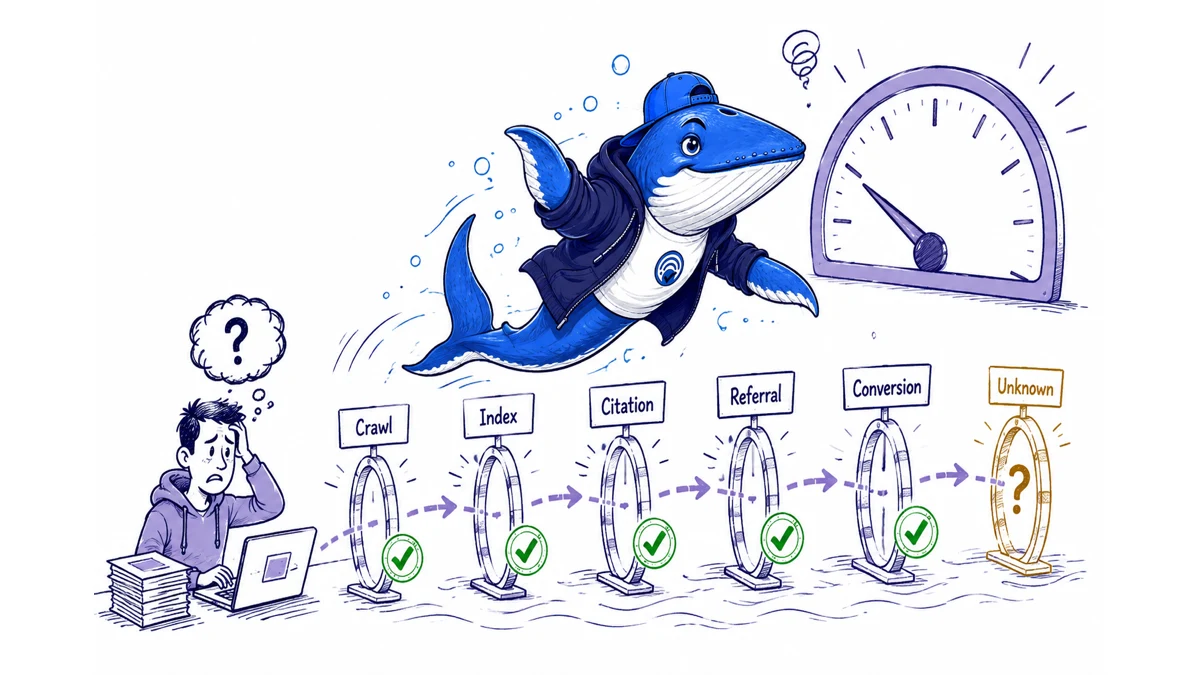
An AI SEO audit should trace evidence from crawl access to business outcome before it recommends a tool or rewrite. The sequence is crawl, index, citation, referral and conversion. “Unknown” is a valid audit result; inventing a score for a missing layer is not.
The checklist below works across Google AI features, ChatGPT search, Bing Copilot experiences and Perplexity because it separates platform documentation from observations on your own site.
Define the audit question and baseline
Choose a page set, market, language and date range. Export canonical URLs, index status, organic clicks, conversions, server-log activity and any saved AI-answer observations. Record the export time and property filters. Without that baseline, a later “visibility increase” can be caused by a changed prompt set, a new country mix or a tool’s scoring update.
Do not begin with “How do we rank in AI?” Begin with a falsifiable question such as “Which revenue pages are indexable in Google but absent from our 40 stable comparison prompts?”
Audit crawl access by named system
Review robots.txt, CDN rules, application firewalls and server logs for each documented crawler. OpenAI distinguishes OAI-SearchBot from GPTBot in its publisher guidance. Perplexity documents separate roles for PerplexityBot and Perplexity-User. A sitewide “AI bot: allowed” cell loses important policy choices.
For every blocked or failed fetch, record the exact URL, response code, rule and owner. Validate IPs or published reverse-DNS methods where a vendor provides them; a user-agent line by itself is weak evidence.
Audit index and snippet eligibility
Google says pages shown as supporting links in AI features must be indexed and eligible to appear with a snippet. Its AI features documentation also says there are no additional technical requirements or special AI files. Check canonical selection, noindex, nosnippet, paywall implementation, rendered main content and duplicate clusters.
Eligibility is not appearance. Mark the technical layer pass or fail, then keep selection as a separate observation. This prevents teams from selling a meta-tag change as a guaranteed citation fix.
Audit page-level information gain
For each priority page, identify the primary task, first-party evidence, sourced external claim, concrete example, comparison basis and limitation. Remove paragraphs that merely restate the title. Add the missing decision support: a formula, template, worked example, annotated screenshot, test protocol or downloadable ledger.
Use our evidence-led publishing guide to distinguish a primary source from commentary. If a competitor’s summary is the only source, follow its link to the original documentation before publishing the claim.
Audit citations with controlled observations
Freeze a modest prompt set based on real intent. Save exact prompt, answer, date, locale, platform state, cited source and claim support. Validate the cited passage manually. A URL appearing in a source list is not enough if it does not support the sentence it accompanies.
Report a numerator and denominator: cited prompts divided by valid completed prompts. Preserve failures, unavailable answers and ambiguous source labels as separate statuses. Otherwise retries quietly inflate the apparent rate.
Audit referrals and conversions separately
Use explicit referral sources and campaign parameters, then review landing-page behavior and conversions. Keep unattributed direct visits and self-reported discovery as supplemental evidence. Do not claim a causal lift from a before-and-after screenshot when seasonality, campaign activity or page changes also moved.
The cross-platform definitions in our AI visibility measurement crosswalk help keep mentions, citations, referrals and revenue distinct.
Prioritize fixes with evidence and reversibility
Score each finding on business importance, confidence, effort and reversibility. A blocked high-value directory with confirmed crawler demand outranks a cosmetic schema warning. A rewrite that removes useful nuance deserves a backup and controlled test. Assign an owner, due date, validation method and rollback trigger.
Download the AI SEO audit evidence register. Replace every EXAMPLE-REMOVE row. The completed sheet should make the next action obvious even if every commercial visibility score disappears tomorrow.
Return to the AI SEO guide and task hub when the audit reveals a content, platform, WordPress, measurement, or operating-model problem that needs a focused workflow.
Keep learning
Continue this topic
Next in this topic
AI Keyword Research: Turn Search and Grounding Data Into Topics
Earlier in this topic
Cloudflare AI Search Metadata: 10 KiB vs 64 Bytes
SEO
Ask a question or join the discussion