AI Visibility Reports: Track Mentions, Recommendations, Citations, and Revenue
Build separate ledgers for mentions, recommendations, citations, detected referrals and business outcomes, then connect them with stable keys and explicit uncertainty.
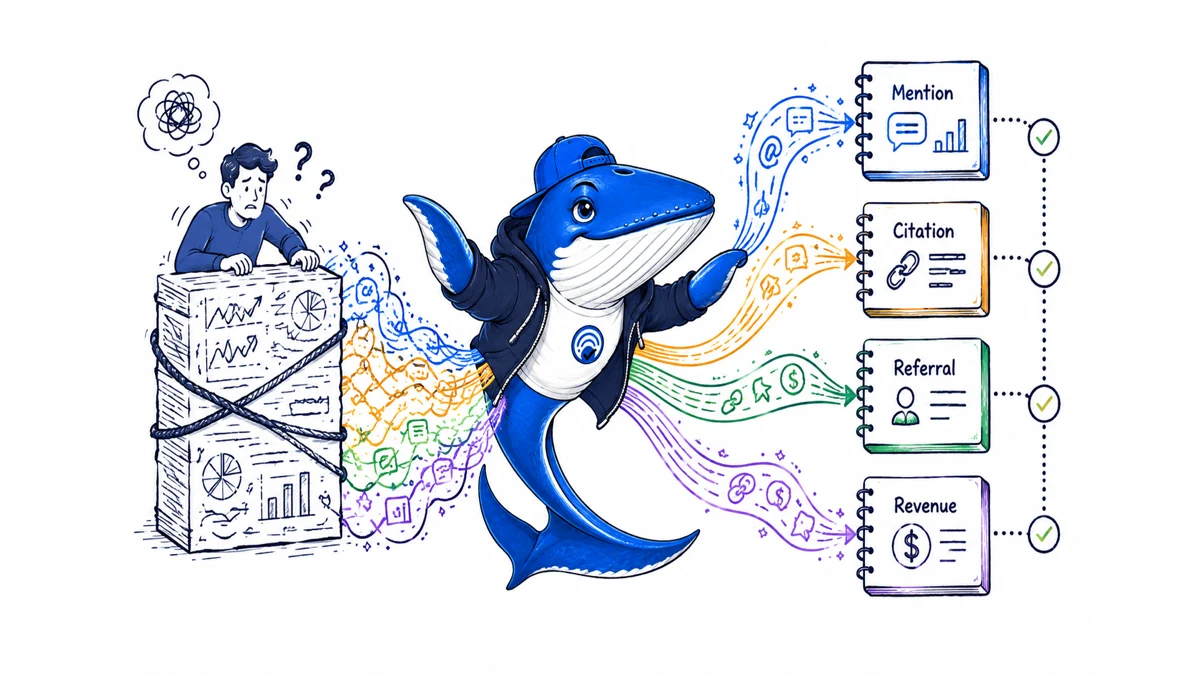
An AI visibility report is useful only when every number has a defined event and denominator. A brand mention, a product recommendation, a cited page, a detected visit and a sale are not interchangeable forms of “AI visibility.” Keep them in separate ledgers, then join only the records for which a defensible connection exists.
Reconcile self-reported discovery without inventing sessions
Ahrefs’ October 6 attribution guidance discusses how detected referrals can miss AI-assisted discovery. It is practitioner guidance with vendor examples, not a controlled attribution experiment. A rise in direct sessions remains unexplained until more evidence connects it to a discovery route.
Consider a fictional reader who sees a recommendation, visits through a link, and later says “I found you through ChatGPT” on a form. The analytics visit and the form response describe related stages, not two new readers. If a permitted first-party journey reference connects them, retain the relationship without counting the same person twice. Without that reference, report the two signals separately.
| Signal | Reportable unit | Boundary |
|---|---|---|
| Detected AI referral | Recorded sessions with a declared source rule | Not every AI-influenced visit |
| Self-reported discovery | Respondents who name an AI source | Recall, response and selection bias |
| Direct or unassigned traffic | Sessions under the current analytics classification | Unknown discovery origin |
Do not add respondents to sessions or rename the increase in direct traffic “hidden AI visits.” A discovery survey can answer a useful question even when it cannot reconstruct the acquisition event. Our GA4 referral guide preserves the recorded visit source; this report keeps the broader claim at the level its evidence supports.
Start with five events, not one score
| Event | Pass rule | Evidence to retain |
|---|---|---|
| Mention | The answer names the entity under a documented matching rule. | Full answer, prompt and surrounding context. |
| Recommendation | The answer presents a named entity as suitable for the task or decision. | Recommendation wording, qualifiers and alternatives. |
| Citation | A visible source link resolves to the target page or domain. | Displayed label, URL, destination and supported claim. |
| Referral | A detectable visit arrives from the answer surface. | Referrer or campaign signal, landing page and session. |
| Outcome | The visit or broader journey reaches a declared business result. | Conversion event, value, attribution rule and date window. |
The events can occur independently. A model can recommend a retailer while citing a third-party review. A citation can generate no detectable click. A direct visit after an AI answer may have no preserved referrer. Report that uncertainty rather than filling the gaps with an invented conversion rate.
Freeze the observation design before collecting answers
Define the prompt set, platform, interface, model or mode when visible, locale, account state, device, capture period and repetitions. Save the complete answer, not just the cited-domain list. Record failed prompts and answers with no sources. If the prompt set changes, start a new series or label the break; otherwise an apparent visibility gain may only reflect a friendlier sample.
A controlled product-advice study illustrates why repetitions and collection surface matter. ChatGPT and Gemini shared no displayed source domain in 76.7% of matched product-answer checks, and the same service changed its source set across repeats. That result does not predict a particular brand’s traffic; it shows why a one-off screenshot should not become a trend line.
Use native reports for their own units
Bing Webmaster Tools AI Performance reports citation-related metrics and sampled grounding queries. Google’s generative AI performance reporting has a different scope and dimensions. Analytics can count detected visits from known AI referrers, but it cannot observe every answer impression or every lost referrer. Our GA4 AI referral guide covers the downstream configuration.
Preserve the platform’s metric name, definition, export date and filter settings in every chart. Do not relabel an answer citation as an impression, or compare a sampled grounding query directly with a site-analytics session. The measurement crosswalk is useful when vendors use the same word for different events.
Comscore’s Q2 report shows why denominators matter
In its September 22 Q2 2026 AI Intelligence release, Comscore says its measured prompt-volume share moved from 70% to 50% for ChatGPT, 17% to 30% for Gemini, and 2% to 11% for Claude between January and June 2026. These are shares of prompts in Comscore’s measurement, not each service’s total users, publisher citations or referral traffic. A falling share can coexist with growing absolute usage if the measured market expands.
The same release says the share of measured Google desktop searches containing AI Overviews rose from 25.8% in July 2025 to 39.4% in June 2026. That is a search-results feature-presence rate, not evidence that 39.4% of searches referred traffic to publishers, or that a particular site appeared in the answers. The public release does not disclose every methodological detail needed to reproduce the full vendor dataset, so use its figures as market context, not as a benchmark for your own site.
BrightEdge’s 95.1% is a share of AI referrals, not all search traffic
BrightEdge reported that ChatGPT generated 95.1% of the AI-platform referrals in its August 2026 measurement and that the volume of ChatGPT referrals grew 101% between January and August. Its separate AI Market Pulse puts AI search at 1.9% of all measured search referrals and Google at 86.9% of that broader frame. These statements can both be true: ChatGPT can dominate a small AI-referral slice while traditional search still sends most detected search visits.
Here is a deliberately hypothetical way to read the denominators. If one site received 10,000 search referrals in a month and 1.9% came from AI platforms, that would be 190 AI referrals. If ChatGPT made up 95.1% of those same 190 referrals, roughly 181 visits would be classified as ChatGPT referrals. This is arithmetic for explaining the units, not a measured SearchEngineAnswer result or an estimate for your site. Do not multiply the two published percentages into a market-share claim without confirming that their samples, periods, platform classifications and referral definitions match.
BrightEdge says it revised historical AI-referral data in July after analytics platforms changed their classification of AI traffic. That makes the measurement rule part of the trend. Before calling a rise a traffic gain, preserve the analytics definition, the reporting window, the absolute AI-referral count and the broader search-referral total. Recalculate the old months under one rule where possible. If that is impossible, mark a series break instead of drawing an uninterrupted growth line.
The public BrightEdge release does not provide raw site-level rows or a complete cohort recipe. It also measures detectable referral visits, not answer impressions, citations or all discovery influenced by AI. For an individual publisher, the next check is its own referral classification and landing-page data, alongside a fixed-prompt citation panel kept in a separate column.
A fixed ChatGPT panel separates brand mentions from cited sources
A BrightEdge analysis published September 21 compared the same non-branded US B2B technology prompts on March 15 and September 13, 2026. For prompts that kept the same intent classification, it reports an average of 5.36 distinct brands named per ChatGPT answer in March and 3.87 in September. BrightEdge calculates a 27.9% decline from its unrounded data; the two displayed averages alone yield about 27.8%.
The useful cross-check is inside the informational group. Its named brands per answer fell from 5.15 to 3.50, while cited sources per answer rose from 2.30 to 3.12. That is an example, within one vendor panel, of why a citation trend cannot stand in for a brand-mention trend. It also does not show that each remaining brand was supported by more independent evidence: the published aggregates do not link individual citations to individual brands.
BrightEdge does not publish the prompt count or raw answers in the public page, and it sells AI-visibility measurement. About 15% of prompts changed intent classification between dates; the headline comparison excludes them. The vendor explicitly withholds a transactional-stage trend because a third observation reversed the two-date direction. Treat these as reported panel findings, not a ChatGPT-wide benchmark or a prediction for another industry.
For a local audit, freeze the prompt text and the answer surface, then record distinct brands named, sources cited and owned pages cited as separate fields for every answer. Publish the prompt count, failures, geography, run dates and repeated captures before charting a change. A report that preserves those units can reveal a shorter recommendation list without claiming a publisher lost visits.
What a one-page report could actually say
Consider a fixed panel of 40 buying and information prompts, each captured three times in two consumer interfaces. The report should state 240 attempted captures and the number that produced a substantive answer. It might then show 68 brand mentions, 21 explicit recommendations and 14 citations to owned pages, each with its own denominator and a sample of manually checked captures. Below that, show 37 detected AI-referral sessions from analytics and six qualified leads attributed under the site’s declared rule. Those numbers are an illustrative layout, not a finding about SearchEngineAnswer or any client.
The interpretation would be conditional: recommendations increased on the fixed prompt panel, but citation frequency did not; detected visits rose, yet some of that change could be seasonality or tracking differences. That is more useful than saying “AI visibility rose 18%” without specifying what moved.
Connect records conservatively, then review the failures
Assign stable prompt and observation IDs. Normalize cited URLs to their resolved canonical pages. Join exposure records to site sessions only where a campaign parameter, referrer or another legitimate identifier supports the relationship. Keep modeled influence and self-reported discovery in a separate column, with assumptions visible. Avoid multiplying an aggregate citation count by a site-wide conversion rate and presenting the result as AI-driven revenue.
Each monthly review should include absent answers, dead links, unsupported citations, prompt failures and a small manual validation sample. If the source list changed after a model release, say so. If the sampling method changed, mark a new baseline. The goal is not to make every number go up. It is to know which part of the path from answer to outcome changed, and whether the evidence is strong enough to act on it.
A citation-density denominator check
The Machine Relations citation-density study exposes a useful counting trap in its own public data. Its top-level runs_cited_domains field counts distinct domains observed across a category-and-question stratum. It is not the number of source appearances across answers. Dividing that field by answer runs therefore understates a sources-per-answer measure.
We recalculated the two ratios from the public JSON release retrieved September 26. Across all 157 top-level strata in that day’s file, 36,471 summed distinct-domain counts divided by 16,925 observed runs gives 2.16. Summing each domain’s per-stratum runs_cited instead gives 117,968 domain-run citation events, or 6.97 per observed run. The study’s September 25 snapshot reports 2.16 versus 6.99; the live file had already changed by the next day. Its 157 strata also included entries still marked collecting or not collectable, so these are dataset-specific arithmetic checks, not a universal estimate for any one engine or publisher.
The practical rule is to label the unit before presenting a rate. A distinct-domain count over a long period, domain appearances per run, visible citation markers and clicks are four different things. Keep the release date and filters with any benchmark, and never use a cross-engine average as a target for one fixed prompt panel.
Keep learning
Continue this topic
Audit citations
Locate the failing answer layer
Compare evidence
Separate mentions, citations and visits
Measure referrals
Check AI search visits in GA4
Tools & Workflows
Ask a question or join the discussion