Google Updates Its AI Content Guidance With Quality-Rater Checks
Google's October 1 guidance update points publishers to separate page-level and site-scale tests for effort, originality, added value and user purpose.
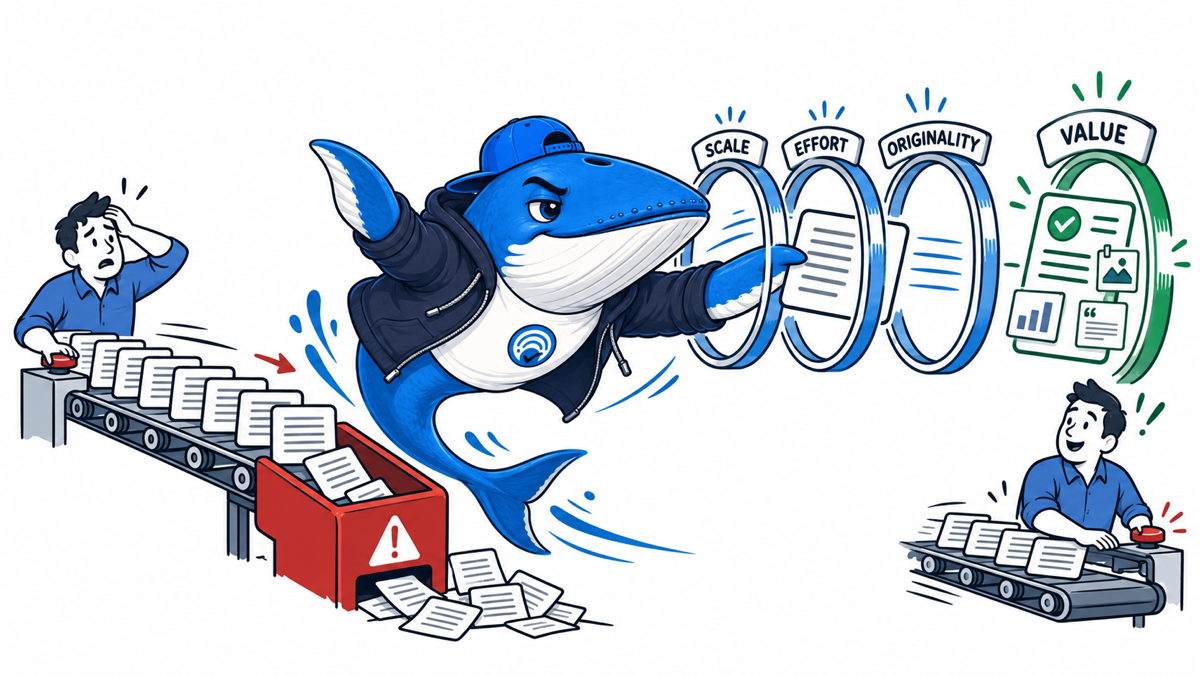
Google has updated its guidance for publishers using generative AI, but it has not announced a new AI-content penalty. The October 1 documentation change points site owners to two sections of the Search Quality Rater Guidelines: one about scaled content abuse and another about pages whose main content shows little effort, originality, or added value.
The practical message is sharper than “AI content is allowed.” AI use alone is not the quality test. Editors need to prove why the page exists, what a human added, which claims were checked, and whether the same production system is creating many interchangeable URLs.
What Google recorded on October 1
Google’s Search documentation update log says it updated the generative-AI content guide with information from the Search Quality Rater Guidelines. Google says the purpose was to align the public documentation with presentations used at developer events.
That wording matters. This is a documentation update. Google did not identify a ranking-system launch, a new manual action, or an AI-detection score. It also repeats that quality-rater assessments do not directly influence rankings. Raters are used to evaluate whether search systems are producing useful results, not to assign a page its live position.
The referenced sections create two tests, not one.
The first test is site-scale. Section 4.6.5 describes scaled content abuse as many pages created mainly to benefit the site owner, with little effort, originality, or value compared with similar pages. It tells raters to inspect several pages when they strongly suspect a scaled pattern.
The second test is page-level. Section 4.6.6 says a page can deserve the Lowest rating when almost all of its main content is copied, paraphrased, embedded, reposted, automatically produced, or AI-generated with little effort, little originality, and little added value. Giving credit to the source does not turn a weak paraphrase into useful original work.
| Question | Page-level review | Site-scale review |
|---|---|---|
| What is inspected? | The main content on one page | A pattern across several pages |
| Primary concern | Little effort, originality, or added value | Many owner-first pages with the same weaknesses |
| What counts as content? | Text, images, audio, video, functionality, and other main content | The repeated production pattern and its resulting pages |
| Does AI use decide the result? | No | No |
This distinction prevents two common mistakes. A publisher should not assume that a carefully reviewed AI-assisted page is low quality merely because AI was involved. It should also not assume that polishing one page solves a library-wide pattern of thin, near-duplicate output.
The four signals editors can use
Google’s current helpful-content documentation describes four attributes of main-content quality. They make a more useful editorial brief than an “AI percentage” detector.
- Effort: Is there visible human work, manual curation, testing, reporting, or custom functionality?
- Originality: Does the page add information or a perspective that is not already available in the source material?
- Talent or skill: Does the result show the writing, production, technical, or subject expertise needed for its purpose?
- Accuracy: Are factual claims correct, with a higher standard for topics that can affect health, safety, money, or civic decisions?
The rater guidelines explicitly say generative AI can be used for high-quality or low-quality content. That is the clearest answer to the wrong question, “Does Google permit AI?” The better question is whether the finished page demonstrates these attributes and fulfills a useful purpose.
Fact-check the search layer too.
Google’s guide warns that generative models predict likely word sequences and can produce inaccurate statements. It calls manual fact-checking and review critical before publication. The responsibility extends beyond the visible paragraphs to the page title, meta description, structured data, and image alternative text.
This is an operationally important detail. A reviewer can correct the article body while leaving an invented statistic in the description, an exaggerated title, mismatched Article schema, or an alt attribute that describes objects the image does not contain. Search can expose those elements or use them to understand the page.
Disclosure is context, not a quality substitute.
Google recommends explaining how content was created when that context would reasonably help the audience, especially when automation substantially generated the work. It does not prescribe one universal sentence for every AI-assisted page.
A disclosure can clarify who reviewed the work, what automation did, and why it was useful. It cannot compensate for unsupported claims or absent original value. Ecommerce publishers also have a separate implementation issue: Google’s guide points to Merchant Center requirements for labeling AI-generated product fields and embedding the applicable IPTC digital-source metadata in AI-generated images.
Our editorial judgment
The October update does not reverse Google’s long-standing position. Appropriate automation is not inherently spam, and AI does not receive a special ranking advantage. The useful change is that Google has made the inspection frame harder to misunderstand.
Publishers should review AI-assisted work at two levels. Inspect each page for effort, originality, skill, accuracy, and a satisfying answer. Then sample the surrounding library for repeated intent, recycled structure, paraphrased sources, and pages that exist mainly to capture another keyword variation.
Use the interactive 30-point generative AI content audit checklist to record evidence, save progress, and export the review. The full guide explains the stopping rules, scoring logic, and worked editorial example.
Primary documentation
Keep learning
Ask a question or join the discussion