How to Use Generative AI for Website Content: A 30-Point Audit Checklist
Audit AI-assisted website content across purpose, evidence, original value, metadata, disclosure, accessibility, indexability and site-scale repetition.
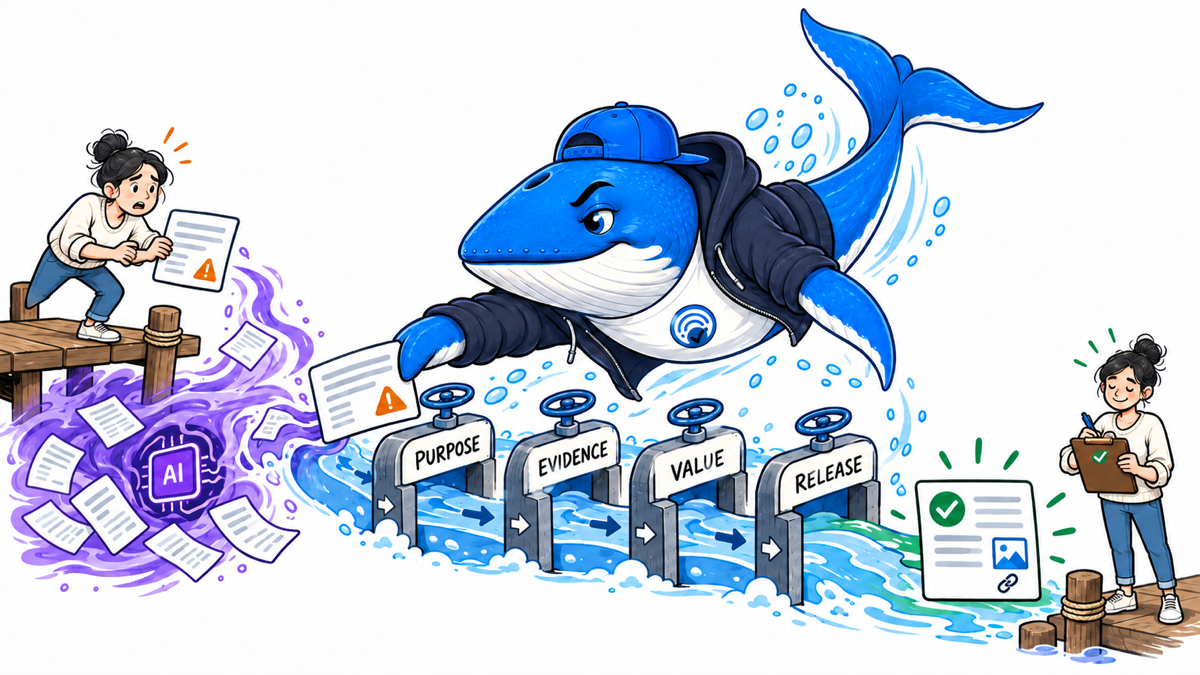
Use generative AI as a bounded production tool, then audit the finished page as if the model were not there. A publishable page needs a clear reader job, verified evidence, a contribution beyond paraphrase, accurate metadata, and a reason to exist as a standalone URL. At site scale, it also needs to avoid a pattern of near-duplicate, owner-first pages.
This guide turns Google’s current generative-AI content guidance and quality-rater framework into a 30-point release check. It is designed for editors, publishers, SEO teams, and site owners who use AI for research, organization, drafting, transformation, or media production.
The interactive checklist saves progress and evidence notes in this browser. It can export a portable progress file, a text report, or a CSV when the review is complete.
Start with the right boundary.
Google does not say that AI-assisted content is automatically low quality. Its current guidance says generative AI can be useful for research and for structuring original content. The risk begins when automation produces many pages without adding value, or when the page’s main content shows little effort, originality, or added value.
The audit therefore has two scopes:
- Page scope: Does this URL fulfill its purpose with effort, originality, skill, and accuracy?
- Site scope: Does the surrounding production pattern create useful coverage, or many interchangeable search entry pages?
Pass both. A strong page cannot excuse a weak scaled library, and a small library does not rescue an inaccurate page.
Gate 1: purpose and ownership
Complete this gate before opening a model. It stops a trending phrase or keyword export from becoming the article brief.
- Name one audience and one task. “People interested in AI” is too broad. “A managing editor deciding whether an AI-assisted draft can be published” is usable.
- Check topical fit. The subject should belong to the site’s established purpose and expertise, not merely appear in a trend feed.
- Write the direct-reader benefit. State why the page would remain useful if it received no search traffic.
- Compare existing URLs. Search the site’s inventory by reader intent, not only by matching words. Update or consolidate when the same decision is already served.
- Document the AI task. Record whether the system will classify sources, organize notes, challenge an outline, transform approved copy, draft bounded sections, or create media.
- Assign a human owner. One person must accept responsibility for facts, judgment, links, media, metadata, and corrections.
Stop rule: if you cannot name the reader job, the distinct URL purpose, and the accountable owner, do not generate the page.
Gate 2: evidence and accuracy
Generative models produce plausible language, not a warranty that every sentence is true. Google explicitly calls manual fact-checking critical and applies that expectation to the full page.
- Map material claims to evidence. Keep a claim-source ledger for facts that affect the conclusion.
- Prefer the primary source. Use official documentation, original research, datasets, filings, standards, or preserved first-hand tests when available.
- Check fragile details manually. Verify every number, date, quotation, named person, product behavior, law, price, and availability claim.
- Label inference. Separate what the source states from what you conclude, and record at least one plausible competing explanation for consequential observations.
- Raise the bar for high-risk advice. Health, financial, safety, legal, and civic content needs current expert review and alignment with established consensus.
- Search for invented authority. Remove fabricated sources, quotations, credentials, first-person experiences, test results, and author identities.
Do not use a citation count as the pass condition. A draft can contain many links while misrepresenting what they support. Open each source and compare the sentence with the relevant passage.
Gate 3: original value and main-content quality
Attribution is necessary, but it does not replace original effort. The finished page should change what the reader can understand, decide, or do.
- Name the information gain. Use original reporting, a first-hand test, data, a worked example, a tool, a comparison under consistent criteria, or a decision framework.
- Compare the draft with its sources. If the page mainly rearranges or simplifies them, return to research.
- Add author judgment. Explain which action comes first, where the advice stops applying, what tradeoff matters, and what evidence would change the recommendation.
- Choose a structure for the task. Use a sequence for implementation, a matrix for comparison, a narrative for an investigation, and a decision tree for conditional choices. Do not pour every topic into the same template.
- Audit every main-content format. Images, video, audio, tools, calculators, comments, and expandable panels can contribute to the purpose or weaken it. The audit is not limited to prose.
- Run a satisfaction read. Ask an independent reader whether the page completes the promised task without sending them back to search for the missing answer.
A longer page does not automatically pass. Google says it has no preferred word count. A concise calculator with transparent logic can show more effort and usefulness than a long article that paraphrases ten sources.
Gate 4: release integrity
The search-facing layer must tell the same truth as the visible page. Review it after the body is final, not as an automated afterthought.
- Check the title. It should describe the real page, avoid exaggeration, and not imply a test, statistic, or official status that the article does not contain.
- Check the meta description. Treat generated descriptions as claims. Remove invented numbers, guarantees, and mismatched dates.
- Validate structured data. The markup must match visible authorship, dates, headline, images, and page type. Use the appropriate validator or Rich Results Test.
- Review alternative text. Describe the meaningful visual action or information without adding details the image does not show.
- Give readers appropriate creation context. When someone would reasonably ask how substantial automation was used, explain the useful role it played and the human review that followed.
- Apply media and commerce rules. Preserve useful image provenance. Ecommerce teams should check Merchant Center’s separate labels for AI-generated product data and the applicable IPTC digital-source metadata for generated images.
A generic disclosure does not cure a weak article. It provides context. Accuracy, value, and honest authorship still need to stand on their own.
Gate 5: scale, indexing, and maintenance
Google’s referenced rater guidance looks beyond one URL when it suspects a scaled pattern. Sample the cluster before release.
- Inspect neighboring pages. Compare openings, headings, examples, source sets, conclusions, images, and reader jobs for template repetition.
- Consolidate repeated intent. Do not create separate indexable pages by swapping a city, industry, platform, or keyword when the decision and evidence remain the same.
- Make an indexability decision. A useful tool state, generated result, filter combination, or campaign landing page does not automatically deserve a standalone search result.
- Connect the page. Add crawlable internal links from relevant hubs and give readers a clear next step. Avoid publishing an orphan.
- Set a maintenance trigger. Name the owner and the event that requires review, such as a documentation change, new evidence, broken source, product release, reader correction, or scheduled audit.
- Complete release QA. Check mobile rendering, keyboard use, accessible names, spelling, links, media dimensions, canonical URL, index directives, and the final rendered page.
How to score the checklist
Do not convert the 30 checks into a percentage that hides critical failures. Use three outcomes:
| Decision | Use when | Next action |
|---|---|---|
| Publish | All purpose, evidence, originality, and release-integrity checks pass; any remaining issue is minor and recorded. | Release with an owner and update trigger. |
| Revise | The reader job is valid, but evidence, judgment, metadata, accessibility, or examples are incomplete. | Return the page to the failed gate. |
| Consolidate or hold | The page duplicates an existing intent, lacks a defensible contribution, or belongs to a scaled template pattern. | Merge it into the stronger URL or keep it out of the index until the job changes. |
Some failures are blockers even if every other row passes. Do not publish when the page fabricates authority, contains unresolved high-risk claims, misrepresents a source, lacks a distinct purpose, or repeats a scaled low-value pattern.
A small worked example
Suppose an SEO publication asks a model to summarize a new Google document. The first draft accurately restates the page and links to it. That is not yet a strong standalone article.
The editor can add value by comparing the documentation update log with the live guide, reading the specific quality-rater sections Google references, separating page-level from site-scale assessment, identifying what the update does not announce, and turning the result into an auditable release process. The model may help group notes or test the outline, but the evidence, distinctions, and publishing decision remain human responsibilities.
That is the difference between another summary and the companion analysis. Google updates its AI content guidance with quality-rater checks.
Primary documentation
Keep learning
Continue this topic
Next in this topic
Cloudflare AI Search Is GA: What the New Retrieval Pricing Buys
Earlier in this topic
WordPress 7.1.2 Fixes a Critical Page-Template Vulnerability
Tools & Workflows
Ask a question or join the discussion