ChatGPT Library Citations Are Not Public Web Visibility
ChatGPT Library can cite private or workspace-shared files. Use the ownership, permissions and signed-out tests to separate connected-source provenance from public web visibility.
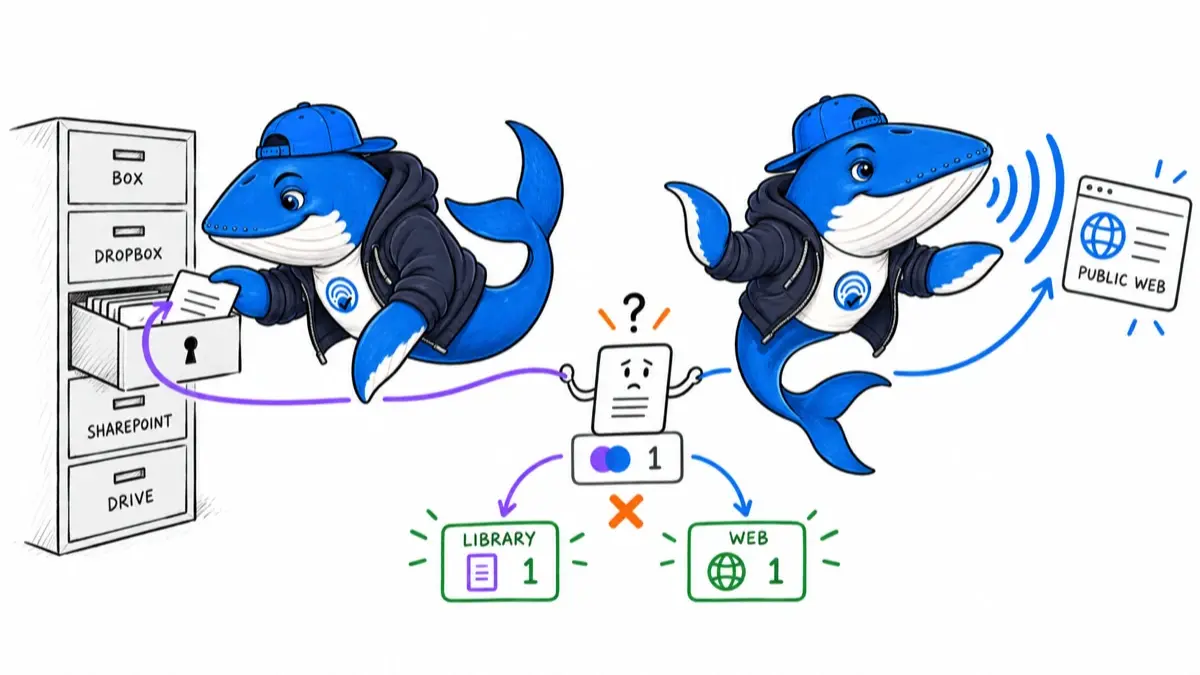
Direct answer: A ChatGPT Library citation can point back to Box, Dropbox, SharePoint or Google Drive. That proves the answer used a connected source available to the user. It does not prove the file ranked on the public web.
Publishers and enterprise teams should label Library citations separately from web citations, search referrals and public answer visibility.
What changed in ChatGPT Library
OpenAI’s September 10, 2026 release notes say Box, Dropbox and SharePoint joined Google Drive in ChatGPT Library. Users can browse and search available files and folders, add them to a conversation without uploading them again and follow citations back to the original source.
The integrations are rolling out on the web across listed ChatGPT plans in Chat and Work. Existing file permissions and workspace controls apply. Mobile support is scheduled to follow.
What a Library citation actually means
A Library citation is a provenance link inside an authorized retrieval path. It can help a user return to the file that supported an answer. Its meaning depends on the connected service, the user’s permissions, the selected file or folder and the workspace configuration.
It does not establish that Google indexed the file, that ChatGPT Search selected a public page, that the publisher earned an open-web citation or that anyone outside the workspace can reproduce the answer.
Sharing does not change the source layer
OpenAI’s September 10 release notes add a second distinction inside Library: a saved file can be shared with specific people or an entire workspace, with Viewer or Editor access. The person who first adds a file remains its owner, while collaborators can receive permissions to use or change it.
That improves collaboration, but it does not turn the file into a public web document. A citation can still resolve to a connected file that search crawlers cannot discover and an unauthenticated reader cannot open. Before labeling the citation as AI-search visibility, record the owner, connector, audience, permission level, and whether the cited object has a separate public canonical URL.
| State | What it proves | What it does not prove |
|---|---|---|
| Private Library file | The signed-in user can retrieve the saved source | Public discovery or indexing |
| Workspace Viewer | An authorized colleague can open the shared file | Access for people outside the workspace |
| Workspace Editor | An authorized collaborator can modify the file | A stable public version or canonical URL |
| Public web page | An unauthenticated visitor can request the URL | Ranking, citation, or referral traffic |
Practical check: open the cited target in a signed-out browser. If authentication is required, report it as connected-source or workspace visibility, not public web visibility.
Keep four outcomes separate
| Observed event | What it supports | What it does not support |
|---|---|---|
| Library citation | An authorized connected source supported the response | Public ranking or open-web discovery |
| Public web citation | A public URL appeared as response evidence | A visit, conversion or stable ranking |
| Search referral | A visit arrived with an observable referral or campaign signal | Every citation or every answer mention |
| Brand mention | The response named the brand | A citation, source use or click |
Why analytics can misclassify the result
A file citation may open inside a provider’s authenticated interface, not on the publisher’s website. Website analytics can therefore show no session even though a user followed the citation. The provider’s audit logs, ChatGPT workspace records and website analytics observe different parts of the journey.
Do not fill the gap with an estimated click count. Report the event each system can see. Our visibility reporting guide uses the same separation for mentions, citations, referrals and revenue.
A paired test for Library and public web
- Choose one public document that is also present in an approved connected repository.
- Record a fixed set of factual questions and expected supporting passages.
- Run the questions with Library access available, then in a permitted context without that connection.
- Record the cited destination, file version, source timestamp and whether the answer used the correct passage.
- Check the public site separately for crawl activity, citations and referrals.
- Do not claim a ranking effect from a change in the connected-source result.
This is a proposed test, not a result from SearchEngineAnswer. The downloadable sheet keeps the two environments comparable.
Actions for publishers and knowledge teams
- Use stable file names, owners and version dates so a citation resolves to understandable evidence.
- Keep source permissions narrow enough for the intended audience.
- Maintain a public canonical page when public discovery is a goal.
- Record whether a key answer should cite a private file, a public page or both.
- Check that a private citation does not expose a title or path that should remain confidential.
The ChatGPT Data agent reporting guide applies the same permission and metric-contract discipline to business analysis.
Download the two-surface test sheet
Download the CSV Library and public-web test. It records question, environment, source type, permission state, cited destination, public crawl evidence and referral evidence.
The sample rows are marked EXAMPLE-REMOVE. They illustrate the fields and are not observed ChatGPT results.
The practical decision
Use Library citations to audit connected-source provenance. Use public citations, crawler evidence and referral analytics to audit public-web visibility. Both can matter to the same organization, but they are not interchangeable metrics.
Evidence boundary
Feature behavior, rollout and permission scope come from OpenAI’s release notes retrieved on September 12, 2026. SearchEngineAnswer has not tested the rollout across every plan or mobile client.
Keep learning
Continue this topic
Next in this topic
GPT-6 Astra’s BrowseComp Score Is Not a Citation Quality Score
Earlier in this topic
ChatGPT Financial Services Creates a Second Citation Layer
AEO & AI Search
Ask a question or join the discussion