ChatGPT Financial Services Adds an Experian Credit Layer
ChatGPT can now combine authorized Experian credit data with hosted premium datasets, entitled connections, private files and the public web. Provenance determines what the answer means.
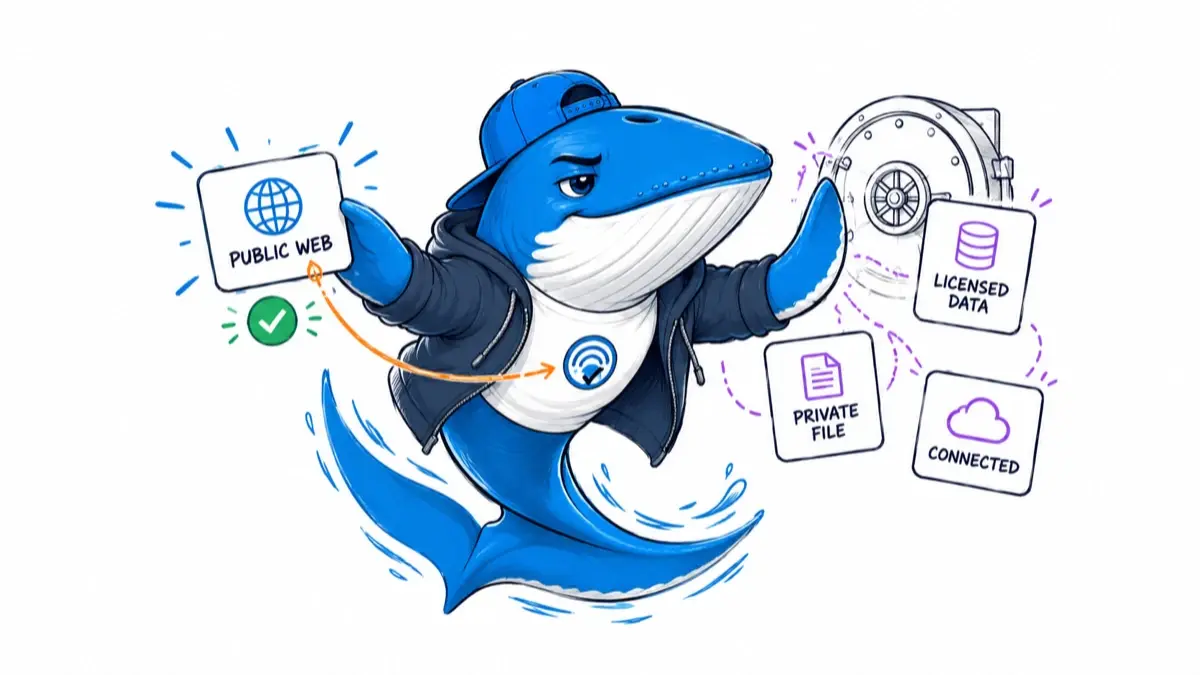
ChatGPT now has another financial-data path that public-web SEO does not control. Alongside hosted premium datasets, entitled provider connections, private files and public web pages, eligible US users can authorize an Experian connection that brings credit-report data and VantageScore 3.0 into ChatGPT.
That makes provenance the first question. Before counting a citation or answer as AI visibility, identify which evidence layer produced it, who authorized the access and whether another user can reproduce it.
Experian adds a consumer-authorized credit layer
OpenAI’s September 21, 2026 ChatGPT release notes describe an Experian integration for eligible Plus and Pro users in the United States on web, iOS and Android. Users can connect their Experian account, view VantageScore 3.0 and credit-report information, receive monthly updates and alerts, and ask ChatGPT questions about factors affecting their credit.
This connection is materially different from a public article about credit scores. The data is permissioned, person-specific and available only after the account holder authorizes access. A public publisher cannot reproduce that source state through rankings.
The institutional product has its own hosted data layer
OpenAI announced ChatGPT for Financial Services on September 10, 2026. It is available to eligible financial institutions and includes GPT-6 Astra, firm governance controls, financial workflows and data access.
OpenAI says datasets from Daloopa, PitchBook, LSEG News and Crunchbase are indexed and hosted on its infrastructure. The product can trace figures and claims to specific tables and passages. Those hosted sources are different again from the new consumer-authorized Experian connection.
Five source layers can sit behind a financial answer
| Layer | Access path | What it can establish | Visibility implication |
|---|---|---|---|
| Consumer-authorized credit data | Experian account connection | Person-specific score, report factors, updates and alerts | Private permissioned data, not public ranking |
| Built-in premium data | Hosted and indexed by OpenAI | A licensed dataset table or passage supported the answer | Public SEO cannot explain selection alone |
| Entitled provider data | Firm sign-in or connector | The user had authorized access to a provider source | Observation may not reproduce without entitlement |
| Private workspace content | Files, apps or internal repositories | The answer used material inside the organization | It is not public-web visibility |
| Public web | Search or open-web retrieval | A public URL was available to the product | Citation, crawl and referral still need separate checks |
Do not merge the Experian and Plaid connections in reporting
A Plaid connection can expose authorized bank or investment account data. Experian supplies credit-report information and a displayed VantageScore 3.0. They answer different questions, have different refresh behavior and require separate user permissions.
A financial assistant could combine a cash-flow question with connected bank data, discuss a credit factor from Experian, and cite a public explanation of how a scoring model works. Reporting that answer as one undifferentiated “ChatGPT source” removes the controls that matter.
Record the provider, data type, authorization state and update time for each claim. If the answer includes public sources, capture those URLs separately from the connected-data references.
The displayed score may not match a lender’s score
The integration surfaces VantageScore 3.0. A lender can use another scoring model, bureau configuration, data snapshot or underwriting process. The number shown in ChatGPT therefore should not be treated as a promise that a lender will see or use the same score.
This is an important content opportunity for financial publishers, but it needs precise wording. Explain model, bureau, timing and purpose instead of publishing a generic claim that one credit score is “the” score. A useful page should help a reader understand why two legitimate score displays can differ.
Audit the source before reporting visibility
- Open the source reference and record whether it is a public URL, hosted dataset, entitled provider, private file or consumer-authorized account.
- Record the account plan, country, device and connection required to reproduce it.
- For credit data, record the named scoring model and displayed update date.
- Separate a cited source from a referral visit. A citation does not prove the reader opened it.
- Separate a provider mention from a publisher-domain mention.
- When permitted, repeat the question without the connection and compare which claims disappear or change.
Timestamps and rights change what can be reused
OpenAI’s Financial Services Terms say data and output may be inaccurate, incomplete, delayed or out of date. They list a 15-minute delay for Nasdaq data and a 24-hour delay for Daloopa data. Experian’s monthly update and alert flow has a different cadence. A timestamp is part of the evidence, not a decorative field.
The terms also describe limits on copying, downloading, storage, model training, derived data and redistribution. A product export option does not automatically grant publication rights. Preserve source labels and check the applicable provider terms before republishing data.
Use four measurements instead of one visibility score
- Source selection: which evidence layer and provider supported each claim.
- Answer visibility: whether the brand, source or public domain appeared.
- Reproducibility: whether another account with the same authorized access receives a comparable answer.
- Reader action: whether the user opened a public citation, reviewed a connected record or completed a task.
Combining these into one “AI visibility” score hides the control point. The same answer can use a private credit report, mention a company, cite a public explainer and generate no referral.
The AI visibility reporting framework explains how to keep mentions, citations, referrals and outcomes separate.
Use the provenance matrix
Download the CSV provenance matrix. It records source layer, access requirement, citation destination, timestamp, reuse boundary and public-web implication.
Rows marked EXAMPLE-REMOVE show the field structure. Replace them with evidence from an environment you are authorized to inspect.
The practical decision
Do not treat every financial answer as a public-web ranking win or loss. First identify whether it came from consumer-authorized credit data, hosted premium data, an entitled connection, private content or the open web. Then choose the right lever: SEO, distribution, licensing, connector governance, privacy controls or internal knowledge management.
The Experian release expands the provenance map. It does not make public publishing irrelevant. It makes source classification necessary before a publisher decides what the answer means.
Keep learning
Continue this topic
Audit citations
Locate the failing answer layer
Compare evidence
Separate mentions, citations and visits
Measure referrals
Check AI search visits in GA4
AEO & AI Search
Ask a question or join the discussion