Google Community Perspectives: What 8 AI Mode Queries Showed
Five of eight AI Mode answers in one signed-in US-English desktop sample showed a distinct community section. See the titles, attribution gaps, destination checks, and limits.
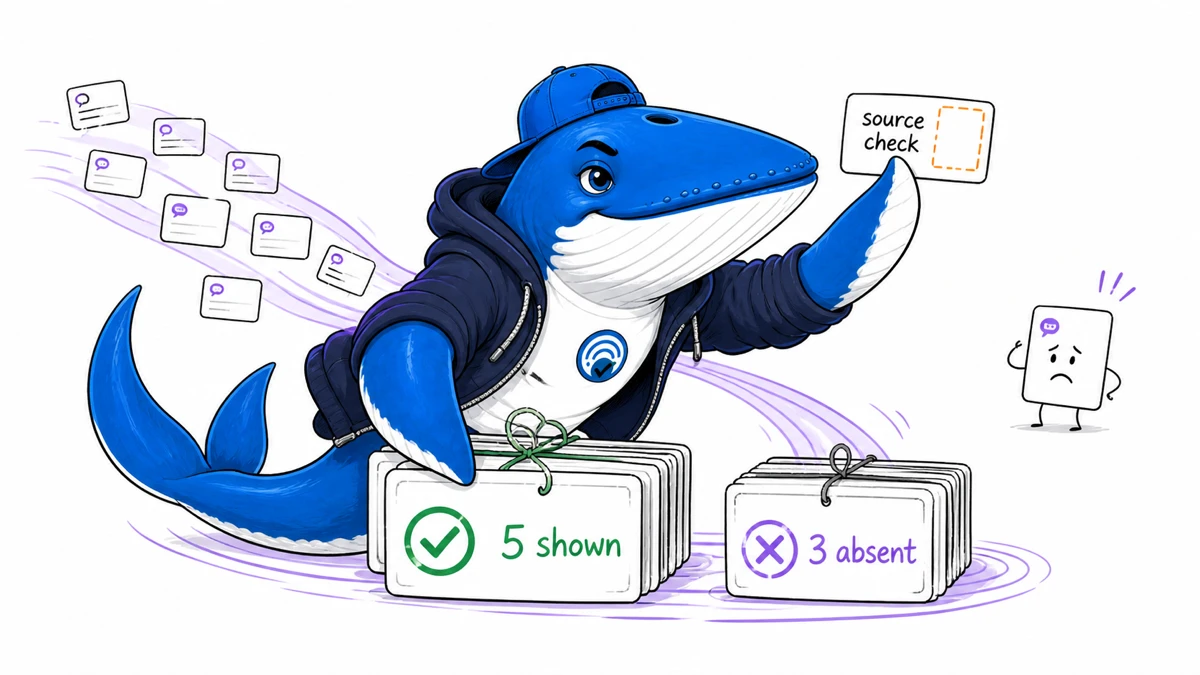
Observed August 31, 2026: five of eight Google AI Mode answers in one signed-in, US-English desktop sample displayed a separately titled community or first-hand section. The five sections used five different headings. Across them, we recorded at least nine visible entries and eight complete destination URLs.
This is a small interface observation, not a prevalence estimate or ranking study. It shows what one deliberately varied sample returned, how attribution differed between entries, and why publishers should verify the destination rather than treating a community label as complete source credit.
What Google announced
In May 2026, Google described new ways to explore the web with generative AI in Search. Its announcement said AI responses could include previews from public discussions, social media, and other first-hand sources, with context that may include a creator name, handle, or community. Google also warned that titles may vary, giving “Community Perspectives” as one example rather than a permanent interface label.
That wording creates testable interface questions. Does a distinct section appear? What title does it use? Which attribution fields are visible? Where does each item lead? It does not create a disclosed selection formula, a publisher optimization checklist, or a promise that every first-hand query receives the same treatment.
Google’s current AI features and your website documentation also says there is no special optimization or schema required for AI features beyond established Search fundamentals. This observation therefore audits presentation and attribution, not a new markup requirement.
Method and environment
We used Google’s consumer AI Mode on a 1280×720 desktop viewport. The stable observation routes used udm=50, hl=en, and gl=us. The account was signed in and personalization remained enabled. The explicit parameters establish a US-English route; the underlying network location was not independently verified.
The eight queries were fixed before coding the sample. They covered photography, home maintenance, painting technique, accessibility travel, product experience, a technical repair, rail travel for work, and a professional workflow. Each query received one primary run. We waited for the response to finish, then looked for a visibly separate section whose title referred to community, forums, first-hand experience, work tips, or real experiences.
| Field | Counting rule | Boundary |
|---|---|---|
| Section present | A distinct titled block appeared in the completed response | Related discussion links elsewhere did not qualify |
| Visible entry | A separate quoted or linked item was readable in the block | Unseen or lazy-loaded items were not inferred |
| Complete destination | The full stable destination URL was captured | A truncated path did not count as resolved |
| Attribution | Platform, community, creator, and date were recorded only when visible | Missing fields were not reconstructed from the destination |
We retained all three negative cases. We also preserved an unplanned rerun of the keyboard query as a stability note, but excluded it from the eight-query denominator because it was not part of the one-run design.
Results at a glance
Five of eight primary runs displayed a separately titled section, an in-sample rate of 62.5%. Three did not. The five positive cases contained at least nine visible entries; eight destinations were captured completely, while one keyboard-forum destination remained truncated.
| Query topic | Section? | Visible title | Entries | Complete URLs |
|---|---|---|---|---|
| Northern-lights camera settings | Yes | Community Insights | 2 | 2 |
| Weeds through gravel | No | ; | 0 | 0 |
| Watercolor washes | Yes | First-Hand Forum Perspectives | 2 | 2 |
| Colosseum wheelchair access | No | ; | 0 | 0 |
| Matte cabinet fingerprints | No | ; | 0 | 0 |
| Keyboard stabilizer rattle | Yes | Community Perspectives | At least 1 | 0 |
| Amtrak laptop seating | Yes | First-Hand Work Tips for the Regional | 2 | 2 |
| Freelance design feedback | Yes | Real Experiences from the Design Community | 2 | 2 |
| Total | 5 of 8 | 5 distinct titles | At least 9 | 8 |
The result is useful precisely because it is uneven. Adding words such as “forum,” “first hand,” “real experience,” or “what worked” did not guarantee a titled community block. This sample cannot identify the system’s trigger or distinguish query semantics from account, time, source availability, or response-generation effects.
Five positive runs used five different titles
The interface did not present one fixed “Community Perspectives” module. The observed headings were “Community Insights,” “First-Hand Forum Perspectives,” “Community Perspectives,” “First-Hand Work Tips for the Regional,” and “Real Experiences from the Design Community.”
This variation matters to anyone auditing screenshots, DOM text, or brand mentions. A monitor that searches for one exact heading will miss semantically similar blocks. Code the section by function and preserve the verbatim title as a separate field. Do not silently normalize the visible wording into Google’s announcement label.
The titles also framed the material differently. “Work Tips” implied task-specific advice, while “Real Experiences” foregrounded practitioner testimony. Those labels may influence how a reader interprets the same kind of linked discussion, but this test did not measure trust, clicks, or usefulness.
Visible attribution was inconsistent
Google’s announcement says context may include the creator’s name, handle, or community. In our sample, those fields were not consistently visible. The strongest entries showed the platform, a named subreddit, and a relative date. Others showed only a platform or domain, or a platform plus a date.
| Observed item | Visible context | Not visible in the section |
|---|---|---|
| Watercolor Reddit item 1 | Community name and date | |
| Watercolor Reddit item 2 | Reddit, r/Watercolor, relative date | Creator handle |
| Keyboard Reddit item | Reddit, r/keyboards, relative date | Creator handle; complete destination |
| Amtrak forum item | Amtrak Unlimited Discussion Forum | Creator and date |
| Amtrak video item | YouTube and creator name | Date |
| Design-feedback items | Reddit, subreddit, relative date | Creator handles |
That does not make the links inaccurate. It means the visible module and the destination page carry different amounts of provenance. A publisher audit should record both layers instead of crediting a creator or community that the interface itself did not display.
Destination checks separated linking from support
We sampled six captured destinations for an independent fetch check. Four Reddit pages were accessible and contained advice consistent with the visible AI Mode item: two watercolor discussions and two design-feedback discussions. A DPReview destination and the Amtrak discussion forum returned access blocks to the independent fetcher, so we could verify that AI Mode displayed those URLs but not the underlying passage in this audit.
| Destination | Fetch result | Support judgment |
|---|---|---|
| r/watercolor101 wash discussion | Accessible | Visible advice was supported |
| r/Watercolor even-wash discussion | Accessible | Visible advice was supported |
| r/webdesign feedback discussion | Accessible | Visible advice was supported |
| r/FigmaDesign feedback discussion | Accessible | Visible advice was supported |
| DPReview aurora-settings thread | Fetch blocked | Unresolved |
| Amtrak seating-advice thread | Fetch blocked | Unresolved |
“Unresolved” is not “false.” A fetch block can reflect bot controls rather than a missing or contradictory page. The conservative record is that the destination was displayed, the independent check could not inspect it, and no support judgment was made.
One unplanned rerun exposed instability
The primary run for the keyboard-stabilizer query showed a “Community Perspectives” section with at least one visible r/keyboards item. Later, during technical checking, the same query was run again in the same general session and no separately titled community section appeared.
That second run was not preregistered, so it is not merged into the 5-of-8 result. It is disclosed because it changes how the result should be interpreted: the panel may be unstable even within a short observation window. A screenshot is evidence of a rendered state, not proof that every rerun, account, or user receives it.
Future repetitions should use new rows with timestamps, account state, personalization state, viewport, response readiness, and exact title. Overwriting the first capture with the later one would destroy the most valuable part of the finding.
What publishers can;and cannot;infer
The sample supports three narrow observations. A distinct first-hand/community block can appear for varied practical queries. Its heading can change substantially. Its visible provenance can range from a bare platform label to a platform, named community, and date.
The sample does not reveal why an item was chosen, whether a page ranked conventionally, whether structured data affected inclusion, or whether a citation produced a visit. It measured no impressions, clicks, conversions, referrals, or persistent position. It also cannot show whether an omitted community source was inaccessible, untrusted, redundant, or simply unused in that response.
Publishers should keep the ordinary foundations Google documents: crawlable pages, index eligibility, accurate visible content, descriptive titles, useful images where relevant, and source context that a human can understand. Use the citation-ready passage test to make claims portable and the small SEO experiment method before attributing an interface change to one edit.
A repeatable attribution audit
- Freeze the environment. Record product surface, date, country and language parameters, viewport, account state, personalization state, and browser.
- Predefine query families. Mix how-to, experience, accessibility, product, local, professional, and ambiguous prompts. Preserve negative cases.
- Wait for response readiness. Code only the state actually rendered; do not infer panels hidden behind later interaction.
- Transcribe the title verbatim. Store a normalized section type in a different field if needed.
- Record each attribution field separately. Platform, domain, community, creator, date, quote, and URL should not be merged into one “source present” flag.
- Open the destination. Separate URL resolution, page accessibility, passage support, and creator attribution.
- Treat reruns as new evidence. Never overwrite an earlier positive or negative state.
For publisher-owned community content, add the canonical URL, index status, visible author, publication date, moderation state, license or reuse terms, and whether the linked passage is still present. That produces a defensible source-quality record rather than a screenshot collection.
Limitations
- Small purposive sample: eight queries cannot estimate how often community sections appear in AI Mode.
- One primary run per query: the design does not measure normal response-to-response variation.
- Signed-in and personalized: the test did not compare signed-out or personalization-disabled states.
- Parameter, not IP, verification: US and English were explicit in the route; network geolocation was not independently audited.
- Viewport and readiness dependence: visible counts belong to the captured desktop response state.
- Conservative keyboard count: only one entry and no complete destination were locked for that section, even if more content may have been available.
- Partial destination audit: six destinations were sampled; two could not be fetched independently.
- No selection or performance test: there was no controlled publisher change, ranking comparison, click measurement, or referral analysis.
- Interface instability: one excluded rerun did not reproduce a previously visible section.
Download the observation data
Download the eight-query observation CSV. It contains the fixed query set, environment, section-presence flag, verbatim title, visible-entry count, complete-destination count, attribution summary, stable observation route, and notes.
The public file excludes the signed-in account’s name and email, cookies, browser storage, request headers, authentication values, and transient session parameters. It preserves only the minimum route and environment fields needed to understand the observation.
Observed result
The community module was present in five of eight fixed queries, but attribution was uneven
That result is useful because it includes negative cases and destination checks. It does not establish a universal trigger for community content.
- Treat the module title as an interface observation, not a stable taxonomy.
- Separate a visible community label from a complete link to the underlying contribution.
- Repeat the same query set because one unplanned rerun already exposed instability.
My takeaway: My publisher takeaway is to make first-hand contributions attributable at the destination. The interface itself remains outside the publisher’s control.
Update and source note
Updated August 31, 2026: this page replaces a protocol-only draft with a completed eight-query observation, exact environment, retained negative cases, attribution coding, destination checks, a disclosed non-reproducing rerun, public row-level data, and limitations. Our evidence, correction, and material-update standards are documented in the editorial policy.
Keep learning
Continue this topic
Next in this topic
Google Subscription Labels: A Publisher Verification Method
Earlier in this topic
Google Generative-AI Search Control: Record Scope, Baseline and Rollback
AEO & AI Search
Ask a question or join the discussion