What Perplexity’s CobbleDB Reveals About AI Search Retrieval
Perplexity reports roughly 80% lower read latency after separating passage processing, publishing and hot retrieval. Here is what publishers can and cannot infer.
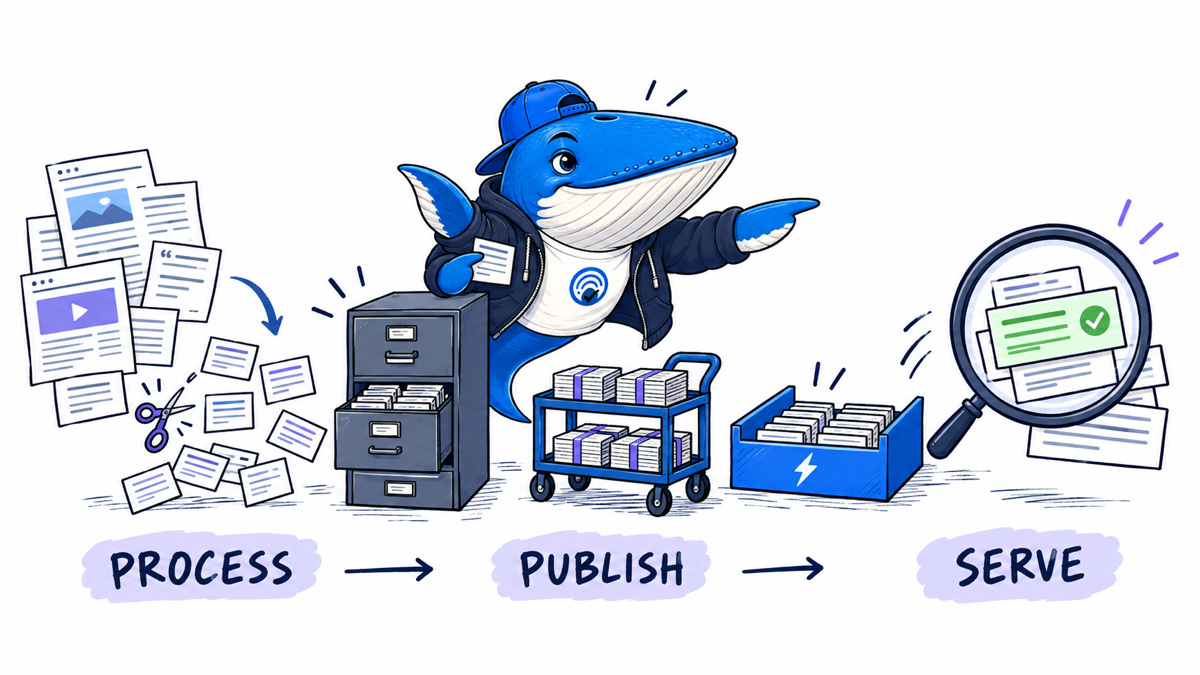
Direct answer: Perplexity’s CobbleDB post is valuable because it separates three jobs that publishers often blur together: turning pages into passage-level records, publishing updates safely, and serving those records fast enough for live retrieval. Perplexity reports roughly 80% lower median, p90 and p99 read latency after moving the hot path to CobbleDB, but that is a production before-and-after comparison, not an independent benchmark.
The useful publisher lesson is not that one database wins citations. It is that freshness, passage quality and retrieval speed are separate failure points. A page can be crawlable and current while the passages available to an answer system are stale, poorly segmented or slow to retrieve.
The page becomes passages before the query arrives
Perplexity describes an ingestion flow that cleans raw HTML, divides the useful text into semantic passages and computes embeddings for those passages. The passage and its embedding are stored together. By the time a person asks a question, the expensive page-cleaning and segmentation work has already happened.
This changes the mental model. Retrieval does not necessarily compare a query with a publisher’s full page as one indivisible unit. It can compare the query with smaller passage records derived from that page. A technically perfect title tag does not repair a passage whose subject, qualifier or supporting evidence becomes unclear when it is read on its own.
That is why the practical writing unit is often a self-contained claim block: a descriptive heading, a direct answer, the evidence that supports it and the conditions that limit it. Our guide to making content easier to cite in AI search applies this principle at the page level.
Three systems split state, publishing and serving
The architecture in Perplexity’s account has three named parts. Treating them as interchangeable would hide the most useful design choice.
- Pillar holds durable document state and coordinates publishing. It is the place where the system can reason about the current document and the update that should become visible.
- Lorry groups updates into batches. Perplexity says a typical batch contains 10 to 15 keys. Batching reduces the cost of sending many small changes individually and gives the publisher path a clear unit of work.
- CobbleDB serves the hot key-value path. It stores passage records and embeddings close to the retrieval workload. This is the component whose read latency Perplexity compares with its former DynamoDB path.
The separation creates a useful invariant: durable state can remain authoritative even when the fast serving layer is rebuilt or repopulated. A retrieval store can therefore be optimized for reads without becoming the only copy of the publishing truth.
The reported latency change is large, but observational
Perplexity published before-and-after latency figures for the old DynamoDB path and CobbleDB. Recalculating the relative reductions from the reported values produces the following comparison.
| Percentile | DynamoDB path | CobbleDB | Calculated reduction |
|---|---|---|---|
| Median | 31.4 ms | 5.60 ms | 82.2% |
| p90 | 56.7 ms | 9.77 ms | 82.8% |
| p99 | 123 ms | 24.2 ms | 80.3% |
Those numbers are operationally meaningful because tail latency can determine whether a retrieval step fits inside the total response budget. The p99 reduction is particularly important: the slowest one percent of reads moved from more than a tenth of a second to about 24 milliseconds in the reported comparison.
There is also a limit. Perplexity says the two datasets were collected at different times in production. The post does not claim a randomized same-request benchmark. Traffic mix, payload composition, cache state and surrounding system changes may differ. The correct description is a strong production observation, not a universal database ranking.
Scale and cost claims need their denominators
Perplexity reports average items of about 50 KB, production traffic near 200,000 requests per second and load tests reaching 500,000 requests per second without degradation. It also estimates that CobbleDB is at least 20% cheaper than DynamoDB for this workload.
These figures describe Perplexity’s workload and implementation. They do not establish that a smaller search product will save 20%, or that a general-purpose key-value workload will reproduce the same latency. The missing denominators include replica count, durability configuration, network topology, operational labor and the exact DynamoDB capacity model. Use the figures to understand why Perplexity made the trade, not as a purchasing calculator.
What this architecture changes for publishers
CobbleDB does not reveal a ranking factor and does not tell publishers how Perplexity scores a page. It does reveal four boundaries worth testing when visibility changes:
- Acquisition: could the system fetch the canonical page and its important assets?
- Transformation: did the meaningful claim survive HTML cleaning and passage segmentation?
- Publication: did the new passage state reach the serving layer, or is an older version still active?
- Retrieval: does the relevant passage appear for the query family before the answer model writes?
This boundary model prevents a common mistake: rewriting an article because an answer changed when the real problem may be stale ingestion or first-stage retrieval. The Q2D-Web benchmark analysis shows the related downstream constraint: an answer system cannot cite evidence its first retrieval stage never returns.
A five-check freshness test publishers can run
You cannot inspect CobbleDB directly, but you can build a small observation record around your own updates.
- Choose a page with a dated, unambiguous factual change.
- Save the old and new passage text, canonical URL, update time and response headers.
- Test a fixed set of questions that can distinguish the old fact from the new one.
- Record whether the platform retrieves or cites the page, which statement it uses and the observation time.
- Repeat on a schedule without editing the page again, so ingestion delay is not mixed with another content change.
The result is a platform-specific freshness observation. It is not proof that a single internal component caused the delay. For a broader measurement model, use the AI visibility metrics crosswalk to keep mentions, citations, referrals and business outcomes separate.
What the source does not establish
The engineering post does not say that CobbleDB selects final citations, that passage length is a publisher-controlled ranking lever or that faster storage gives a domain more visibility. It also says open sourcing is planned, not that the code is currently available for an independent reproduction.
The defensible conclusion is narrower and more useful: modern AI search can rely on a preprocessed passage store with a distinct publishing path and a performance-sensitive serving path. Publishers should diagnose those stages separately instead of treating every answer change as a content-quality verdict.
Primary source
Perplexity’s engineering article, CobbleDB: A High-Performance Key-Value Store for AI Search. Calculated percentage reductions use the latency values reported in that article.
Keep learning
Continue this topic
Next in this topic
Google Tests Publisher Payments for Contributions to AI Answers
Earlier in this topic
Search and AI Changes: September 14-30, 2026
AEO & AI Search
Ask a question or join the discussion