Four Search and AI Operations Changes Publishers Should Review
Review Google Ad Manager deal blocks, Claude for Salesforce, an observed AI Mode ad format and Cloudflare indexing for extensionless R2 objects.
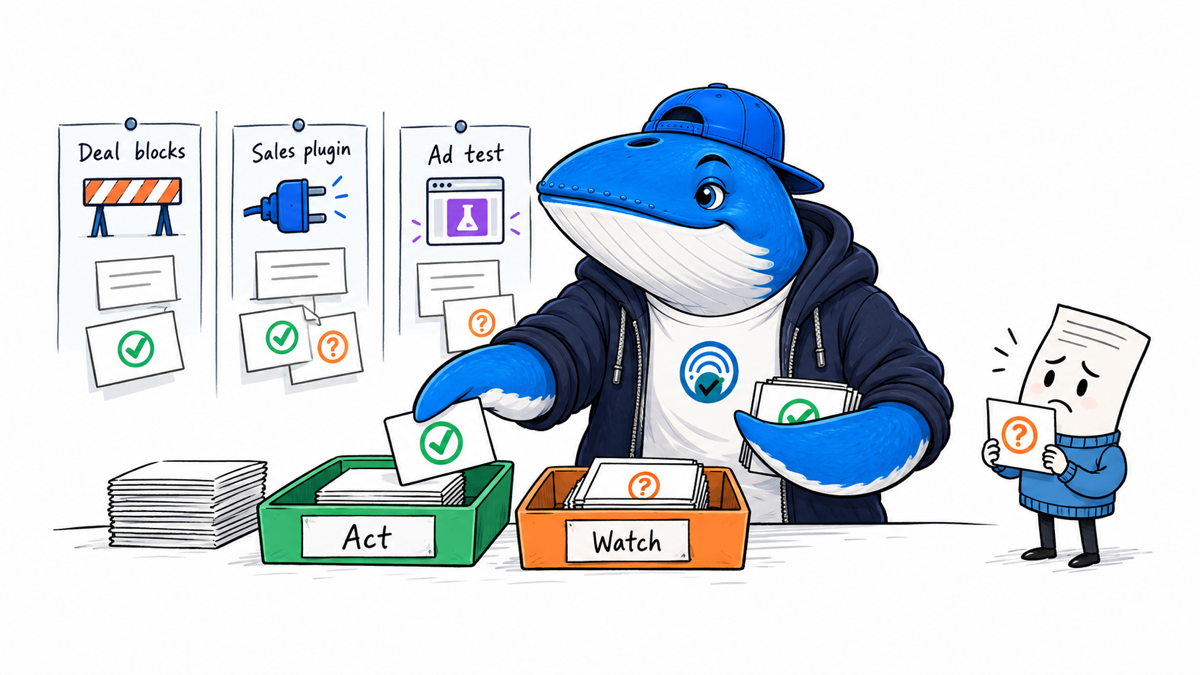
Four product changes this week can produce large operational mistakes if teams treat them as generic AI news. They cover Google Ad Manager private-auction blocks, a Salesforce connection inside Claude, an observed AI Mode ad test and Cloudflare indexing for extensionless R2 objects.
Act on the first two. Test the fourth. Watch the third. The private-auction block change has a documented effective date. Claude’s Salesforce beta has documented access and capabilities. The AI Mode text-link format has been observed, but Google has not published scope or performance guidance.
Google Ad Manager: audit intentional private-auction exceptions
Beginning September 17, publisher-level advertiser, brand and buyer blocks apply to Private Auction deals. Google says publishers who intentionally want a deal to bypass those blocks need to enable Override blocks by Deal ID.
This is not a general demand-policy rewrite. It changes the default interaction between existing publisher blocks and one deal type. The failure mode is silent underdelivery: a private auction can remain configured while blocked demand no longer qualifies.
- Export active and scheduled Private Auction deal IDs.
- List advertiser, brand and buyer blocks at the publisher level.
- Mark only the deals with a documented business reason to override those blocks.
- Record who approved each exception and when it expires.
- Compare eligible impressions, bid responses and revenue before and after September 17.
Google documents the change in the Ad Manager release notes. A broad override defeats the purpose of the policy layer, so exceptions should remain deal-specific.
Claude for Salesforce: test the workflow boundary, not the logo connection
Anthropic’s September 15 release notes describe a Claude for Salesforce beta for approved organizations on paid plans. The integration includes 37 pre-built sales skills and lets Claude work with Salesforce context.
The useful question is whether a specific workflow improves without exposing the wrong records or writing an unreviewed change back to the CRM. Start with one bounded task, such as preparing an account brief, comparing opportunity notes or drafting a follow-up from approved fields.
| Gate | Evidence to collect |
|---|---|
| Access scope | Objects, fields and record types visible to the integration. |
| Grounding | Whether every material claim maps to a current Salesforce record. |
| Write behavior | Which actions require human confirmation before a record changes. |
| Freshness | How quickly a source update becomes available to the workflow. |
| Auditability | User, source records, generated output and final action retained in logs. |
Availability and the 37-skill count come from Anthropic’s release notes. They do not establish accuracy, time saved or conversion impact for a particular sales team.
Google AI Mode text-link ads: observe before forecasting
Search Engine Roundtable documented an AI Mode result in which a sponsored text link appeared inside the answer experience. That makes the format worth monitoring. It does not establish a broad launch, stable eligibility or advertiser performance.
If the format appears in your account or market, capture the query, device, market, answer state, sponsor label, landing page and whether the ad appeared before or after an interaction. Keep the observation separate from ordinary Search text ads and from the ChatGPT advertising delivery audit.
Cloudflare AI Search now indexes extensionless R2 objects
Cloudflare’s September 11 AI Search changelog says objects in R2 can now be indexed without a file extension when the object carries a supported Content-Type metadata value. The change matters for document pipelines that use hashes, IDs or generated object keys instead of filename extensions.
Before changing a production corpus, test four objects: extension plus correct type, no extension plus correct type, no extension plus missing type, and no extension plus incorrect type. Record indexing state, extracted text, canonical source identifier and retrieval result. The release note establishes eligibility logic, not guaranteed extraction quality for every supported format.
The operational board
| Change | Status | Owner | Next proof |
|---|---|---|---|
| Private Auction block behavior | Act | Ad operations | Deal-level eligibility and delivery after September 17. |
| Claude for Salesforce beta | Act if approved | Revenue operations and security | One bounded workflow with source and action logs. |
| AI Mode text-link ad | Watch | Paid search | First-party account or market observation. |
The common discipline is to match evidence to action. A release note can justify an operational audit. A beta can justify a controlled test. A screenshot of a limited experiment can justify monitoring, but not a budget forecast.
Keep learning
Continue this topic
Next in this topic
ChatGPT for Word: A Five-Gate Editorial Workflow for Publishers
Earlier in this topic
OpenAI Plans to Retire Custom GPTs: Build the Migration Inventory
Tools & Workflows
Ask a question or join the discussion