
OpenAI’s Le Figaro deal brings journalism links to ChatGPT
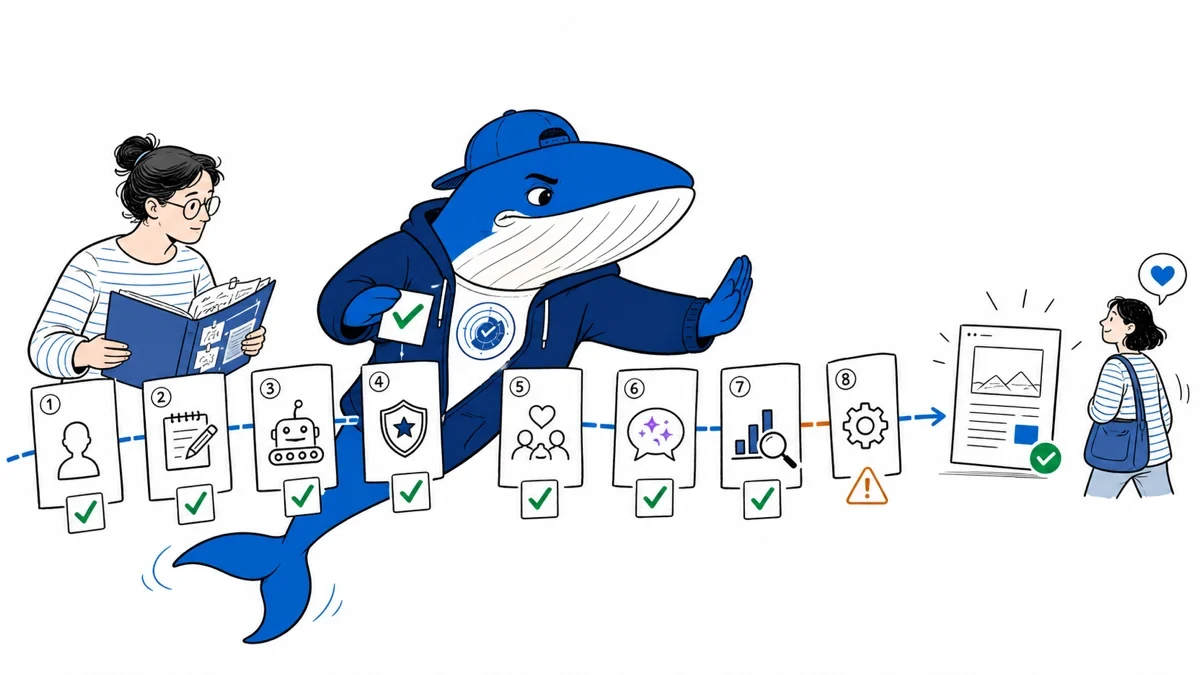
The agreement covers current and archive stories. A five-stage audit checks attribution, destinations, factual support, access and measurement.
Le Groupe Figaro and OpenAI announced a partnership on November 18, 2026, covering current reporting and archive journalism. OpenAI says ChatGPT will make that material discoverable through summaries and excerpts linked to the underlying stories. The agreement adds another documented publisher relationship to examine as readers use AI answers to find original reporting. OpenAI’s announcement
The announcement also describes plans to use ChatGPT Enterprise across teams while retaining editorial independence. It provides no measured increase in citations, visits, or subscriptions. A publisher evaluating the opportunity needs to follow the reader’s journey beyond a brand name in an answer.
Turn the agreement into observable questions
Begin with the experience promised to readers. Can a person identify the publication responsible for a claim? Does the source link point to the relevant article? Does the landing page allow the reader to understand what is available and how to continue?
You can check those questions without guessing the commercial terms. Build a record around particular stories and prompts. Keep the partnership date separate from the date you observed an answer, because an announcement alone doesn’t establish that every article is already appearing in every account or region.
For a fresh story, preserve the headline, publication time, canonical URL, and the important fact being cited. For an archive story, record its historical date and any visible correction or update. This gives the reviewer a reference when a generated answer mixes current reporting with older context.
Audit five stages of the reader handoff
First, inspect attribution. Record the visible publication name and whether the answer makes clear which statement the source supports. A publication can be mentioned in prose, linked as a source, or cited for a specific factual sentence. These are distinct observations worth preserving.
Next, inspect the destination. Open the source link and save the final URL after redirects. Check whether it reaches the story, a section page, or another destination. Review the canonical on the landing page when you control the publication and can investigate a mismatch.
Third, compare the answer with the article. Select a claim with a clear qualifier, such as a statement limited to a region or time period. Check that the summary retains the qualification. A link that reaches the right article still needs a factual relationship with the sentence it supports.
Fourth, inspect access. In an ordinary visitor session, record whether the page opens fully, shows an excerpt, asks for consent, or presents a subscription offer. A paywall can be intentional. The important record is what the reader can see and whether the next action is clear.
Finally, inspect measurement. If you operate the site, record what analytics or server logs can observe after the visit. Preserve the attribution rules used by the report, including how redirects and missing referrers are treated. An appearance in an answer and a recorded referral belong in different columns.
Use a sample that includes awkward cases
A useful proposed sample includes recent news, an archive explanation, a corrected article, a subscription story, and a page with regional limitations. These cases expose different ways a summary or link can lose context.
Write a factual prompt for each story without supplying its URL first. Then conduct a separate URL-supplied check if that is part of your workflow. Label the two conditions clearly. Supplying the destination in the prompt changes the discovery task, so combine their results only with an explanation.
Save the complete answer and the links visible before and after opening any source panel. If the publication does not appear, retain the result and record which sources did. This provides a useful comparison when you repeat the check after a rollout or product change.
The method is proposed here for future testing. This article does not claim newly observed Figaro citations or access to the publisher’s analytics.
Calculate the outcome at the right stage
Suppose a hypothetical sample contains 40 answers. Ten cite a publication, eight link to the intended story, and six preserve the important qualification. The observed citation rate is 25%, the correct-destination rate across the entire sample is 20%, and the fully supported handoff rate is 15%.
Each figure can also be expressed conditionally. Eight correct destinations out of ten citations is an 80% destination success rate among cited answers. State that denominator beside the percentage so a reader can tell what it measures.
A separate analytics report might show 12 visits from ChatGPT in the same period. Those visits cannot be divided by the 40 manually collected answers to infer a click-through rate. The observations and visits would need a reliable shared measurement boundary for that calculation.
What another publisher can learn
The Figaro announcement supports a concrete investigation into attribution and distribution. Other publishers can use the same audit on their own visible material, while documenting whether they have a partnership and which conditions were tested.
SearchEngineAnswer’s review of partner citations gives context for comparing appearances. The LVMH Media agreement coverage describes another recent arrangement, and the measurement crosswalk helps connect observations with referral evidence.
The practical deliverable is a record another editor can inspect. Keep the original story, generated claim, visible attribution, final destination, and reader access state together. That makes a discussion about AI distribution specific enough to support a repair or a further test.
Keep learning
Continue this topic
Audit citations
Locate the failing answer layer
Compare evidence
Separate mentions, citations and visits
Measure referrals
Check AI search visits in GA4
AEO & AI Search
Ask a question or join the discussion