Google UCP Is Not SEO: Prepare for Checkout in AI Mode and Gemini
Universal Commerce Protocol is an early-access checkout integration for eligible AI Mode and Gemini experiences—not a ranking shortcut.
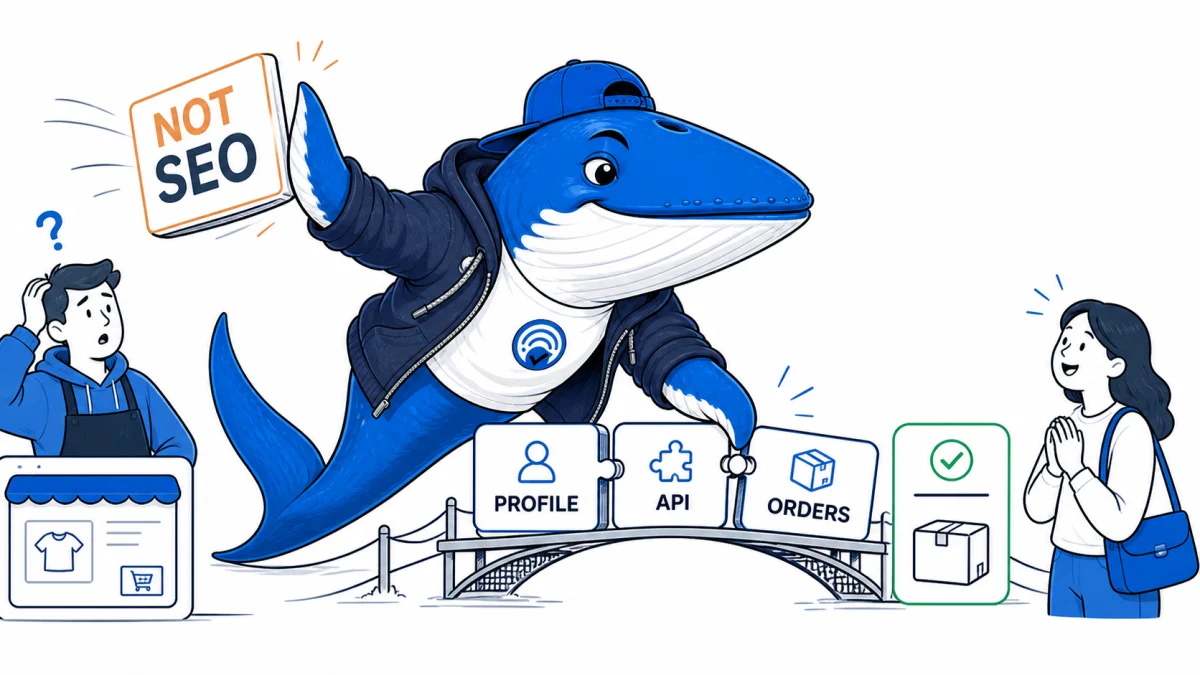
Direct answer: Google’s Universal Commerce Protocol (UCP) is a checkout integration for AI Mode and Gemini, not a new ranking signal or an SEO markup shortcut. A participating merchant remains the merchant of record and exposes capabilities, checkout endpoints and order updates so an eligible Google experience can complete a purchase.
UCP can change what happens after a product is selected. It does not replace Merchant Center eligibility, product data quality, ordinary Search requirements or the need to earn visibility.
Where UCP fits in the commerce path
| Layer | Main job | UCP role |
|---|---|---|
| Discovery | Make products eligible and understandable | Not the ranking mechanism |
| Selection | Help the user choose a product | Provides declared commerce capabilities |
| Checkout | Price, inventory, identity, payment and confirmation | Core UCP integration surface |
| Order lifecycle | Status, fulfillment, cancellation and support | Endpoints and webhooks keep systems aligned |
Google describes the current program as early access with a waitlist and approval. Preparation includes Merchant Center, Google Pay, a public UCP profile, three core REST endpoints, guest or account-linking behavior, and order webhooks. That is an engineering and operations project.
The public profile is a capability contract
A merchant publishes an unauthenticated profile at /.well-known/ucp. The profile declares protocol version, endpoints, supported capabilities, payment information and public keys. It tells a UCP client how to interact with the merchant; it is not a promotional landing page.
Operate it like an API contract:
- return a fast, cache-aware, valid response over HTTPS;
- publish only capabilities the production endpoints actually support;
- version changes and keep compatibility during rollout;
- monitor the well-known URL separately from the storefront;
- rotate keys without creating an outage window;
- do not expose secrets, private configuration or customer data.
The core endpoints must agree with the merchant’s source of truth for price, availability, tax, shipping and order state. A polished profile cannot compensate for a checkout service that accepts stale inventory.
Build an observable UCP funnel
Google documents two useful request identifiers. UCP traffic includes an UCP-Agent: Profile header and a user agent beginning with Google/UCP; health checks use Google-UCP-Prober/1.0. Log those signals so commerce requests can be separated from human sessions and generic bots.
Measure operational stages rather than one “AI sales” number:
- profile health check;
- checkout session created;
- price and availability confirmed;
- payment handoff attempted;
- order accepted by the merchant;
- webhook delivered and acknowledged;
- order fulfilled, cancelled or refunded.
Each stage needs a stable request or order identifier. Do not put personal data in analytics labels, and do not count a UCP checkout start as revenue. If you also track AI referrals, keep the operational UCP event stream separate from the browser referral stream in GA4.
Merchant readiness checklist
- Merchant Center and product data are healthy before protocol work begins.
- The business accepts merchant-of-record responsibilities.
- Guest checkout and account linking have explicit identity rules.
- Price, tax, shipping and inventory are revalidated at checkout.
- Order creation is idempotent and duplicate-safe.
- Webhooks are authenticated, replay-safe and observable.
- Customer support can locate a UCP-originated order.
- Rollback disables the capability without breaking the main storefront.
UCP belongs beside your AEO strategy, not inside it as a ranking tactic. Use SEO and product feeds to compete for visibility; use UCP to make an eligible transaction reliable.
Primary documentation
Limit: UCP is in early access. This guide separates the documented protocol from SEO inference; it does not claim availability, ranking benefit or transaction performance.
September 4 update: distinguish the offer from the checkout path
Before evaluating a checkout journey, verify which seller, variant, condition, and price the result actually represents. A used item and a new item can share a product model while remaining different offers. Our new AI Mode shopping offer-comparison analysis explains Productrise’s September study and adds a downloadable worksheet for recording equivalent offers, shipping, and unresolved matches. This does not change the checkout availability described above or establish a conversion effect.
September 16 rollout: cart transfer, checkout tests and named merchants
Google now says UCP cart transfer and checkout-flow testing is rolling out in the United States. Australia and Canada are planned for early 2027. Tapestry is using UCP to sell products in Search, including AI Mode, and Gemini. These details move the protocol beyond an abstract capability while keeping eligibility market- and merchant-specific.
For a production acceptance test, preserve the originating surface, cart line items, selected variant, price, currency, availability, shipping promise, tax state, consent, merchant handoff and final order identifier. A successful transfer is not a completed purchase, and an eligible merchant is not guaranteed placement.
Google also reports that lululemon’s conversational attributes appeared in 50% of relevant recommendations during its test. Because the announcement does not publish the denominator or experimental design, the number should not be treated as a universal UCP performance rate.
Keep learning
Continue this topic
Next in this topic
ChatGPT Product Feeds: Separate Discovery, Ads, and Checkout
Earlier in this topic
ChatGPT Conversion-Optimized Campaigns Still Charge Per Click
AEO & AI Search
Ask a question or join the discussion