Search and AI Changes: September 7–13, 2026
Thirteen documented search and AI changes from September 7–13, plus two community signals that still require controlled tests.
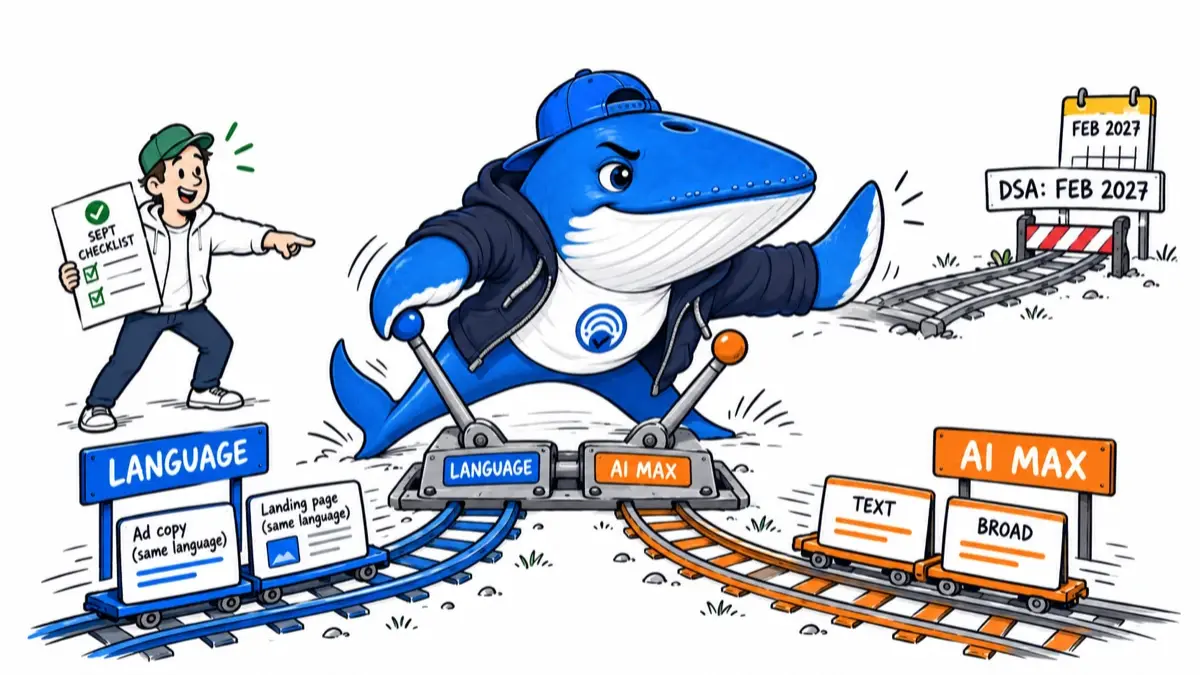
Direct answer: This briefing consolidates 13 documented search and AI changes into one decision-focused report. It preserves the facts, source links, checks and downloads without turning every announcement into a separate guide.
This week’s changes share one operational pattern: platforms are moving decisions into automated systems while exposing narrower reporting and control surfaces. The useful response is not to chase every announcement. Preserve the pre-change state, identify the decision that moved, and measure the downstream page, query or conversion outcome.
What changed this week
| Change | What it affects | Best next check |
|---|---|---|
| Two Google Ads Changes Alter Search Campaign Controls | Google is removing campaign-level language targeting from Search while moving some legacy automation settings into AI Max. Dynamic Search Ads follow a different 2027 schedule. | Search matching moves away from a campaign checkbox and toward query, ad and landing-page language. |
| ChatGPT Financial Services Creates a Second Citation Layer | ChatGPT for Financial Services can cite premium data hosted by OpenAI alongside connected, private and public sources. Publishers need to identify the source layer before calling it AI visibility. | The terms list source-specific delays and require users to review dates, calculations and partner conditions. |
| ChatGPT Shopping Can Use Memory to Select Products | ChatGPT shopping results can consider Memory and custom instructions, but product data, merchant conditions and fresh search still affect what appears. A four-cell test can separate those influences. | Budget-friendly and most-popular labels should be checked against price and review evidence. |
| ChatGPT Data Agent Makes Metric Definitions Part of SEO Reporting | OpenAI's Data agent can work across approved warehouses, files and BI tools while applying a team's metric definitions and access rules. That changes where SEO reporting errors can be caught. | The downloadable contract records source, freshness, calculation and review fields for each metric. |
| Some Sites Report Bing Visibility Falling to Zero | Several site owners reported sudden zeroes in Bing Webmaster data after August 31. No official incident was found, so diagnosis must separate five possible failure paths. | Use URL Inspection, live Bing results, server logs and analytics before changing site content. |
| Google Search Profiles Connect Publisher Content and Followers | Google Search profiles can gather a publisher's articles, videos and social posts and add a follow action. Initial eligibility and control remain limited. | The checklist audits names, URLs, authors, social accounts, logos and editorial ownership. |
| Google's August Spam Update Is Complete: Diagnose Before Editing | Google's August 2026 spam update ran globally from August 18 to August 21. A traffic change in that window is a clue, not a diagnosis. | The global update began August 18 and completed August 21, 2026. |
| Google Merchant Center's AI Report Exposes Shopping Terms and Intent | Merchant Center now groups organic AI shopping visibility by share of voice, products, terms, attributes and shopping stage. The labels need careful interpretation. | The worksheet connects each observation to a product action, owner and recheck date. |
| Google Developer Knowledge Adds Command-Line Answer and Document Checks | The beta gcloud surface can call AnswerQuery and inspect document chunks without building a separate client first. | Use returned references and relevance scores to debug a knowledge application, not to infer Google Search rankings. |
| Gemini Grounding Metadata Needs a URL-Presence Test | Developers report that some grounded structured responses can omit source URLs from grounding metadata. | Reproduce with fixed prompts and saved raw responses before changing citation parsing. |
| Gemini 3.8 Flash Reaches Google Search AI Mode | Google AI Pro and Ultra subscribers can access the model in AI Mode, the Gemini app, and Gemini in Sheets. | Record the selected model and subscription state before comparing answers or citations. |
| Google Ads Adds Data Strength and Meridian Measurement Controls | Google added data-pipeline, diagnostic, uplift, marketing-mix and geo-experiment features across separate products. | Map each reported uplift to its product, dataset, period and account-level control before using it as a forecast. |
| OpenAI Expands Journalism Education and Newsroom Programs | OpenAI is funding access, training, credits and newsroom programs across schools and publisher networks. | Evaluate one bounded newsroom task with a human review rule and an outcome measure. |
Originally reported 2026-09-12
Two Google Ads Changes Alter Search Campaign Controls
Why it matters: Google is removing campaign-level language targeting from Search while moving some legacy automation settings into AI Max. Dynamic Search Ads follow a different 2027 schedule.
Next check: Search matching moves away from a campaign checkbox and toward query, ad and landing-page language.
Direct answer: Two September 2026 Google Ads changes affect Search campaign control. Campaign-level language targeting is being removed for Search, and campaigns using text customization or campaign-level broad match can be moved into AI Max. Dynamic Search Ads have a later February 2027 transition.
The safe response is an account audit, not a blanket migration claim. Inventory which control changed, what still applies and how performance will be compared.
The two changes are separate
Google’s language targeting documentation says Search campaign language settings are being removed. Search ads will match using the language of the ad and landing page alongside signals about the user’s language.
Separately, Google says campaigns using text customization, formerly automatically created assets, or campaign-level broad match will begin upgrading to AI Max. These changes can reach the same campaign, but they alter different control layers.
What changes and what remains
| Control | September state | Audit focus |
|---|---|---|
| Search campaign language setting | Removed | Creative language, landing-page language and query mix |
| PMax language setting on Search | No longer applies | Separate Search behavior from other PMax channels |
| PMax language setting on YouTube, Display, Discover and Gmail | Still applies | Do not delete controls needed by non-Search inventory |
| Text customization | Eligible campaigns begin AI Max upgrade | Generated assets, final URL expansion and exclusions |
| Campaign-level broad match | Eligible campaigns begin AI Max upgrade | Search term matching and account notifications |
| Dynamic Search Ads | Transition delayed | Plan for February 2027, not September 2026 |
Language moves closer to the creative and query
Google says Search will prioritize ads that match the language of the search term and use signals about the languages a user understands. That makes the ad and landing page more important evidence than the former campaign checkbox.
For multilingual accounts, map every responsive search ad to a landing page in the same language. Then segment search terms by language and market. A translated ad that lands on a different-language page can create a poor user experience even if the system considers the user multilingual.
Performance Max keeps a split contract
The campaign language setting no longer controls ads shown on the Search Network portion of Performance Max. Google says the setting continues to apply to YouTube, Display, Discover and Gmail, while Shopping ads are not affected by language settings.
Do not evaluate the change only at total-campaign level. A Search shift can be hidden by stable video or display volume. Preserve channel-level observations where the reporting surface allows them.
The AI Max upgrade needs a settings snapshot
Google’s text customization help page says eligible campaigns using the setting will automatically upgrade to AI Max starting in September. Google also documents that turning off text customization can turn off final URL expansion when that feature is enabled.
Before the upgrade, export campaign settings, asset reports, exclusions, search terms, landing pages and conversion definitions. After the change, compare the new state with that snapshot. Our Microsoft AI Max defaults guide shows why imported automation settings deserve their own review.
Do not put Dynamic Search Ads on the wrong deadline
Google’s April announcement originally described a September DSA transition, but an update dated June 11 moved the DSA sunset and auto-upgrade to February 2027. Text customization and campaign-level broad match kept the September 2026 schedule.
A current migration plan should use the updated date. It should also preserve the existing DSA state so the later move can be checked rather than assumed.
Run this seven-step account audit
- List Search and Performance Max campaigns by market and creative language.
- Record current language settings even though Search will stop using them.
- Map ad language to landing-page language and canonical destination.
- Flag campaigns using text customization or campaign-level broad match.
- Save AI Max, URL expansion, brand, location and exclusion settings.
- Define comparison metrics by campaign, language and channel before the change.
- Review search terms, generated assets, landing pages and conversions after the upgrade.
Do not use conversion totals alone. Check spend, impression share, query-language mix, landing-page distribution, asset source and conversion quality.
Download the control audit
Download the Google Ads September controls CSV. It records pre-change state, affected control, expected behavior, post-change evidence, guardrail and rollback decision.
Rows marked EXAMPLE-REMOVE are examples, not account observations.
The practical decision
Treat language targeting and AI Max as two releases. Audit multilingual relevance at the creative and landing-page level, and audit automation at the campaign-settings level. Keep DSA on its updated February 2027 timeline. Use the same before-and-after discipline for the other systems in our Tools and Workflows library.
Originally reported 2026-09-12
ChatGPT Financial Services Creates a Second Citation Layer
Why it matters: ChatGPT for Financial Services can cite premium data hosted by OpenAI alongside connected, private and public sources. Publishers need to identify the source layer before calling it AI visibility.
Next check: The terms list source-specific delays and require users to review dates, calculations and partner conditions.
Direct answer: ChatGPT for Financial Services introduces a citation surface that public-web SEO does not control. Some answers can draw from premium datasets that OpenAI indexes and hosts, while others can use a firm’s entitled connections, private files or the public web.
That makes provenance the first question. Before counting a citation as AI visibility, identify which evidence layer produced it and who can open the cited source.
What OpenAI launched
OpenAI announced ChatGPT for Financial Services on September 10, 2026. It is available to eligible financial institutions and includes GPT-6 Astra, firm governance controls, financial workflows and data access.
The unusual part for publishers is the built-in data layer. OpenAI says datasets from Daloopa, PitchBook, LSEG News and Crunchbase are indexed and hosted on OpenAI infrastructure. The product can trace figures and claims to specific tables and passages.
Four source layers can sit behind one answer
| Layer | Access path | What a citation can establish | Publisher visibility implication |
|---|---|---|---|
| Built-in premium data | Hosted and indexed by OpenAI | The answer points to a licensed dataset table or passage | Public ranking alone cannot explain selection |
| Entitled provider data | Firm sign-in or connector | The user had authorized access to a provider source | Observation may not reproduce outside that entitlement |
| Private workspace content | Files, apps or internal repositories | The answer used material available inside the firm | It is not public-web visibility |
| Public web | Search or open-web retrieval | A public URL was available to the product | Citation, crawl and referral still need separate checks |
Why public-web SEO cannot explain every finance citation
A publisher can improve a public page’s clarity, crawlability, sourcing and entity identity. Those choices matter when the answer uses public-web retrieval. They do not place a page inside a licensed dataset that OpenAI already hosts.
This is a second visibility layer, not a replacement for SEO. Financial publishers need to separate open-web discovery from commercial data distribution, licensing, connector access and private-workspace use. Our ChatGPT SEO guide covers the public-web layer; the matrix here covers the provenance split.
Audit the source before reporting visibility
- Open the citation and record its destination type: public URL, provider page, table, passage or private file.
- Record the account plan, workspace and entitlement needed to reproduce it.
- Check whether the cited value has a timestamp or delay label.
- Separate a cited source from a referral visit. A citation does not prove the reader opened it.
- Separate a provider mention from a publisher domain mention. The data brand may be visible while the underlying page is not.
- Repeat the same prompt in an account without the entitlement when that comparison is permitted.
Source timestamps and rights change what can be reused
OpenAI’s Financial Services Terms say data and output may be inaccurate, incomplete, delayed or out of date. They list a 15-minute delay for Nasdaq data and a 24-hour delay for Daloopa data. A timestamp is part of the evidence, not a decorative field.
The terms also describe limits on copying, downloading, storage, model training, derived data and redistribution. A product export button does not automatically grant publication rights. Teams should preserve the source label and check the applicable partner terms before republishing a table or model output.
Use three different measurements
- Source selection: which evidence layer and provider supported the answer.
- Answer visibility: whether the brand, source or public domain appeared in the response.
- Reader action: whether a user opened a citation, visited a page or completed a task.
Combining these into one “AI visibility” score hides the control point. The same answer can cite premium data, mention a company and generate no public referral. The AI visibility reporting framework explains how to keep mentions, citations, referrals and outcomes separate.
Download the citation provenance matrix
Download the CSV provenance matrix. It records the source layer, access requirement, citation destination, timestamp, reuse boundary and public-web implication.
Rows marked EXAMPLE-REMOVE show how to use the fields. Replace them with evidence from your authorized environment.
The practical decision
Do not treat every financial citation as a public-web ranking win or loss. First identify whether the answer came from hosted premium data, an entitled connection, private content or the open web. Only then choose the right lever: SEO, distribution, licensing, connector governance or internal knowledge management.
Originally reported 2026-09-11
ChatGPT Shopping Can Use Memory to Select Products
Why it matters: ChatGPT shopping results can consider Memory and custom instructions, but product data, merchant conditions and fresh search still affect what appears. A four-cell test can separate those influences.
Next check: Budget-friendly and most-popular labels should be checked against price and review evidence.
Direct answer: ChatGPT shopping results can use Memory and custom instructions as context when selecting products. A preference saved before the shopping query may therefore change which products appear, their order or the explanation attached to them.
That does not mean Memory controls the result. The current query, structured product data, fresh web search, merchant availability, price and quality signals can also affect the output. A matched four-cell test is the cleanest way to isolate saved context.
What OpenAI documents
OpenAI’s updated shopping results guidance says product selection considers the query and context, which can include Memory and custom instructions. Structured product metadata from first-party and third-party providers may be used, and the model can form an initial response before performing fresh searches.
This creates several possible sources for a product result. A single screenshot cannot show which source or preference caused the selection.
Product selection and merchant ordering are separate
ChatGPT can select a product and then show merchants that sell it. OpenAI says merchant ranking can consider availability, price, quality and whether a seller is the maker or primary seller. The first price shown is not guaranteed to be the lowest available price.
Measure product inclusion separately from merchant inclusion. A product can remain first while the merchant changes, or the same merchant can appear for a different product variant.
Generated labels need verification
Labels such as “Budget-friendly” or “Most popular” are generated summaries, not verified guarantees. OpenAI also says it does not verify review and rating information. A useful audit therefore checks the underlying price range, review source, sample and timestamp before repeating a label as a fact.
For publishers and merchants, this is an information-quality task. Clear model identifiers, variants, current prices, stock status and review provenance reduce ambiguity even though they do not guarantee selection.
Use a four-cell personalization test
| Cell | Memory | Custom instructions | Question answered |
|---|---|---|---|
| A | Off | Off | What is the baseline? |
| B | On | Off | Does saved memory change the result? |
| C | Off | On | Do explicit account instructions change it? |
| D | On | On | Do the context sources combine? |
Keep the prompt, locale, device, account, time window and product constraints as stable as possible. Repeat each cell because shopping inventory and search results can change between runs.
A practical test fixture
- Choose a category with measurable constraints, such as a waterproof trail shoe under a fixed price.
- Create one neutral baseline account state.
- Add one relevant Memory, such as a recurring fit or material preference.
- Add one custom instruction that is related but not identical.
- Run all four states in alternating order.
- Record product, variant, seller, price, position, label and explanation.
- Repeat the panel on at least three observation dates.
Alternating order reduces the chance that one context state always receives the newest inventory snapshot.
Measure stability before calling it personalization
Calculate overlap of selected products across cells, first-position agreement, merchant agreement and explanation differences. A genuine context effect should appear repeatedly and align with the saved preference. One different product in one run may be ordinary result volatility.
Also record a negative-control preference unrelated to the category. If an irrelevant memory appears to change every result, the fixture may be too noisy to support a conclusion.
What merchants can improve now
- Keep product identifiers and variants consistent across feeds and pages.
- Expose current price, currency, availability and return information clearly.
- Describe decision-relevant attributes in plain language rather than only marketing copy.
- Show the source and date of review aggregates.
- Use accurate product structured data and validate the rendered page.
- Check whether key facts agree across the brand site, merchant feed and retailer pages.
These actions improve the evidence available to shoppers and systems. They are not a promise of inclusion or rank. The agentic commerce standards map explains how identity, product data, consent and trust fit around the transaction layer.
Download the shopping personalization test
Download the four-cell test CSV. It records Memory and instruction state, prompt, product, seller, price, label, position, explanation and repeat number.
Delete the EXAMPLE-REMOVE row before using the sheet. It demonstrates the fields and is not an observed shopping result.
A safe interpretation ladder
Observed: the product set changed between two saved-context states. Repeated: the change returned across matched runs. Aligned: the difference matched the stored preference. Attributed: competing changes in inventory, price and search results were checked.
Stop at the strongest level supported by the evidence. “The result changed” is often defensible. “Memory caused the change” requires more control.
Primary documentation
Originally reported 2026-09-11
ChatGPT Data Agent Makes Metric Definitions Part of SEO Reporting
Why it matters: OpenAI's Data agent can work across approved warehouses, files and BI tools while applying a team's metric definitions and access rules. That changes where SEO reporting errors can be caught.
Next check: The downloadable contract records source, freshness, calculation and review fields for each metric.
Direct answer: OpenAI’s Data agent can investigate approved warehouses, files and business-intelligence systems while using a company’s metric definitions and access rules. For SEO teams, its value is not a magic Search Console connection. It is a governed analysis layer over data the organization already controls.
The practical opportunity is faster investigation without losing the formula, grain, source date or permission boundary behind a number. The risk is a polished dashboard that hides a weak metric contract.
What OpenAI actually launched
OpenAI announced the Data agent in ChatGPT Work on September 10, 2026. The documented connections include Amazon Redshift, Google BigQuery, Databricks, Snowflake, MongoDB, ClickHouse, Datadog, Google Drive and SharePoint. It can also work with business-intelligence tools including Power BI, Tableau, ThoughtSpot, Sigma, Omni and Oracle BI.
Search Console is not on that published connector list. An SEO team would first need to place Search Console, analytics, crawl, revenue or log data in an approved source. That boundary matters because it separates a documented capability from an imagined direct integration.
Metric definitions move into the analysis layer
The notable feature is the use of company context: metric definitions, custom calculations, data relationships, semantic layers and existing dashboards. If a team defines an organic landing-page session differently from a finance conversion or a content-qualified visit, the agent can use those definitions rather than inventing a convenient formula.
A useful metric contract records six things: grain, formula, source object, timezone, exclusions and freshness. Without them, two correct queries can still produce incompatible numbers. The contract also makes it possible for a reviewer to challenge the computation before accepting the conclusion.
Permissions remain part of the answer
OpenAI says queries respect the connected system’s table, row and column permissions. That is important for teams combining query data with revenue, customer or sales records. A content strategist may be allowed to see aggregated conversions but not customer-level rows.
Access control is not the same as analytical correctness. A permitted query can still join tables at the wrong grain or compare incomplete periods. Keep permission owner and analytical reviewer as separate fields in the evidence receipt.
A useful SEO workflow starts with a decision
- Name the decision, such as which declining landing pages deserve investigation this week.
- Select the governed metrics and confirm their freshness.
- Ask for segmented evidence by query, page type, country, device and date.
- Require the output to show formulas, filters and source objects.
- Spot-check a small sample against the source system.
- Record the decision, owner and next review date.
This is stronger than asking for a generic monthly summary. It directs the agent toward an operational question and leaves a reproducible path back to the data.
Four investigations are better candidates than a vanity dashboard
| Question | Required sources | Critical control |
|---|---|---|
| Which page losses affected qualified demand? | Search Console, analytics, conversion data | Match page and date grain |
| Did a crawl change alter discovery? | Server logs, sitemap history, index status | Separate bot fetches from indexed URLs |
| Which updates produced durable gains? | Editorial ledger, queries, conversions | Preserve pre-change baseline |
| Where do reporting systems disagree? | Warehouse, BI dashboard, source exports | Compare formulas and timezones |
Each investigation has a falsifiable relationship. A page can lose clicks while qualified conversions remain stable. A sitemap update can precede a crawl without causing it. The agent should surface those distinctions, not compress them into one score.
The most expensive failures look reasonable
- Grain mismatch: joining query-level clicks to page-level revenue duplicates values.
- Partial periods: comparing a fresh three-day window with a complete prior week creates a false decline.
- Definition drift: a metric name stays the same after its filters change.
- Silent null handling: missing values become zeroes and imply a measured absence.
- Dashboard authority: a familiar chart is treated as proof even when its source is stale.
The remedy is not a longer prompt. It is an explicit contract and a short verification sample.
Start with one reporting lane
Choose a recurring report where the sources and owners are already known. A weekly page-opportunity brief is a practical first lane. Give the agent read access to the smallest necessary set, define its output fields, and require a source timestamp for every table.
Compare the first four runs with the current manual process. Track analyst time, correction count, unresolved discrepancies and decisions taken. Use our SEO client reporting guide to keep the output tied to decisions, and the small-experiment method when an investigation leads to a site change.
Download the SEO metric contract
Download the metric-contract CSV. It records the decision, grain, formula, source object, timezone, exclusions, freshness, permission owner and reviewer for each metric.
The row marked EXAMPLE-REMOVE demonstrates the structure. Replace it with definitions approved by your analytics and business owners before connecting an agent to production reporting.
The decision rule
Use the Data agent when faster cross-source investigation is worth the governance work and the underlying data already has owners. Do not use it to disguise undefined metrics, missing source data or a reporting process nobody is prepared to review.
The useful output is not the dashboard itself. It is a decision supported by a traceable definition, current evidence and a named reviewer.
Primary documentation
Originally reported 2026-09-10
Some Sites Report Bing Visibility Falling to Zero
Why it matters: Several site owners reported sudden zeroes in Bing Webmaster data after August 31. No official incident was found, so diagnosis must separate five possible failure paths.
Next check: Use URL Inspection, live Bing results, server logs and analytics before changing site content.
Direct answer: Several site owners reported Bing Webmaster visibility falling to zero after August 31, 2026. We found no official Bing incident confirmation that establishes a platform-wide outage. A zero in one interface should trigger a five-path diagnosis: reporting, indexing, serving, tracking and demand.
Do not rewrite or remove content until independent evidence shows which layer changed.
What the community reports show
A thread in r/bing and a related r/SEO discussion include site owners describing a similar sudden zero. Replies are mixed, and the posts do not provide a controlled, representative sample.
Community clustering is a useful lead. It can locate a possible start date and reveal which checks practitioners have tried. It does not prove scope, cause or platform responsibility.
The same zero can come from five paths
| Path | Independent evidence | First action |
|---|---|---|
| Reporting | Later export, API or unaffected property. | Preserve the chart and wait for refresh. |
| Indexing | URL Inspection and representative index checks. | Inspect templates, not random URLs. |
| Serving | Clean-browser queries and exact URL searches. | Compare country and device. |
| Tracking | Server logs and analytics configuration. | Check code and consent changes. |
| Demand | Query impressions and seasonal history. | Compare matched periods. |
First test whether only the report changed
Save screenshots, filters, date range and property. Check whether crawl, URL Inspection and sitemap areas still update. Compare another verified property if you have one, but do not share private account details publicly.
A reporting delay can display zero while pages remain indexed and served. If independent Bing results and server logs are stable, content changes are unlikely to fix the chart.
Inspect a stratified URL sample
Choose a homepage, category, recent article, older article, high-traffic page and known low-traffic page. Record inspection state, last crawl, canonical and sitemap membership. A six-page sample does not describe the whole site, but it can distinguish one broken template from a sitewide pattern.
If pages are excluded, correct the demonstrated access or canonical problem. Do not resubmit hundreds of unchanged URLs as a substitute for diagnosis.
Compare serving with crawler and referral evidence
Check whether representative pages appear for exact title or URL searches in a clean browser. Review server logs for verified Bing crawler requests and analytics for Bing referrals. Our Bing operations guide covers the distinction between API, IndexNow and performance data. The crawler log verification guide explains how to authenticate crawler evidence.
Logs must be verified carefully. A user-agent string alone does not prove a request came from Bing.
Avoid three destructive reactions
- Do not remove useful pages because a dashboard displays zero.
- Do not change robots, canonicals and sitemaps simultaneously.
- Do not call the pattern a penalty without an official message or page-level evidence.
Preserve a stable baseline so a later recovery can be attributed to the correct layer.
When to escalate
Escalate to Bing support or public status channels when several independent signals fail together, representative URLs show unexpected exclusion, or the reporting gap persists beyond normal data latency. Include property type, timestamps, country, affected report and a small set of example URLs.
Remove private verification tokens, account identifiers and raw logs before sharing evidence in a public forum.
Download the five-path diagnostic ledger
Download the CSV diagnostic ledger. It records time, path, expected and observed signal, evidence, interpretation, next action and recheck time.
All starter rows are marked EXAMPLE-REMOVE. They are not observations from a real site.
Evidence note
This is a dated community-led investigation, not an outage declaration. We reviewed the cited Reddit discussions and looked for official confirmation. The five-path model is designed to remain useful whether the cause is delayed reporting, property-specific indexing, serving behavior, tracking or demand.
Originally reported 2026-09-10
Google Search Profiles Connect Publisher Content and Followers
Why it matters: Google Search profiles can gather a publisher's articles, videos and social posts and add a follow action. Initial eligibility and control remain limited.
Next check: The checklist audits names, URLs, authors, social accounts, logos and editorial ownership.
Direct answer: Google Search profiles are publisher and creator surfaces that can gather recent articles, videos and social posts and let people follow the source. They may strengthen discovery and identity continuity, but publishers cannot assume eligibility, force creation or treat the profile as a ranking shortcut.
The controllable work is public identity consistency: one canonical organization name, clear authorship, linked official accounts and content that is recognizably owned by the same publisher.
What Google announced
Google introduced Search profiles for publishers and creators on June 4, 2026. Google said profiles can show work from multiple sources and be reached through a knowledge panel, a publisher name in Discover or a direct URL.
Google’s current documentation says the feature is limited to eligible people and organizations in the United States. A profile owner must be at least 18 and have at least 10,000 followers on YouTube, Instagram, X or TikTok. Google can connect up to 10 identities to one profile, and the public address follows https://profile.google.com/@handle.
Those are eligibility conditions, not ranking requirements. Google explicitly says creating a Search profile does not directly affect Search ranking.
The current badge and pairing rules
Google now documents a Search Profile badge or text link for bylines, biographies and newsletters. The public URL follows https://profile.google.com/@handle. On the web, the badge target should be at least 44 by 44 CSS pixels and have a clear accessible label.
A Search Profile follow action and a Preferred Sources preference are separate. If they appear together, Google recommends the higher-emphasis Search Profile control and says not to use the multicolor Super G for that paired Search Profile button. See the standalone Search Profile publisher guide and Preferred Sources implementation guide.
Four related Google surfaces are different
| Surface | Main role | Publisher control |
|---|---|---|
| Search profile | Collect work and enable following. | Eligibility and generation are controlled by Google. |
| Knowledge panel | Summarize an entity in Search. | Facts may be claimable or suggestible, but appearance is not guaranteed. |
| Preferred Sources | Let a user favor a domain for Top Stories and supported AI experiences. | Publisher can share its preference link. |
| ProfilePage structured data | Describe a first-person profile page. | Publisher controls valid markup on an eligible page. |
Build a verifiable identity graph
Use the same public name and logo across the website and official accounts. Give each author a stable page with role, expertise, recent work and contact or editorial path where appropriate. Link official accounts from the publication, and link back to the canonical site when the platform permits it.
Consistency does not mean stuffing every page with identical biographies. It means a reviewer can follow the relationships without guessing who owns the work.
Make content ownership clear
- Use visible bylines that link to real author pages.
- Separate publication and modification dates.
- Show the publisher name in article metadata and structured data.
- Keep canonical URLs stable when syndicating summaries elsewhere.
- Label sponsored or supplied material near the content.
- Maintain correction and editorial policy pages.
SearchEngineAnswer uses a dedicated author profile and editorial policy for these jobs.
Structured data supports clarity, not entitlement
Organization, Person, ProfilePage and Article markup can describe relationships already visible on the page. The markup should use the same names, URLs and images a reader sees. It cannot guarantee a Search profile or knowledge panel.
Validate syntax, then inspect whether the represented facts remain accurate. A technically valid graph with outdated social URLs is still weak identity evidence.
A monthly publisher identity audit
- List the canonical publication and author names.
- Check website, author pages and major profiles for exact or explainable matches.
- Confirm official accounts are linked from a controlled property.
- Inspect article bylines, publisher markup and canonical URLs.
- Remove abandoned or impersonating accounts from official references.
- Record Search profile, knowledge panel and Preferred Sources observations separately.
- Recheck after a rebrand, domain migration or author change.
Measure the feature without promising a ranking lift
Track whether the profile appears, which content is included, follower changes and referral or Discover patterns where available. Do not attribute a ranking change to the profile from timing alone. Profile access, content publishing and search demand can move together.
The useful question is whether users can recognize and follow the publisher across surfaces. That value can exist without a measurable organic ranking effect.
Download the identity consistency checklist
Download the CSV identity checklist. It records each surface, field, canonical value, match, public evidence, owner and action.
The starter rows are marked EXAMPLE-REMOVE. Replace them with your publication and author records.
Evidence note
Feature behavior, current eligibility, badge use and the ranking caveat come from Google’s Search Profile documentation and help page. The comparison table and audit are SearchEngineAnswer’s framework. Availability and appearance can change, so verify the current Google surface for the specific publisher.
Originally reported 2026-09-10
Google's August Spam Update Is Complete: Diagnose Before Editing
Why it matters: Google's August 2026 spam update ran globally from August 18 to August 21. A traffic change in that window is a clue, not a diagnosis.
Next check: The global update began August 18 and completed August 21, 2026.
Direct answer: Google confirmed a global spam update that began August 18, 2026 at 9:27 a.m. Pacific and completed August 21 at 1:49 a.m. Pacific. If visibility changed in that window, investigate the overlap, but do not assume the update caused it.
A useful diagnosis separates the date match from the shape of the loss, independent technical evidence and the site’s own recent changes.
The confirmed facts are narrow
Google’s Search Status Dashboard incident states that the update applied globally and to all languages. Google did not publish a list of affected tactics, a winner-and-loser table or a guaranteed recovery timetable.
Those absences are not an invitation to infer causes from one site’s chart. Keep the official facts separate from industry observations and your own hypotheses.
Start with the shape of the change
- Sitewide or limited to one directory?
- Impressions, clicks, position, conversion or all four?
- One country, device or search appearance?
- Brand, nonbrand, informational or commercial queries?
- A step change, gradual slide or normal weekly pattern?
A sitewide tracking failure and a query-cluster ranking loss can begin on the same date but require entirely different actions.
Run independent checks before editing content
| Hypothesis | Independent check |
|---|---|
| Tracking broke | Server logs, another analytics source and conversion events. |
| Pages left the index | URL Inspection, sitemap state and representative exact-URL checks. |
| Demand changed | Query impressions, seasonality and comparable prior periods. |
| Technical release failed | Deploy log, status codes, canonicals, robots and rendered HTML. |
| Ranking systems reassessed pages | Segmented position and competitor changes after other causes are checked. |
Review spam risk at the system level
Do not rewrite a few paragraphs while leaving the production system unchanged. Inspect scaled page creation, copied or minimally transformed material, doorway patterns, hacked content, expired-domain misuse, deceptive functionality, link practices and whether pages exist primarily to capture search visits without a distinct reader outcome.
Our AI-generated tool launch gate covers the difference between repeatable utility and scaled templates. The spam-policy guide covers policy language and evidence.
Make fewer, better-observed interventions
Prioritize changes that are justified even without the update: remove deceptive pages, consolidate true duplication, restore broken access, disclose ownership and add original evidence. Record each intervention and allow an observation window appropriate to crawling, indexing and demand.
A mass rewrite can erase the baseline. It may also replace useful pages because a date coincidence felt urgent.
Recovery is not one event
Technical repair can be visible after recrawl. Indexing can recover on a different schedule. Ranking changes may depend on systems that refresh continuously or during later updates. Demand and click behavior can mask either direction.
Define recovery by the affected segment and metric. “Traffic is back” is too vague to audit.
Download the change-point worksheet
Download the CSV diagnostic worksheet. It separates confirmed facts, hypotheses, checks, interventions and observation windows.
Every starter row is marked EXAMPLE-REMOVE. Replace it with your own dated evidence before drawing a conclusion.
Evidence note
The dates, scope and completion state come from Google’s Search Status Dashboard. The diagnostic model is SearchEngineAnswer’s contribution. It cannot identify the cause of an individual site’s change without site-specific Search Console, analytics, log and release evidence.
Originally reported 2026-09-10
Google Merchant Center's AI Report Exposes Shopping Terms and Intent
Why it matters: Merchant Center now groups organic AI shopping visibility by share of voice, products, terms, attributes and shopping stage. The labels need careful interpretation.
Next check: The worksheet connects each observation to a product action, owner and recheck date.
Direct answer: Google Merchant Center’s AI performance view can show how a merchant appears in organic AI shopping experiences through share of voice, visible products, terms, product attributes and shopping stages. It is a directional merchandising report, not a complete sales attribution system.
The highest-value use is to connect a visible demand pattern to a catalog or landing-page decision, then recheck it after the reporting lag. Screenshots without filters and dates are weak evidence.
What Google documents
Google’s Merchant Center help page describes organic traffic insights for AI Mode and AI Overviews. The interface can compare a merchant’s share of voice with a competitor average, show how often products appear and surface terms, attributes and intents associated with AI shopping activity.
Availability is limited by market, language, category and data sufficiency. Record the country, selected category and date range with every observation.
Read each metric as a different denominator
| Metric | Useful question | Do not infer |
|---|---|---|
| Own share of voice | How often did my products appear in the selected view? | Total market share or revenue. |
| Competitor average | How did a defined comparison set appear? | A complete list of rivals. |
| Frequency | How often was a term or intent observed? | Exact query volume. |
| Products showing | How many products appeared? | Clicks, orders or product quality. |
Zero, dash and 100% require different treatment
Google’s help text distinguishes unavailable or insufficient data from exact product counts. A dash indicates no impression data. A zero share-of-voice value can reflect insufficient impressions, while zero products is an exact count in that view. A 100% share can occur when no competitors are defined, so it does not automatically mean dominance.
Preserve the UI state in your worksheet. Do not turn a blank, dash and numeric zero into the same database value.
Shopping stages turn terms into tasks
The report groups activity into discovery, evaluation and ready-to-buy stages. Use those labels to ask different content questions. Discovery may expose missing category education. Evaluation may reveal attributes buyers compare. Ready-to-buy may expose availability, delivery, price or compatibility requirements.
A stage is a modelled classification, not a transcript of an individual’s intent. Validate it against the actual page, product feed and customer support language.
Connect an observation to one controlled change
- High term frequency, low product coverage: inspect feed eligibility and category mapping.
- Strong discovery visibility, weak evaluation: improve comparable attributes and evidence.
- Products show but landing pages mismatch the offer: reconcile price, availability and canonical URL.
- Own and competitor averages both rise: avoid calling it a competitive win without the denominator.
- No data: widen the date range or wait for sufficient activity before editing.
Change one important layer at a time. A simultaneous feed rewrite, page redesign and promotion leaves no interpretable result.
A practical weekly workflow
- Select one country and one product category.
- Save the date range and report update time.
- Capture share, competitor average, frequency and product count.
- Record the top term, intent or attribute behind the decision.
- Open the affected products and verify feed-to-page consistency.
- Assign one change, an owner and a recheck date.
- Compare matched filters after the documented reporting lag.
For broader measurement, pair this with our AI search analytics framework and product-data guidance.
What the report cannot settle
The view does not prove why a product was selected, whether a user noticed it, or whether an AI appearance caused a purchase. Google also controls the competitor set, and the interface does not provide an all-category comparison. Daily updates can arrive several days late.
Treat the report as a hypothesis generator. Revenue attribution still needs analytics, clean campaign logic where available, order evidence and a realistic observation window.
Download the Merchant Center AI worksheet
Download the CSV worksheet. It preserves filters, shopping stage, UI state, metric values, decision, owner and recheck date.
All sample rows are marked EXAMPLE-REMOVE. Replace them with dated observations from your own account.
Evidence note
This guide uses Google’s current Merchant Center help documentation and translates its labels into a decision workflow. We did not access a merchant’s private report or claim that the feature is available in every market, language or account.
Reported 2026-09-12
Google Developer Knowledge Adds Command-Line Answer and Document Checks
Why it matters: Google added beta gcloud commands for answering queries, describing documents, and searching document chunks. Teams can inspect a knowledge application from the command line before writing more integration code.
Next check: Save the returned references, citations, relevance scores, filters, and corpus version with every test.
Direct answer: The September 9 Developer Knowledge release adds answer-query, documents describe, and documents search-chunks to the beta gcloud interface. The commands expose application retrieval and answer behavior. They are not a Google Search ranking or indexing report.
Use each command for a different failure layer
| Command | Question it helps answer | Evidence to retain |
|---|---|---|
answer-query |
What answer and references were returned? | Query, answer, citations, model settings, time |
documents describe |
Was the expected document ingested with the expected metadata? | Document ID, state, metadata, corpus |
documents search-chunks |
Which chunks matched and how strongly? | Chunk IDs, relevance scores, filters, returned text |
Keep application retrieval separate from web search
AnswerQuery can return references and citations, and document search can return relevance scores. Those signals describe the configured Developer Knowledge corpus. They do not reveal whether a public URL is crawled, indexed, ranked, shown in an AI Overview, or cited by Gemini on the open web.
Primary source: Google Developer Knowledge release notes, September 9, 2026.
Test lead added 2026-09-12
Gemini Grounding Metadata Needs a URL-Presence Test
Why it matters: Developers in Google’s forum report that some grounded structured responses can omit groundingChunks or source URLs. A parser that assumes every grounded answer contains a clickable source can silently lose provenance.
Next check: Treat this as a reproducible test lead, not a confirmed platform-wide change.
Record four states instead of one grounded flag
- Grounding metadata present and URL present.
- Grounding metadata present but URL absent.
- Grounding metadata absent.
- Request failed or was blocked.
Run the same prompt set with and without structured output. Save the model name, API version, tool configuration, raw response, timestamp, and region. Do not repair a missing URL by guessing the source from answer text.
Current evidence status
The evidence is a community report on Google’s developer forum. SearchEngineAnswer has not reproduced the behavior in a controlled API test, and Google has not documented a general removal of grounding URLs. The report is useful enough to justify a regression test, not a standalone news claim.
Community lead: Google AI Developers Forum discussion.
Added 2026-09-13
Gemini 3.8 Flash Reaches Google Search AI Mode
Why it matters: Google says Gemini 3.8 Flash is available to Google AI Pro and Ultra subscribers in Search AI Mode, the Gemini app, and Gemini in Google Sheets.
Next check: Save the model selector, subscription tier, query, answer, and sources before comparing the new model with an earlier result.
The September 2 Google announcement describes product availability. It does not announce an AI Mode ranking change, a citation-system update, or a traffic effect for publishers.
For measurement, use matched prompts and record whether the model is explicitly selected or automatically routed. A different answer after the release can reflect model choice, account state, search freshness, location, or normal response variation.
Added 2026-09-14
Google Ads Adds Data Strength and Meridian Measurement Controls
Why it matters: Google announced first-party data integrations, diagnostics, an uplift metric, Meridian changes, and global GeoX availability. These features observe different layers and should not be collapsed into one performance score.
Next check: Record the product, input data, comparison, period, and decision owner before using a reported uplift to change spend.
The measurement controls sit in different systems
| Change | Evidence layer | Decision boundary |
|---|---|---|
| Data Manager in Google Analytics and DV360 | First-party data connection and activation | A connected source does not prove incrementality. |
| Universal Data Manager API and diagnostics | Pipeline configuration and issue detection | A valid pipeline does not prove that identity matching or conversion definitions are correct. |
| Data Strength Uplift metric | Google’s estimate of conversions recovered through a first-party data setup | It is not a universal account forecast or an independent causal study. |
| Meridian and GeoX | Marketing-mix modelling and geo-experiment design | A model output and an experiment result require separate assumptions, samples, and review. |
Read the uplift figures with their footnotes
Google reports a 26% average increase in incremental return on ad spend for advertisers connecting offline and app data to Data Manager, an 11% average increase in Search conversions for enhanced conversions compared with standard imports, a 14% average conversion uplift for Google tag gateway users, and more than 20% for Demand Gen campaigns. Each figure comes from a different Google dataset, product, period, and comparison. The announcement does not disclose a shared sample size that would make the four percentages directly comparable.
Use those numbers as vendor-reported context. For an account decision, preserve the pre-change conversion definition, consent and matching setup, campaign mix, observation window, and a guardrail such as qualified revenue or lead acceptance.
Primary source
Google Ads and Commerce: Drive profitable growth with new data and measurement tools, published September 10, 2026. Product descriptions and percentages are Google’s statements; SearchEngineAnswer has not reproduced the reported uplifts.
Added 2026-09-14
OpenAI Expands Journalism Education and Newsroom Programs
Why it matters: OpenAI is expanding access, training, API credits, and newsroom programs. The announced participant counts describe program reach, not editorial accuracy, productivity, audience trust, or business impact.
Next check: Choose one newsroom task, define the human review boundary, and measure errors and time before expanding access.
The announcement names three different program scales
- More than 400 ChatGPT Edu subscriptions for interested graduate students and faculty at CUNY’s Newmark J-School and Northwestern’s Medill School.
- Enterprise and API-credit access for more than 50 news organizations in the American Journalism Project portfolio.
- A WAN-IFRA accelerator that OpenAI says has served more than 165 newsrooms across several regions since the partnership began.
Those are access and participation figures. They do not show how many people used the tools, which workflows reached publication, how many errors were caught, or whether revenue, subscriptions, trust, or reporting capacity changed.
Use an outcome card before calling a newsroom pilot successful
- Task: name the bounded job, such as archive search, document comparison, translation, or headline variants.
- Input: record the source set, rights, confidentiality, and version.
- Review: assign a human who checks facts, quotations, attribution, and publication risk.
- Outcome: measure time, corrections, usable output, and reader or business effect separately.
- Stop rule: define the error, privacy, legal, or quality threshold that pauses the workflow.
Tool access is an input to this card, not the result. A program can be useful while still requiring rejection of a particular workflow.
Primary source
OpenAI expands initiatives to support journalism from classrooms to newsrooms, published September 8, 2026. Program scope and participant counts are OpenAI’s statements; SearchEngineAnswer has not audited the participating schools or newsrooms.
Two community signals to test, not report as incidents
First-crawl delay: a detailed r/TechSEO report describes a new, linked, self-canonical URL that regular Googlebot had not requested after seven days. The public post does not provide the underlying logs or establish a platform incident. A useful test needs matched URLs, preserved server logs, and at least a 14-day window.
News-tab instability: one reported example and an r/SEO discussion describe fresh articles appearing, disappearing, and returning in Google’s News tab. Google had not confirmed an incident in the located sources. Preserve query, region, language, account state, timestamps, and screenshots before calling it a defect.
Neither signal justifies a site-wide content rewrite. They belong on an observation plan until direct evidence separates crawling, indexing, News-tab display, and reporting delay.
What I would do first
Choose the one change that can alter a measurement, crawl path, conversion or publishing control you already use. Save the current state, run one bounded comparison and document the result before changing the next variable. Items that do not touch an active workflow can stay on the watchlist.
Keep learning
Continue this topic
Next in this topic
AI SEO: What It Is, How It Works, and What to Measure
Earlier in this topic
GPT-6 Astra’s BrowseComp Score Is Not a Citation Quality Score
AEO & AI Search
Ask a question or join the discussion