How to Audit First-Party Review Pages for AI Answers
Audit testimonial provenance, disclosures, crawlability, structured-data limits, claim portability, and observed AI citations without promising influence.
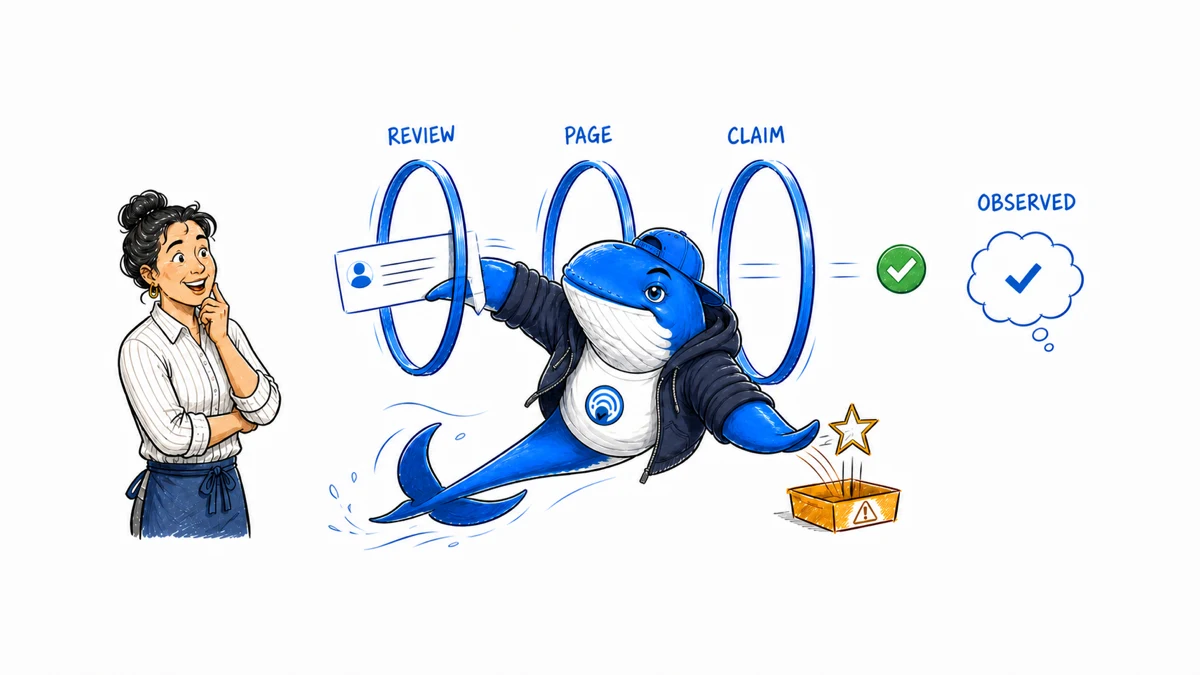
Direct answer: a first-party testimonial page can be a crawlable source, but publishing reviews does not prove that an AI answer system will retrieve, cite, or rely on it. Audit four decisions separately: whether each review is publishable, whether the page is technically accessible, whether any structured data is appropriate, and whether a saved answer actually cites or supports a claim from the page.
Google says its AI features use ordinary Search eligibility and require no special AI schema. OpenAI says public pages can appear in ChatGPT search when OAI-SearchBot is allowed, but it does not promise inclusion. The practical job is therefore evidence control;not adding stars and waiting for a model to change.
Open the browser-local review-page auditor Download the 48-field evidence ledger
Separate four decisions before changing the page
| Decision | Evidence | Does not prove |
|---|---|---|
| Publishable review | Genuine experience, permission, accurate wording, material-connection disclosure, moderation record | Crawlability or search visibility |
| Accessible page | Final 200 response, self-canonical URL, indexable controls, visible HTML text, internal discovery path | Retrieval, citation, or recommendation |
| Appropriate markup | Structured data matches visible content and the reviewed-item rules | Review stars, AI inclusion, or ranking |
| Observed AI use | Saved answer, surface state, cited URL, resolved destination, supported claim, timestamp | A permanent source preference or causal effect |
This separation prevents a common reporting error. A compliant testimonial may never be crawled. A crawled page may never appear in an answer. A citation may support one narrow service detail without supporting the recommendation. A before-and-after answer difference may come from a new index, another source, location, personalization, or ordinary response variation.
Start with review provenance, not schema
Create one ledger row per testimonial before deciding how to display it. Preserve the submitted wording separately from the published wording. Record who collected it, when the experience occurred, what product or service it describes, whether the reviewer gave publication permission, and whether the business supplied money, a discount, a free service, loyalty credit, entry into a prize draw, or another material benefit.
For a United States-facing page, the Federal Trade Commission’s current review guidance is a useful minimum boundary: do not ask only likely-positive customers, do not condition an incentive on positive sentiment, do not suppress negative reviews, do not edit a review to change its message, and disclose a material connection clearly and conspicuously. The FTC’s Consumer Review Rule and endorsement guidance are legal sources, not an AI-search optimization checklist. Other jurisdictions may impose different duties; obtain qualified advice for the markets in which the page is used.
Keep three versions when wording changes
- Submission: the reviewer’s original words and rating, retained in the evidence system.
- Approved edit: spelling, length, privacy, or clarity changes with the reviewer’s approval and an edit note.
- Published text: the exact version readers and crawlers receive.
Do not silently convert “the team replied the same day” into “24/7 instant support.” The first is one person’s dated experience; the second is a general service claim that needs separate substantiation.
Make collection and selection policy visible
A page of only praise can be truthful at the quotation level while still creating a misleading overall impression. Explain how reviews were requested, which customers were eligible, whether every genuine submission is published, why a review may be removed, how incentives are handled, how disputes are investigated, and how a reviewer can request a correction or deletion.
If the page is intentionally a curated testimonial page rather than a complete review system, call it that. State the selection basis in plain language. Do not label a selected set “all customer reviews” or calculate an average from a subset while implying that it represents every submission.
| Check | Pass evidence | Stop condition |
|---|---|---|
| Collection | Neutral request and declared eligible audience | Only satisfied customers were invited |
| Moderation | Content-neutral rules applied consistently | Negative sentiment triggers extra scrutiny |
| Material connection | Plain disclosure beside the affected review | Benefit is hidden in a remote policy page |
| Editing | Meaning preserved, change recorded, approval retained | Published wording improves the claim |
| Correction | Named contact and traceable review identifier | No practical correction or removal route |
Build review blocks that remain understandable
A testimonial should retain its meaning when extracted from the page. Keep the quotation near the reviewer display name or declared anonymity label, experience date or period, reviewed product or service, location only when relevant and permissioned, material-connection disclosure, and enough surrounding explanation to identify the claim’s scope.
Use HTML text rather than placing the only copy inside an image, carousel canvas, video, or client-side widget that fails without interaction. Give expandable sections accurate controls and ensure the review text is present in the rendered response available to the intended crawler. A screenshot can document visual presentation, but it is not a substitute for accessible text.
Separate a reviewer’s words from the business response. A short label such as “Customer testimonial” and a distinct “Business response” block reduce speaker ambiguity. If the business corrects a factual point, retain the correction next to the quotation rather than rewriting the reviewer’s history.
Run the technical access check
- Request the final public URL without an authenticated session and record status, redirects, response bytes, and visible main content.
- Confirm the canonical points to the intended review page and that the page is not blocked by robots.txt, a CDN challenge, a login wall, or a
noindexdirective. - Check that important review text exists in HTML available after the page’s normal rendering path.
- Add a descriptive internal link from a relevant service, product, about, or customer-stories page.
- Include the canonical URL in the appropriate sitemap when it meets the site’s indexability standard.
- Recheck after consent banners, localization, caching, widget updates, and mobile breakpoints load.
For Google AI Overviews and AI Mode, Google says the page must be indexed and eligible to appear with a snippet; it also says there are no additional AI-feature technical requirements. For ChatGPT search, OpenAI says OAI-SearchBot access helps public content be discovered, surfaced, cited, and linked. Neither operator promises that a technically eligible review page will appear.
Do not confuse review schema with AI-answer access
Google’s current review-snippet documentation limits review rich-result eligibility by reviewed type and source relationship. Google treats reviews about a business or organization on that same entity’s controlled site as self-serving for LocalBusiness and Organization review snippets, including reviews delivered through an embedded third-party widget. The reviews may remain useful to readers; the limitation concerns those rich results.
Do not add Review or AggregateRating markup to a first-party local-business testimonial page merely because it contains praise. Do not import a third-party platform’s stars into first-party markup unless the applicable documentation permits the exact use. Where review markup is appropriate for another supported reviewed type, visible content, author, item, rating, count, and aggregate math must agree with the structured data.
This schema decision is separate from AI answers. Google says no special schema is required for its AI features. OpenAI’s publisher documentation describes crawler access, not a testimonial schema that guarantees ChatGPT citation.
Audit claim portability before watching answers
Break each testimonial into material claims and classify the speaker. “I received a reply in two hours” is a reviewer-experience claim. “Average response time is under two hours” is a business performance claim. “Best electrician in Portland” is an opinion or comparative superlative, not a verified market fact.
| Claim class | Safe evidence record | Do not upgrade it to |
|---|---|---|
| Personal experience | Exact quotation, reviewer, date, product or service context | Typical outcome for all customers |
| Business fact | Owned policy, system record, or current service documentation | Reviewer opinion |
| Outcome | Declared starting state, measured result, timeframe, material limits | Guaranteed result |
| Comparison | Named alternatives, method, date, and comparable attributes | Unbounded “best” claim |
| Sentiment | Reviewer’s attributed opinion | Independent rating or consensus |
The downloadable ledger preserves both the review-level evidence and later answer observation. It keeps the page URL, review identifier, permission, material connection, published text hash, technical checks, answer surface, citation destination, claim support, and reviewer decision in one joinable record without treating those fields as one score.
Use the browser-local auditor before release
The first-party review-page evidence auditor runs in the browser and makes no network request. Enter the page state and one review record. It returns separate provenance, disclosure, technical, schema, and observation decisions; it also exports a single compatible CSV row.
- Choose whether the page represents the reviewed local business or organization.
- Record consent, original wording, publication edit status, incentive, disclosure, and selection method.
- Record HTTP, canonical, robots, visible-text, internal-link, and sitemap checks from a real request.
- Choose the proposed markup. The tool raises a stop when a controlled business page proposes self-serving
LocalBusinessorOrganizationreview markup. - If an AI answer was observed, save the surface, timestamp, cited URL, resolved URL, quotation or claim span, and support decision.
The tool cannot verify that a review is genuine, inspect a remote URL, give legal advice, validate structured data, or prove what an answer system used internally. Its purpose is to expose missing evidence before someone turns a testimonial into a search claim.
Record AI-answer observations without reverse engineering a cause
Use a fixed reader job, surface, account state, language, region, location permission, and timestamp. Save the complete answer and its visible sources before coding. Resolve each cited URL through redirects, preserve the displayed destination, and identify the exact answer claim the page supports.
Code at least five outcomes separately: page cited, business mentioned, business recommended, review theme repeated without visible citation, and absent. A phrase that resembles the testimonial is not proof that the page supplied it. A link proves only that the page was presented as a source in that saved response. It does not establish a stable preference, recommendation, or ranking.
If you compare runs before and after a page release, keep the method narrow. Save zero and contradictory answers, note index and product changes, and report the result as an observed difference unless competing causes are controlled. The citation-versus-recommendation guide provides the answer-level coding contract; the local recommendation source protocol provides the source-owner taxonomy.
Worked release example
Assume a local repair company has permission to publish a customer’s statement: “The technician explained the failed part and finished the repair the same afternoon.” The customer received no incentive. The business corrects one spelling error with approval, labels the service and month, publishes its neutral collection and moderation policy, and provides a correction contact.
The page returns 200, is self-canonical, contains the quotation in HTML, has no noindex, and is internally linked. Because the page is controlled by the reviewed local business, the release record sets self-serving LocalBusiness review-rich-result markup to “do not add.” The page can still be published for readers and remain technically eligible for ordinary discovery.
Later, a saved answer links the page while stating that the company offers same-day repairs. The auditor should mark the citation as partial or unsupported unless the page contains a current business-level same-day service policy. One customer’s afternoon completion does not substantiate a general availability promise. This example is illustrative; it is not a SearchEngineAnswer result or a claim about any AI product.
Use explicit release states
- Hold;provenance: authenticity, permission, original wording, or experience context is missing.
- Hold;disclosure: a material connection exists but is not clear beside the review.
- Repair;selection: collection or moderation can make the visible set misleading.
- Repair;technical: final response, canonical, robots, text rendering, or discovery path fails.
- Repair;schema: markup is self-serving, ineligible, or inconsistent with the visible page.
- Publishable, observation unproven: the page passes release checks but no answer citation is claimed.
- Observed in one saved answer: the page and supported claim are recorded for a declared run without a causal or permanent conclusion.
A page can remain in “publishable, observation unproven” indefinitely and still serve readers. Do not keep a useful page thin or hidden merely because an AI system has not supplied a study result. Conversely, do not index a testimonial page whose evidence and disclosures are not ready.
What this audit does not prove
- That reviews cause inclusion, citation, recommendation, ranking, or referral traffic.
- That a crawler request means a model used the page.
- That review structured data is required for AI answers.
- That a first-party testimonial has the same independence as a third-party review.
- That one cited quotation represents typical customer experience.
- That United States FTC guidance resolves duties in another jurisdiction.
- That a browser-local checklist replaces source verification, legal review, or a real rendered-page test.
First-party proof
A useful review page shows what only the reviewer could have observed
Specifications and vendor claims are available everywhere. The information gain comes from a repeatable task, visible conditions and a result that can be inspected.
- Task
- Describe the job, starting state and success condition.
- Evidence
- Show original captures, exports or measurements from the test.
- Friction
- Record setup failures, limits and recovery steps.
- Verdict
- Name who should use the product and who should not.
My takeaway: I would rather publish one narrow review with a defensible verdict than a broad feature tour assembled from marketing pages.
Primary documentation
- Google Search Central: AI features and your website
- Google Search Central: Review snippet structured data
- Google Search Central: Self-serving review rich-result policy
- OpenAI: Publishers and developers FAQ
- Federal Trade Commission: Consumer Reviews and Testimonials Final Rule
- Federal Trade Commission: Featuring Online Customer Reviews
Operator documentation and law can change. Record retrieval dates beside decisions, recheck the applicable source before release, and keep the page’s claims narrower than the evidence.
Keep learning
Continue this topic
Next in this topic
How to Audit Capterra Citations in ChatGPT SaaS Recommendations
Earlier in this topic
AI Mode Connected Apps Turn Search Into an Action Layer
AEO & AI Search
Ask a question or join the discussion