How to Audit Capterra Citations in ChatGPT SaaS Recommendations
This guide separates Capterra mentions, citations, SaaS recommendations, and measurable referrals, then gives you a 43-field ledger and browser-local evidence auditor.
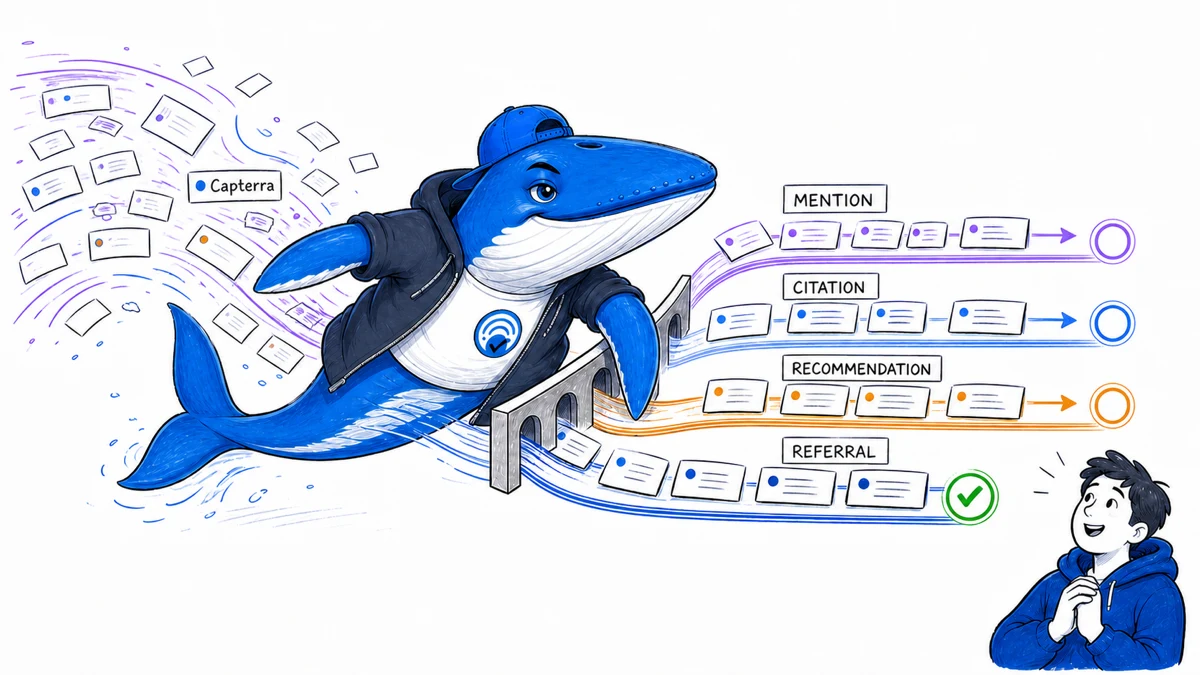
Direct answer: audit Capterra in ChatGPT SaaS recommendations by recording four outcomes separately: a Capterra mention, a clickable citation, a product recommendation, and a measurable referral. A citation proves that a page was exposed as supporting material for that answer; it does not prove that Capterra caused the recommendation or that ChatGPT “relies on” Capterra generally.
Use the browser-local Capterra evidence auditor with the 43-field source-audit ledger. The eight included rows are synthetic teaching examples marked EXAMPLE-REMOVE. Replace them with your own observations before calculating a rate or publishing a finding.
Define what you are measuring
The phrase “ChatGPT uses Capterra” collapses several observable events into one vague claim. OpenAI says ChatGPT Search responses may contain inline citations, and its Sources panel can show cited pages plus other relevant links. OpenAI also warns that search results and citations can be incomplete, outdated, or incorrect. That makes each link evidence to inspect, not a quality certificate.
| Observed event | Minimum evidence | Safe conclusion | Not established |
|---|---|---|---|
| Mention | The answer names Capterra without a Capterra link | Capterra appeared in the prose | That its page was retrieved or cited |
| Citation | A clickable link resolves to a specific Capterra URL | That page was presented as a source | That it caused product selection |
| Recommendation | The answer names and evaluates one or more SaaS products | The product was recommended in that response | That Capterra determined the ranking |
| Referral | Your analytics records a session from ChatGPT | A visit reached your site from ChatGPT | That the visit followed a Capterra citation |
This separation also prevents denominator drift. Mention frequency uses all eligible answers. Citation frequency uses answers containing a clickable source. Recommendation frequency uses eligible recommendation tasks. Referral volume belongs to analytics, not to an answer-level citation count.
Freeze the ChatGPT surface and context
ChatGPT can search automatically or after a user selects Search. According to OpenAI’s ChatGPT Search help, availability spans signed-in plans and unsigned use, while query rewriting and contextual signals can affect what is searched. Account state, workspace configuration, location, language, memory, and conversation history can therefore make two superficially identical prompts non-equivalent.
For every answer, record the surface, plan, signed-in state, whether Search was on, country, language, and whether the prompt started a new conversation. Keep one primary setup stable. If you deliberately compare signed-in with unsigned use, or Search on with Search off, treat each as a separate condition rather than pooling the rows.
Timestamp observations in UTC. Search results, product pages, reviews, and model behavior change. A later reviewer must know whether two responses were gathered five minutes apart or five months apart.
Design neutral SaaS tasks before source-requested tasks
Start with buyer jobs, not source names. A neutral task might ask for a three-product CRM shortlist for a five-person agency with a defined budget, integrations, and reporting need. Create task families across categories such as CRM, help desk, project management, accounting, and email marketing. Keep the constraints stable across repeats.
Do not mix “Which tools fit this buyer?” with “Use Capterra to find tools.” The second prompt tests compliance with a requested source; it does not measure spontaneous source selection. The ledger keeps source-requested rows, but the auditor warns that they must be excluded from a neutral source-frequency rate.
- Write the task and expected output shape before opening ChatGPT.
- Hash the exact prompt and reuse its task ID across repeats.
- Start a fresh conversation for the primary series.
- Record every eligible answer, including answers with no Capterra appearance.
- Schedule repeats across declared time windows instead of stopping after an interesting result.
Null rows matter. Without them, a collection of screenshots can demonstrate that Capterra sometimes appears, but it cannot estimate how often.
Code the Capterra page and its role
Capterra is not one source type. Its research methodology distinguishes reviews, buyer-interaction data, Shortlist scoring, and “best” product lists. Capterra says Shortlist combines Ratings and Popularity dimensions subject to eligibility criteria. Its current “best” list methodology also describes how sponsorship or client status can affect ordering without determining selection. Those distinctions change what a citation can support.
| Page type | Possible source role | Claim it may support | Extra check |
|---|---|---|---|
| Category directory | Market orientation | Products commonly grouped in a category | Was the cited category current and relevant? |
| Vendor profile | Product attributes | Listed features, integrations, or positioning | Verify material facts with the vendor |
| Review collection | User experience signal | Patterns in submitted opinions | Inspect sample size, date, and verification disclosure |
| Shortlist | Comparative scoring | Placement under the stated methodology | Save eligibility and scoring version |
| Best-products list | Editorial or commercial comparison | Inclusion under the disclosed method | Read ordering and relationship disclosures |
Capterra’s review-verification explanation describes moderation, verification, incentives, and controls intended to detect problematic submissions. That process is relevant context, but it does not make every review claim true or turn user opinion into a Capterra endorsement.
Preserve claim-level evidence
Save the full answer privately, then make a redacted evidence copy. Record the Capterra URL exactly as opened, the page type, its role in the answer, and the specific claim it appears to support. Hash both the prompt and answer capture so later edits are detectable.
A citation attached to a sentence about ease of use is not automatically evidence for price, market popularity, or security. If the answer recommends Product A because it “has the highest user rating,” open the cited Capterra page and verify that the visible rating, comparison set, and date match the sentence. If the page supports only general category context, code it that way.
Keep other source domains in the same row. A recommendation may cite Capterra for reviews, the vendor for specifications, and an independent publication for implementation experience. Treating the answer as “Capterra-derived” erases that source mixture.
Separate recommendations from citations
Code product_recommended only when the answer does more than mention a product. Capture the product name, position, and the stated rationale. Then code Capterra mention and citation independently. This creates four useful cells: recommended with Capterra cited, recommended without Capterra cited, no recommendation with Capterra cited, and neither.
The related guide on measuring AI citations and recommendations separately explains why visibility metrics should not be merged. A high Capterra citation rate could coexist with a low product-recommendation rate. Likewise, a product can be recommended without any Capterra link in the answer.
For source-frequency estimates, define one eligible answer per task-run and report the numerator and denominator. Avoid percentages when the denominator is tiny. Publish raw counts, date range, task mix, repeats per task, and the number of null outcomes.
Measure referrals in a separate analytics join
OpenAI’s publisher and developer FAQ says ChatGPT referral URLs include utm_source=chatgpt.com. That gives publishers a practical analytics signal. It does not reveal which unseen source shaped an answer, and it cannot connect a visit to Capterra unless the observed click path and landing session support that claim.
Record the outbound URL from the answer, its UTM parameter, whether an analytics session was observed, and the resulting source/medium. Use the GA4 AI referral tracking guide to configure channel definitions and retain landing-page context.
Do not place personal identifiers, account data, raw cookies, or private analytics exports in the public ledger. A run ID and redacted session observation are enough for an audit trail. Store any restricted join table separately with access controls.
Check search eligibility without confusing crawlers
OpenAI’s crawler documentation separates OAI-SearchBot, which controls eligibility for ChatGPT Search inclusion, from GPTBot, which relates to potential model training. The two controls are independent. ChatGPT-User represents user-triggered visits and is not the automatic search crawler.
If you are auditing your own pages, verify that the page is publicly reachable and that OAI-SearchBot is allowed. OpenAI notes that an opted-out page will not be included in search answers, although a navigational link may still appear. Eligibility still does not guarantee crawling, citation, placement, or referral.
For a first-party comparison, use the review-page evidence test. Freeze both the publisher-side controls and the prompt-side conditions before comparing your page with a marketplace page.
Use the ledger and browser-local auditor
- Download the 43-field CSV ledger.
- Delete every row marked
EXAMPLE-REMOVEand insert one row per eligible answer. - Keep answer captures outside the CSV and reference them by a non-sensitive path plus SHA-256 hash.
- Open the evidence auditor, paste or load the CSV, and select Audit evidence.
- Resolve impossible combinations, missing evidence, source-requested contamination, and causal language.
- Export the findings and archive them with the frozen prompt set and coding guide.
The utility runs entirely in the open browser tab. It performs no fetch, upload, analytics call, cookie write, or local-storage operation. It checks internal consistency only; it cannot verify that a screenshot is authentic, open a cited page, query ChatGPT, read GA4, or determine why a model selected a source.
Apply decision and stopping rules
| Observed pattern | Decision | Do not write |
|---|---|---|
| Named, no link | Mention only | “ChatGPT cited Capterra” |
| Clickable Capterra category link | Citation; code category context | “Capterra ranked the products” |
| Capterra link and product recommendation | Co-occurrence in one answer | “Capterra caused the recommendation” |
| Product recommended, no Capterra appearance | Recommendation without visible Capterra evidence | “Capterra was not used internally” |
| ChatGPT referral in analytics | Observed traffic from ChatGPT | “The referral came through Capterra” |
| Source-requested prompt cites Capterra | Instruction-compliance observation | Include it in neutral source-selection frequency |
Predeclare stopping rules: number of categories, tasks per category, repeats per task, collection dates, exclusion reasons, and handling of failed or interrupted answers. If the product changes during collection, stop, document the change, and begin a new wave rather than silently combining regimes.
Use a second coder on a sample or on all ambiguous rows. Report the agreement method and retain disagreements. A neat percentage built on unstable coding is weaker than a smaller, transparent dataset.
Avoid common causal overclaims
Answer-level observations cannot expose private model weights, undisclosed retrieval candidates, ranking features, or the causal influence of an unseen document. Even repeated citation is an association under your test conditions. It may reflect query rewriting, index availability, page relevance, product popularity, prompt wording, or other sources.
Do not infer absence either. If a recommendation has no visible Capterra citation, you can say no Capterra citation was exposed in that answer. You cannot conclude that no Capterra-derived information exists anywhere in the system.
For publisher controls and measurable outcomes, see the OpenAI publisher controls guide. Keep crawler eligibility, citation appearance, recommendation, and referral as separate funnel stages.
Sources, method, and limits
Sources: OpenAI’s ChatGPT Search help, publisher FAQ, and crawler documentation; plus Capterra’s proprietary-data, Shortlist, best-list, and review-verification methodology pages. Each primary source is linked beside the claim it supports and was checked on September 1, 2026.
Method: SearchEngineAnswer mapped documented product behavior and source disclosures into four observable outcomes, a 43-field ledger, deterministic consistency checks, and bounded reporting rules. The synthetic examples cover citation, non-citation, mention-only, referral, source-requested, Search-off, citation-without-recommendation, and vendor-profile cases.
Limits: SearchEngineAnswer did not run a new ChatGPT source-frequency study for this guide and reports no Capterra mention, citation, recommendation, or referral rate. The artifact rows are examples, not observations. ChatGPT interfaces, search behavior, citations, crawler controls, Capterra pages, and methodologies can change. The method can audit preserved evidence; it cannot establish hidden retrieval, ranking, training use, or causal influence.
Keep learning
Continue this topic
Next in this topic
How to Track AI Search Referrals in GA4
Earlier in this topic
How to Audit First-Party Review Pages for AI Answers
AEO & AI Search
Ask a question or join the discussion