Claude Workbench Retirement: August 17 Checklist
Anthropic is ending legacy Claude Workbench access and three experimental prompt-tool endpoints on August 17, 2026. Export the artifacts, inventory dependencies, and rehearse the replacement path.
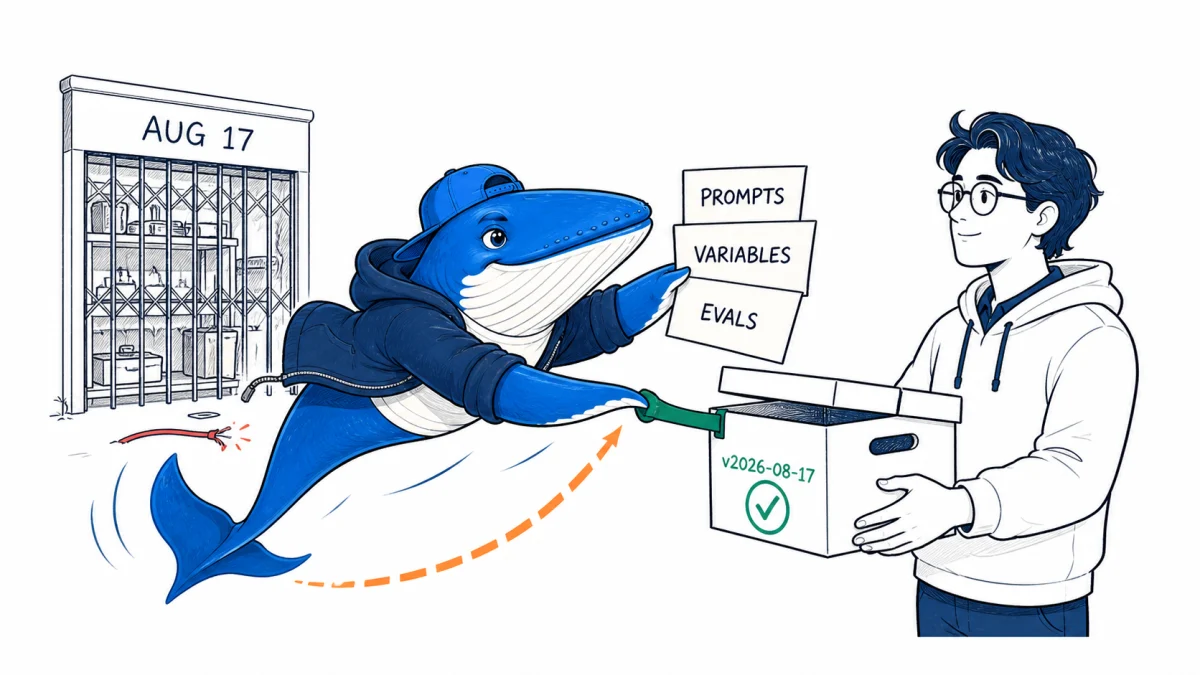
Direct answer: Anthropic says access to the legacy Claude Workbench ends on August 17, 2026. The updated Workbench does not support saved prompts, variables or evals, so teams that need those artifacts should export them from the banner or Organizational Settings. Anthropic is also retiring the experimental generate, improve and templatize prompt endpoints on the same date; requests will return an error after removal.
The urgent job is not to copy a few prompt sentences. It is to preserve the reproducible unit: prompt, variables, model and settings, test cases, expected behavior, owner, dependencies and release history.
Identify what will stop working
| Surface | Documented change | Immediate action |
|---|---|---|
| Legacy Workbench | Access ends August 17, 2026 | Export artifacts that must be retained |
| Updated Workbench | Saved prompts, variables and evals are not supported | Choose a new system of record |
generate_prompt | Experimental endpoint retires | Remove or replace callers |
improve_prompt | Experimental endpoint retires | Preserve human review and test criteria |
templatize_prompt | Experimental endpoint retires | Move templates and variable contracts |
Search repositories, CI configuration, notebooks, internal tools, browser bookmarks and team documentation for the Workbench URL and the three endpoint paths. An endpoint can remain in a rarely used script long after its original owner has moved on.
Export a restorable prompt package
For each production or decision-critical prompt, record:
- a stable prompt ID, purpose and owner;
- system and user instructions in their original order;
- variable names, types, defaults, validation rules and examples;
- model ID, API version, tools, output schema and material generation settings;
- eval inputs, expected properties, scoring rubric and known failures;
- the application, job or workflow that calls it;
- privacy classification and prohibited data;
- last verified date and rollback version.
Store the exported Workbench archive unchanged, then create a readable normalized copy for review. Hash or version the source so later edits do not erase what existed before the retirement.
Replace the prompt-tool APIs with an owned workflow
If an application automatically generated or improved prompts, decide what job the endpoint was actually performing. Was it drafting an initial instruction, converting prose into variables, linting a template, or scoring alternatives? Replace that job explicitly rather than hiding it inside a new generic model call.
- Freeze representative input fixtures and current accepted outputs.
- Define the properties a replacement must preserve: variables, structure, safety constraints, evidence rules and tone.
- Build the replacement behind a feature flag.
- Run old and new paths before the deadline while both are available.
- Review regressions by task, not only by average score.
- Remove the retired endpoint and make a rollback package available.
The evidence-led publishing guide shows how to preserve file versions and references when prompt material moves between interfaces. For broader API change control, use the grounded-answer migration pattern.
Run a deadline checklist
| Check | Evidence | Owner |
|---|---|---|
| Inventory | All Workbench artifacts and endpoint callers listed | Platform lead |
| Export | Original archive plus versioned normalized copy | Prompt owner |
| Replacement | Documented target for every required job | Application owner |
| Regression | Fixtures, rubric, failures, latency and cost saved | Reviewer |
| Restoration | Second person reconstructs one workflow | Independent operator |
Limit: Anthropic’s release note defines the retirement boundary. It does not guarantee that an exported artifact contains every undocumented assumption in a team’s production workflow. That is why the dependency inventory and restoration rehearsal matter.
Primary documentation
Keep learning
Continue this topic
Next in this topic
Microsoft Clarity AI Visibility: Query Topics and Brand Terms Workflow
Earlier in this topic
Claude Compliance API: Govern Local Session Retrieval
Tools & Workflows
Ask a question or join the discussion