After a Website Outage: Diagnose the SEO Impact Before Blaming an Algorithm Update
Reconstruct the availability timeline, crawler-facing status, recovery signals and competing explanations before attributing a search decline to an outage or update.
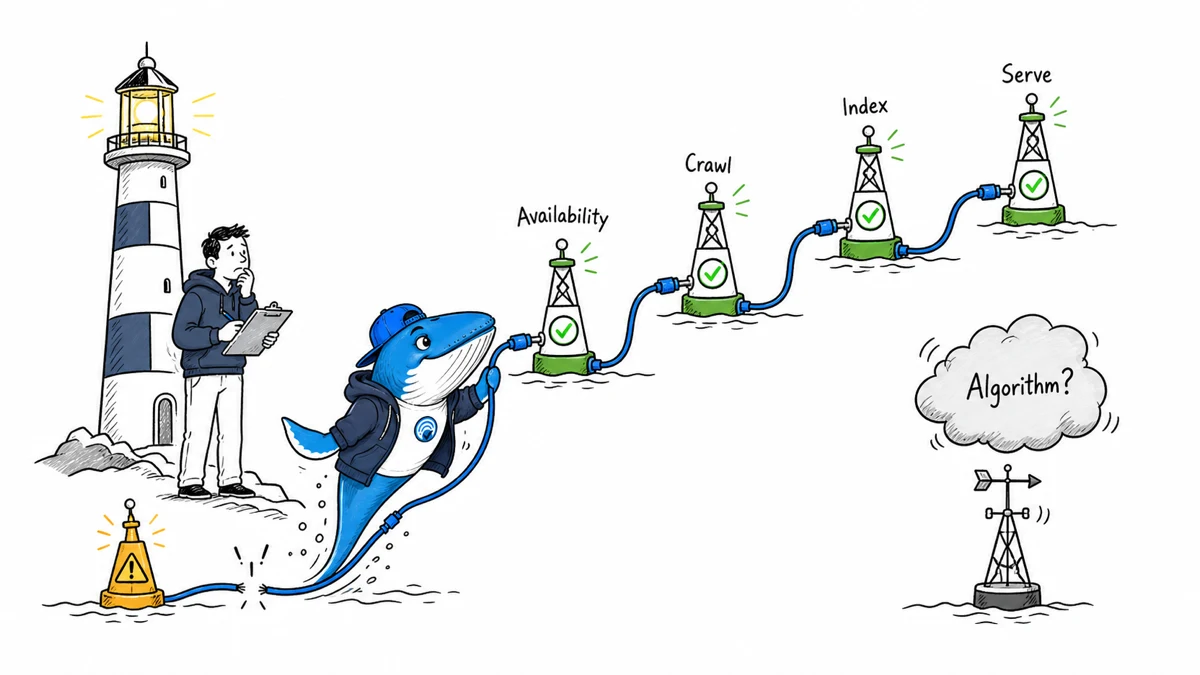
Direct answer: after a website outage, prove what Googlebot received, which URLs were affected, how long the failure lasted, and whether crawling, indexing or search serving changed. A close sequence in time is not enough to say the outage caused a ranking decline or that an algorithm update did.
A detailed r/SEO incident report described a short availability problem followed days later by a reported 73% decline in Google sessions. It is a C1 community self-report: the site, raw logs and Search Console exports are not available for independent review. The correct response is a timeline and layer-by-layer diagnosis, not a verdict from the sequence alone.
Preserve the outage timeline
Record incident start and end in UTC, affected hostnames, DNS state, TLS state, CDN and origin status, response codes, retry headers, geographical scope, IPv4 and IPv6 behavior, cache state, deployment identifiers and the exact recovery action. Save evidence from external uptime checks and edge or origin logs.
Distinguish a connection failure from an HTTP response. Google documents DNS and network errors separately from 5xx, 429 and other status codes. A browser screenshot after recovery cannot establish what Googlebot received during the failure window.
| Layer | Evidence | Recovery question |
|---|---|---|
| Availability | DNS, TLS, edge and origin logs | Can representative regions fetch stable responses? |
| Crawling | Crawl Stats and verified crawler requests | Did fetch volume and host availability recover? |
| Indexing | URL Inspection and Page Indexing samples | Are important canonical URLs still selected? |
| Serving | Pages, queries, countries and devices in Search Console | Where did impressions and clicks change? |
| Demand and competition | Query trends, SERP captures, releases and seasonality | Did the market or result page change too? |
Understand the duration boundary
Google’s crawling documentation says temporary 503 and 429 responses can slow crawling and that prolonged server errors can eventually cause URLs to be dropped. The documentation does not provide a universal number of minutes after which rankings fall, and a properly returned temporary response is not a penalty.
Record whether the site returned an honest temporary status, a soft-404 page with HTTP 200, a redirect loop, a DNS failure or an incomplete body. The repair differs. A cached 200 at one edge may coexist with failures elsewhere, and a WAF can block verified crawlers while serving ordinary users.
The robots.txt network diagnostic provides the same dual-stack, TLS, CDN and WAF evidence path. Use it for the robots file and for representative page URLs.
Separate recovery signals
- Availability recovery: external tests and logs show stable final responses across important regions and IP families.
- Crawl recovery: verified crawler requests and Crawl Stats return to an expected band without a new host-availability problem.
- Index recovery: sampled priority URLs remain indexed under the intended canonical.
- Serving recovery: Search Console impressions and clicks stabilize for affected page/query groups.
- Business recovery: measured visits and outcomes recover under a verified analytics setup.
These signals can recover at different times. Do not keep restarting deployments because sessions have not returned when crawling and indexing are stable. Likewise, do not declare recovery from one successful URL Inspection if the affected template still returns intermittent errors.
Test competing explanations
Build a comparison group of stable pages and queries. Check whether the decline affects Google only or several channels, one country or all countries, mobile or desktop, branded or non-branded demand, and one template or the whole site. Preserve competitor and SERP observations for the same queries.
If the outage ended before the decline, that timing is relevant but not decisive. Other candidates include query demand, content or internal-link releases, canonical changes, robots controls, result-page features, manual actions, security incidents, measurement changes and ordinary volatility. Search for the smallest explanation that matches the affected segment and timing.
The unconfirmed volatility diagnosis explains how to investigate ranking movement without inventing an update. Use the two-system traffic workflow when GA4 quality is also in doubt.
Keep learning
Continue this topic
Next in this topic
How to Measure Google Business Profile Post Actions
Earlier in this topic
Crawled Isn’t Indexed: A Large-Ecommerce Indexation Workflow
SEO
Ask a question or join the discussion