Google AMP Direct Hosting: Run a 28-Field Publisher Audit
Audit publisher-hosted AMP responses after Google Search’s direct-delivery change, including parity, consent, analytics, performance and legacy cache dependencies.
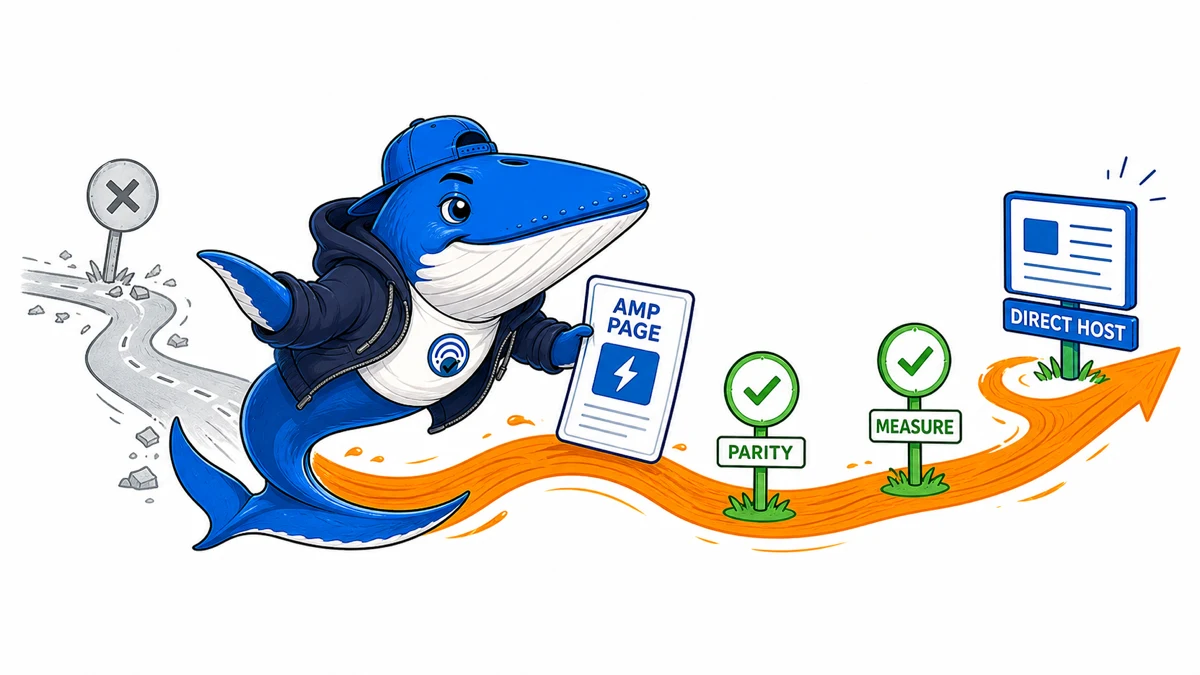
Direct answer: Google Search has sent AMP visits directly to publisher-hosted AMP pages since July 1, 2026. Publishers no longer need the Google Search delivery path to update an AMP Cache or configure signed exchanges. That does not make the publisher response fast, analytics accurate or duplicate templates worth maintaining. Audit the direct URL before removing legacy components or retiring AMP.
The downloadable 28-field AMP direct-hosting ledger joins URL identity, parity, measurement, performance, legacy dependencies and rollback. Its two rows are marked EXAMPLE-REMOVE; they illustrate the fields and are not observations from a real publisher.
What Google changed on July 1
Google’s Search documentation update says Search now takes users directly to publisher AMP host pages. The same update removed outdated references to the AMP Viewer, AMP Cache and signed exchange from the Search documentation. Google described the change as a way to simplify maintenance for publishers creating AMP content.
| Question | Documented answer | Not established |
|---|---|---|
| Where Search sends the click | Directly to the publisher’s AMP host page | That every other product or referrer uses the same route |
| AMP Cache maintenance for Search | No longer required for this delivery path | That every cache-related component is unused elsewhere |
| Signed exchange for Search | No longer needs to be configured for this path | That deleting certificates or jobs is risk-free |
| Ranking treatment | AMP ranks like any other web page | An AMP bonus or penalty |
Treat the July entry and the current AMP guide as separate evidence. The update records the transition; the guide owns the current Search contract.
What did not change
Google says AMP pages are indexed like other web pages and held to the same standard regardless of the technology used. AMP pages can appear as ordinary or rich results when they meet the relevant requirements, but structured data does not guarantee a rich result.
The current guide still requires valid AMP, a sensible publisher URL, Google-friendly practices and equivalent content and actions where an AMP page corresponds to a canonical page. Direct delivery changes the transport path. It does not remove the content, canonical, validity, accessibility or quality work.
Map the current AMP inventory
List representative AMP URLs by template and business importance. Record each corresponding canonical, owner, sitemap source, internal links, alternate relationship, structured data, analytics container, consent implementation and redirect behavior. Sampling one article is not enough when news, product and evergreen templates have separate code paths.
Preserve the current configuration before changing it. Export CDN rules, certificate jobs, signed-exchange packager settings, cache purge hooks and monitoring checks. A component described with “AMP” in its name may serve another delivery path.
Verify the direct publisher response
| Layer | Evidence | Stop condition |
|---|---|---|
| HTTP | Status, redirect chain, final host, headers and content type | Error, redirect loop or unexpected host |
| Document | AMP validity, canonical relationship and visible content | Invalid or mismatched page |
| User action | Navigation, forms, media, consent and conversion path | Blocked or missing essential action |
| Measurement | Pageview, referrer, consent state and outcome event | Unattributed or duplicated activity |
| Performance | Field data where available plus a declared origin test | Exceeded performance budget or unstable response |
Record the test entry path. A direct request pasted into a browser confirms the publisher URL, but it does not reproduce a click from Google Search. When possible, use a privacy-safe live observation and keep its date, device, consent state and referrer visible.
Check content and action parity
Compare the AMP and canonical page as a reader would. Check headline, byline, dates, body, images, captions, related links, structured data, paywall or subscription behavior and correction notes. Then complete the important action on both versions.
A technically valid AMP page can still be a weak duplicate when its content is stale or its actions are missing. Google’s guidance says users should be able to experience the same content and complete the same actions where possible. Treat a parity failure as a release blocker, not a cosmetic difference.
Retest consent, analytics and conversions
Direct publisher hosting may simplify the visible URL and some attribution paths, but it does not prove measurement correctness. Test pageviews, consent transitions, campaign parameters, referrer capture, cross-domain behavior and the smallest meaningful conversion. Check for duplicate events if old cache or viewer assumptions remain in the analytics logic.
Annotate July 1 in reporting before comparing periods. A delivery change, analytics repair and template release can overlap. Keep each event separate so a traffic or conversion movement is not assigned to the wrong cause.
Measure origin and field performance separately
Direct delivery makes the publisher’s origin and CDN path operationally central. Measure response latency under a declared network and location, then use field Core Web Vitals when the URL or origin has enough eligible data. A lab result can diagnose a release; it cannot replace field experience.
Record INP, LCP and CLS with their source, period and scope. Keep server response percentiles in separate fields. A fast origin does not guarantee good interaction behavior, and a strong field aggregate can hide a broken template route.
Trace legacy cache and signed-exchange dependencies
Name every certificate renewal, packager, cron job, CDN rule, monitoring check and cache invalidation process created for the old Search path. For each one, identify its current consumer and owner. Remove a component only when no active path depends on it and a rollback is documented.
Do not delete certificates or configuration merely because Google removed the terms from current Search documentation. The same infrastructure may support another product, integration or internal process. The ledger’s legacy_cache_dependency and sxg_component_owner fields force that question into the decision.
Choose keep, repair, consolidate or retire
| Decision | Use when | Required evidence |
|---|---|---|
| Keep | AMP remains complete, measurable, fast and owned | Parity, performance and maintenance checks pass |
| Repair | The reader job is sound but a bounded defect exists | Named owner, fix, verification and deadline |
| Consolidate | The canonical delivers the same job with lower duplication | Redirect, alternate, sitemap and internal-link plan |
| Retire | No active reader or product path justifies the template | URL mapping, rollback trigger and post-release monitoring |
Maintenance cost is a valid input, but it is not the only one. Search demand, direct audience use, syndication, partner dependencies and editorial workflow can justify keeping an AMP route that no longer needs the old Search delivery components.
Retire AMP with normal URL-migration discipline
Map every AMP URL to its canonical destination, choose the correct redirect behavior, remove obsolete alternate references, update sitemaps and internal links, then verify crawl and index signals. Preserve the content and user outcome at the destination.
The domain-variant migration matrix provides reusable redirect and rollback logic, while the technical launch checklist covers response, canonical, rendering and measurement gates. An AMP retirement is smaller than a domain move but deserves the same evidence discipline.
Use one ledger row per template state
Create separate rows when one AMP URL changes materially across the audit. Record the test time, response, host, parity, measurement, performance, dependencies, decision, rollback trigger and recheck date. Replace the example rows before using the file.
The ledger is intentionally an operating record rather than a performance benchmark. It contains no SearchEngineAnswer AMP measurements and should not be presented as proof that direct hosting improved speed or traffic.
Limits of the documented change
Google’s documentation establishes the Google Search delivery contract. It does not disclose every referring surface, guarantee identical behavior for every user or provide performance results for your host. A publisher test can verify its own URLs and analytics, but it cannot establish a global ranking effect.
Do not describe the change as an AMP shutdown. AMP remains a web technology that Google says it indexes like other pages. The decision to keep or retire it belongs to the publisher’s evidence and maintenance model.
Primary documentation and next check
Sources retrieved August 29, 2026: Google Search Central’s July 1 documentation update and current AMP on Google Search guide. Start with one high-traffic template, complete the 28 fields and stop if content, consent, measurement or performance fails. More technical recovery methods are available in the SEO topic archive.
Keep learning
Continue this topic
Next in this topic
How Google Chooses Image Thumbnails for Search and Discover
Earlier in this topic
Google canonical recovery: compare crawl and country-page evidence
SEO
Ask a question or join the discussion