How to use AI for content briefs without publishing generic work
Use AI for content briefs with a defined reader job, verified source packet, evidence ledger, information-gain requirement, scorecard, and skeptical review.
Updated August 9, 2026: Re-edited around one direct operating rule: source first, model second, skeptical review before drafting.
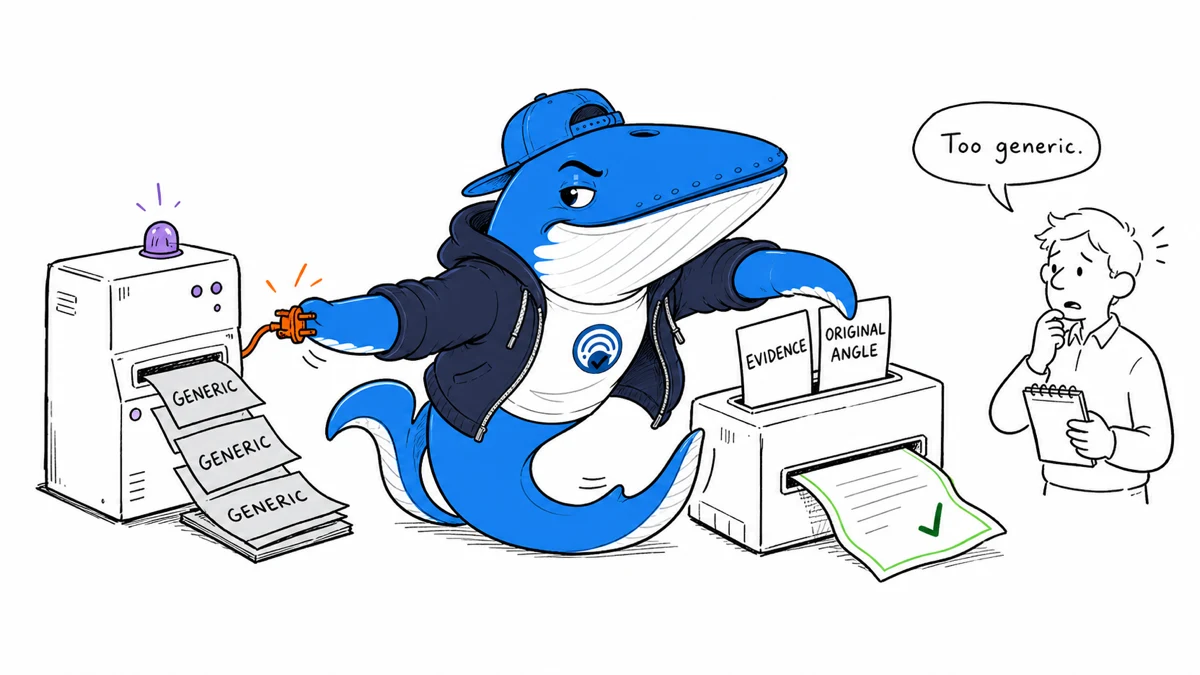
Use AI to organize a verified content brief, not to supply its evidence. Without a source boundary and an original contribution, the model can turn ten search results into an eleventh page that says nothing new.
The prompt is secondary. A useful brief begins with verified sources, a precise reader job, and an information-gain requirement. AI can organize that material, expose gaps, and test the outline; it cannot upgrade an unsupported claim into evidence.
1. Write the assignment before opening the model
Define the audience, situation, decision, deliverable, and exclusions in plain language. “Write about technical SEO” is not an assignment. “Help a small-site owner decide whether a pre-launch issue blocks release, needs a scheduled fix, or can be accepted” is.
Add the page’s intended job and format. A checklist, comparison, case study, and reference page should not share the same outline simply because they mention the same keywords.
2. Build a source packet
Collect primary documentation before asking for an outline. Record the source owner, URL, publication or update date, the exact claim it supports, and any limits. For a product feature, use the vendor’s documentation. For a statistic, find the original study or dataset. For a first-hand claim, save the screenshot, export, test conditions, and date.
Keep discovery material separate from evidence. A search result, social post, or secondary article can reveal a question worth investigating; it should not silently become the authority for the answer.
3. Create an evidence ledger
| Claim | Evidence | Confidence | Boundary | Draft status |
|---|---|---|---|---|
| Verifiable fact | Primary source URL | High/medium/low | Date, product, market | Use, qualify, or remove |
| First-hand observation | Test record | High/medium/low | Environment and sample | Use with method |
| Interpretation | Reasoning plus sources | High/medium/low | Alternative explanations | Label as analysis |
The model may summarize an item in the ledger. It may not upgrade a low-confidence observation into a universal fact.
4. Require an information-gain layer
Choose the page’s original contribution before generating headings. It might be a decision matrix, a tested workflow, a reusable template, a new calculation, a comparison under consistent conditions, or a first-hand case record.
For this article, the contribution is the source-bounded brief: each planned section must map to evidence and a reader decision. If a proposed section has neither, it is probably filler.
5. Ask AI for gaps, not finished certainty
Give the model the assignment and source packet, then ask it to:
- group the evidence by reader question;
- identify unsupported claims and missing definitions;
- propose two or three structurally different outlines;
- mark which headings require first-hand evidence;
- list likely counterexamples or alternative explanations;
- avoid facts that are not present in the packet.
This makes the model an organizer and critic. It is much safer than asking it to “research everything” and trusting polished sentences as proof.
6. Score the brief before drafting
Give one point for each “yes”:
- Does the brief name one reader and one job?
- Does every factual section map to evidence?
- Is the page’s original contribution explicit?
- Are uncertainty and exclusions documented?
- Does the structure differ for a reason, not novelty alone?
- Are internal links selected by the reader’s next step?
- Does the brief specify what must be checked again before publication?
A brief scoring below six should return to research. Drafting faster from a weak brief only creates faster rework.
7. Draft close to the sources
Draft each section with its source material open. Cite the claim where it appears. Distinguish a documented requirement from a recommendation, and a recommendation from an opinion. If the model supplies a number, quote, product behavior, or named attribution that is absent from the ledger, stop and verify it.
Google’s guidance on generative AI content is deliberately ordinary: focus on accuracy, quality, and relevance, including metadata and alternative text; explain automation when it helps users; and avoid scaled content created mainly to manipulate rankings. AI assistance does not reduce the publisher’s responsibility.
8. Humanize by increasing specificity
Remove throat-clearing, repeated conclusions, fake quotations, and symmetrical lists that exist only because the model likes them. Replace vague advice with the actual decision, condition, or example. Read the article aloud. A human voice is not manufactured slang; it is a clear point of view supported by concrete detail.
A reusable brief instruction
Use only the supplied sources for factual claims. For every proposed section, state the reader question, evidence used, original contribution, uncertainty, and next useful action. Flag missing evidence rather than completing it from memory. Do not invent experience, statistics, quotations, or product behavior.
If the brief cannot map every factual section to evidence and name what the page adds, send it back to research. After drafting, use the evidence-led publishing guide for the final review and the citation-ready passage test for high-value answers.
Primary documentation
Prompts belong inside an editorial system
A prompt is useful only when it produces an inspectable input to a human decision. The consolidated workflow below connects prompt design to sources, uncertainty, examples and approval rather than presenting a list of magic phrases.
| Change | What it affects | Best next check |
|---|---|---|
| AI SEO Prompts That Produce Auditable Work, Not Generic Content | Use separate research, synthesis, drafting and review prompts with claim-source IDs, rejection rules, human ownership and measurable correction rates. | Research, synthesis, drafting and review need different checks. |
Originally reported 2026-09-03
AI SEO Prompts That Produce Auditable Work, Not Generic Content
Why it matters: Use separate research, synthesis, drafting and review prompts with claim-source IDs, rejection rules, human ownership and measurable correction rates.
Next check: Research, synthesis, drafting and review need different checks.
The best AI SEO prompts produce auditable work: every material claim has a source, scope and reviewer decision, and the model is allowed to return “unknown.” Prompts that ask for a complete ranking article from one keyword optimize for fluent completion, not reliable publishing.
Give the prompt an evidence contract
Specify allowed sources, cutoff or retrieval date, target audience, decision, exclusions and output fields. Require claim IDs tied to source IDs. Tell the model not to invent missing data and to label inference. Provide the source pack directly when possible instead of asking the model to browse invisibly.
Our evidence-led publishing guide explains source priority and claim verification.
Separate research, synthesis and writing
Use different steps. The research prompt extracts source metadata and relevant support. The synthesis prompt compares claims, conflicts and gaps. The writing prompt uses only approved evidence. The review prompt tests the draft against the ledger. A single giant prompt makes it difficult to see where an unsupported statement entered.
Use a structured research prompt
Task: build an evidence ledger for [decision].
Allowed sources: [URLs or supplied documents].
For each claim return: claim_id, claim, source_id, support_note, scope, retrieved_date, status.
If support is missing, return unknown. Do not create URLs.
The output should be data you can inspect, not finished prose. Verify links and important claims manually.
OpenAI’s prompt-engineering guidance describes explicit instructions and structured outputs as practical controls. For publishing, extend those controls with your own source allowlist, rejection rules and accountable reviewer.
Use a constrained drafting prompt
Write for [audience] completing [job].
Use only approved claim_ids from the ledger.
Lead with a direct answer. Include method, example, limitation and next step.
Do not add facts, quotes, credentials or product behavior absent from the ledger.
Add the intended internal pages and the unique information gain. If you cannot name the gain, update an existing article instead. The framework in our AI content brief guide prevents topic-only briefs.
Prompt the reviewer to look for failure
Ask for unsupported claims, source-claim mismatch, missing dates, hidden assumptions, duplicated site intent, unverifiable superlatives and advice that exceeds evidence. Require line-level references. A “quality score: 92” without definitions is not review.
| Check | Pass evidence |
|---|---|
| Source exists | URL opens and publisher is identified |
| Claim supported | Source supports the stated scope |
| Original value | Method, data, example or tool is present |
| Limits | Uncertainty and non-guarantees are explicit |
| Human approval | Named reviewer and timestamp |
Keep sensitive data and credentials out
Do not paste API keys, customer records, confidential strategies or unpublished personal data into prompts. Use redacted examples and least-privilege connectors. Log model, prompt version and source set without storing secrets. Treat retrieved web text as untrusted input; it can contain instructions unrelated to your task.
Measure prompt usefulness by corrections
Track unsupported-claim rate, reviewer rewrite rate, missing-source rate, duplicate-intent blocks and publication rollbacks. A prompt is improving when it reduces high-risk corrections while preserving useful detail; not when it simply produces longer drafts.
Download the auditable AI SEO prompt pack. Replace the examples and keep the required-output and rejection-rule columns so each prompt remains testable across model changes.
For the publication and measurement system these prompts support, return to the AI SEO guide and task hub.
Keep learning
Continue this topic
Next in this topic
You.com Answer API: Audit Citations, Excerpts, and Uncited Claims
Earlier in this topic
Two Google Ads Changes Alter Search Campaign Controls
Tools & Workflows
Ask a question or join the discussion