
Microsoft expands Web IQ access and adds source controls for agents
Trace the path from a crawlable page to retrieved evidence and a supported answer, with a practical publisher and agent evaluation.
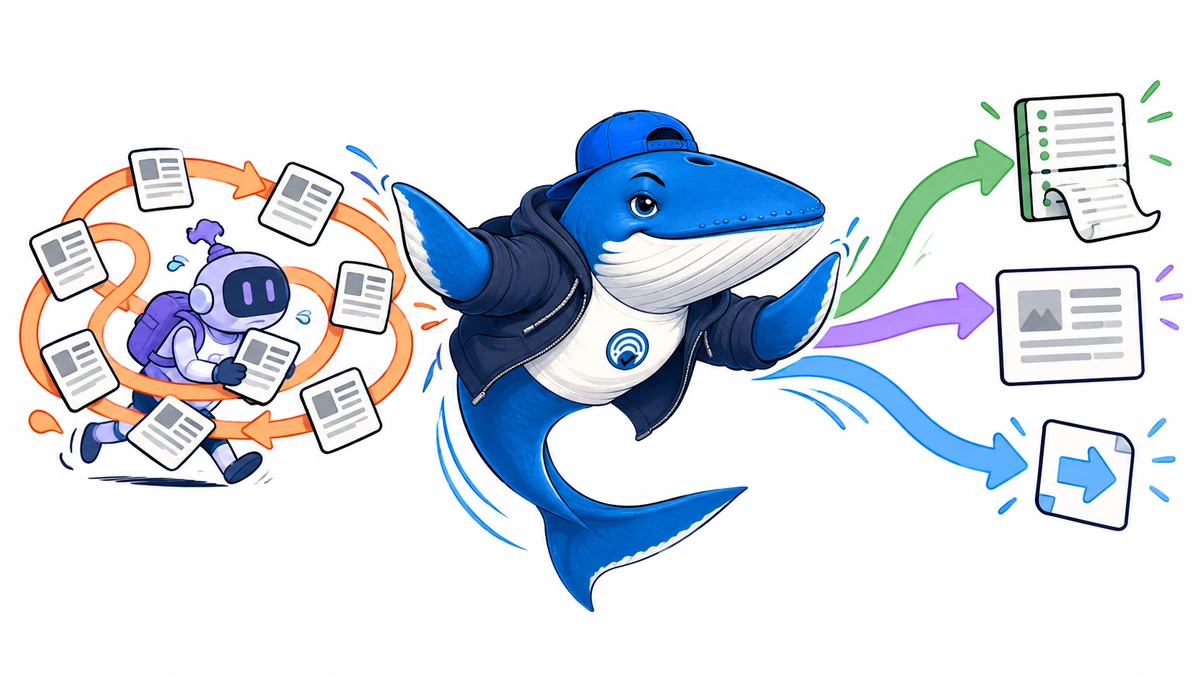
Microsoft announced broader Web IQ availability for Azure customers on November 17, 2026. The service retrieves current web information for AI agents. The update includes Auto and Auto Advanced retrieval, source controls through Scopes and additional structured sources. Commerce is in private preview. For publishers, the relevant questions are how an agent finds a page, what evidence it receives, and where the resulting answer links. Microsoft’s announcement
The announcement connects Web IQ to Microsoft’s own search index and identifies Bingbot as the crawler supporting Bing Search, Copilot and Web IQ. It also describes separate mechanisms for crawling, indexing, and grounding preferences. These layers give a publisher several records to inspect before interpreting an absent citation.
Start with the route from page to answer
A page must be accessible to the systems collecting it, represented in the relevant retrieval source, and selected as useful evidence for the question. The agent must then use that evidence in its answer. Finally, the reader needs a working link to reach the source.
Use that sequence to assign an owner to a failure. A blocked page may require technical investigation. A relevant indexed page omitted from a particular retrieval response needs a different review. A source returned by the retrieval system but ignored in the final answer belongs in the agent evaluation.
This distinction helps teams commissioning an AI application. Ask for the retrieved evidence alongside the final answer during testing. Otherwise, an incorrect answer can be difficult to trace to source selection, answer generation, or a broken destination.
What the new retrieval controls mean
Microsoft describes Auto as a way to coordinate retrieval across sources in one call. Auto Advanced can iterate when the initial evidence is insufficient. Scopes lets customers constrain or exclude websites used for grounding. The announcement also describes weather and places sources alongside the commerce preview.
For an evaluation, record which mode and source controls the application used. A response limited to an approved website collection answers a different question than one that draws on the broader web. Keep these conditions in the saved run rather than treating every Web IQ result as interchangeable.
Microsoft supplies performance comparisons in its announcement. Those are vendor evaluations with stated methods and observation dates. A production decision should also use questions and success criteria drawn from your own application, particularly where freshness, citation accuracy and response time have different priorities.
A practical publisher inspection
Choose one page whose contents and publication history you control. Prefer a durable guide with a factual section you can verify, a clear date where relevant, and a stable canonical URL. Save its HTTP response, visible content, and intended canonical as the initial record.
Check whether Bingbot is allowed to request it and whether the page carries an indexing directive. Review the site’s actual crawling and indexing settings before making a change. Record the current grounding preferences described by Microsoft’s documentation separately from the crawler permissions.
If you have authorized access to the agent application, ask a specific question the page can answer. Save the retrieval request, returned sources, and final answer. Check whether the source URL resolves to the intended page and whether the quoted or summarized detail is still present.
This procedure diagnoses the evidence path for that application. It cannot establish how all Web IQ customers configure their agents or which publishers will be selected for other questions.
Build an evaluation with an answer key
Develop a small set of factual questions from documents you can inspect. Include a recent fact with a known date, a question requiring two sources, and a question whose answer should remain uncertain. Write down the acceptable answer and evidence before running the agent.
For every response, judge four things. Does it satisfy the requested task? Do the returned sources support its factual claims? Is the evidence current enough for the question? Can the reader open the specific supporting page? Use an explicit pass, fail, or unresolved status for each.
An unresolved answer is valuable when the available evidence does not support a definite conclusion. If a test expects uncertainty and the agent confidently invents a fact, record that as a failure even when it includes plausible links.
A worked diagnosis
Imagine ten questions about recently changed opening hours. The retrieval system returns a current branch page for eight questions. The final answers use the correct hours on six, preserve an old value on two, and give no usable result on two.
The retrieval coverage is eight out of ten. Final-answer success is six out of ten. Calling the entire system “80% accurate” would hide the two failures after successful retrieval. Keep the stages visible so the team can repair the relevant component.
The numbers are hypothetical and describe an evaluation design. They are not a measured result for Web IQ. A useful production test would preserve the exact branch URLs, dates, requests, and answers behind every count.
Make evidence review part of deployment
Before expanding use, agree how the application will log sources, handle changed pages, and flag unsupported answers. Review questions after a major model, retrieval, or source-control change. Retain a stable question set so improvements and regressions remain comparable.
The AI visibility crosswalk explains related measurement layers. The agentic retrieval attribution guide adds context on separating system activity from user success.
For a publisher, the immediate contribution is an inspectable path from an accessible page to a usable citation. For an agent builder, it is an evaluation that can identify where evidence stopped supporting the answer.
Keep learning
Continue this topic
Next in this topic
OpenAI’s Le Figaro deal brings journalism links to ChatGPT
Earlier in this topic
Google adds temporary AI Mode threads for searches without past preferences
AEO & AI Search
Ask a question or join the discussion