Shopify’s Google AI Checkout Omits Analytics and Checkout Blocks
Shopify documents a Google-hosted checkout that omits standard pixels and many checkout blocks. Use this merchant audit to test eligibility, reporting, disclosures and revenue impact.
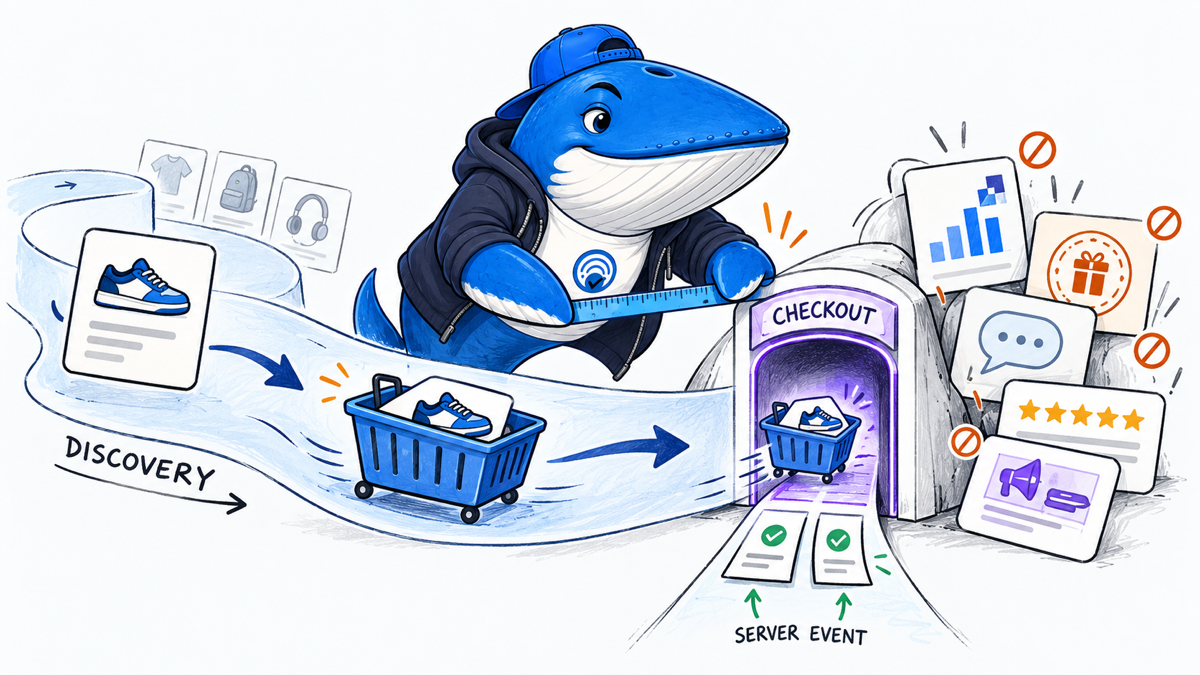
Shopify merchants should audit analytics, checkout blocks, and product eligibility before enabling direct checkout in Google AI Mode or Gemini. The checkout can keep a shopper inside Google’s interface, but Shopify says Google Analytics and custom pixels do not fire there. Many familiar checkout extensions can also be absent.
This is a rolling United States launch for eligible stores and customers, not a universal checkout replacement. A store can turn off direct checkout while keeping products discoverable through Google Merchant Center. That separation is the first control merchants need to understand.
Map three controls that do different jobs
Product discovery
Merchant Center can make eligible products discoverable in Google shopping experiences even when direct AI checkout is disabled.
Direct checkout
The Shopify setting controls whether an eligible shopper can complete the purchase in Google AI Mode or Gemini.
Open-web access
Crawler rules affect open-web discovery. They do not turn off a catalog channel the merchant has separately activated.
Shopify also serves /agents.md, /llms.txt and /llms-full.txt. It describes /agents.md as an agent-discovery URL. These files do not replace structured product syndication and should not be treated as the switch for Google catalog participation.
Run a checkout compatibility audit.
| Store capability | Documented behavior | Merchant check |
|---|---|---|
| Analytics and custom pixels | Do not fire in the Google-hosted flow | Rebuild reporting around Shopify’s server events and order data |
| Checkout started and completed | Shopify records server-to-server events | Confirm fields, timing and deduplication |
| Discounts and Shopify Functions | Supported | Test the exact discount and function combinations |
| Upsells and loyalty blocks | May not display | Measure average order value and loyalty identification |
| Consent, chat, trust badges and reviews | May not display | Move required disclosures into supported content |
| Subscriptions, bundles and customizable products | Not supported | Exclude or route the shopper to the store |
| Local pickup, local delivery and B2B-only products | Not supported | Verify catalog eligibility before launch |
The phrase “may not display” needs an inventory, not an assumption. Export the blocks and apps used on the current checkout. Label each one as revenue, legal, trust, support, or measurement. Then test whether its job is still completed in the Google flow. A missing decorative badge and a missing age declaration do not have the same risk.
Replace pixel reporting with an order-level comparison
Do not interpret an analytics gap as zero sales. Create a baseline before activation and compare the direct AI checkout cohort with an ordinary store checkout cohort. Keep market, product set, and date window visible.
- Coverage: eligible products, visible products, and products that reached direct checkout.
- Funnel: server-recorded checkout starts, completed orders, and abandonment.
- Economics: revenue, average order value, discounts, refunds, and payment processing cost.
- Customer outcome: support contacts, delivery exceptions, returns, and repeat purchase.
- Attribution quality: orders with a reliable channel marker versus orders inferred from timing or landing behavior.
Shopify says there are no additional Shopify fees for this channel beyond payment processing. That does not make the route cost-free. Lost upsell revenue, weaker loyalty capture, reporting work, and support exceptions belong in the commercial comparison.
Move decisive disclosures into the visible product content
Shopify advises placing important legal disclosures within the first 6,000 characters of product content. Treat that as a maximum boundary, not a writing target. Put age restrictions, material conditions, safety warnings, delivery limits, and other purchase-critical facts close to the claim or option they qualify.
Review product titles, descriptions, variants, prices, inventory, and return terms as they appear in the syndicated record. A disclosure that exists only in a checkout extension may disappear exactly when a shopper completes the purchase outside the storefront.
Test the transaction, not only the product card.
Create a small order matrix that combines a full-price product, an automatic discount, a discount code, different shipping zones, and a taxable address. For each order, compare the product price, discount, tax, shipping charge, payment result, inventory change, confirmation message, and final Shopify order record. A product can be eligible for discovery even if a transaction still produces an unexpected total or unsupported delivery option.
Then reverse the transaction. Cancel one order before fulfillment, refund another after fulfillment, and test a partial refund if the store uses it. Record whether inventory, tax, payment status, customer notification, and financial reports reconcile. This is especially important when the normal storefront relies on an app or checkout block to explain an exception that the Google-hosted flow does not render.
Keep the test orders clearly labeled and remove them from ordinary revenue analysis. The output should be a signed compatibility record for the current configuration, not a claim that every Shopify app or future Google checkout version behaves the same way.
Use a reversible release sequence.
- Save the current Google channel, direct-checkout, and crawler settings.
- Export the eligible product set and list every exclusion reason.
- Inventory checkout blocks, pixels, validations, and disclosures.
- Choose a small product cohort without subscriptions, bundles, customization, B2B restrictions, or local fulfillment.
- Place required disclosures in supported product content.
- Validate discounts, tax, shipping, payment, confirmation, and refund behavior.
- Run the cohort long enough to compare server-side starts, orders, average order value, and support outcomes.
- Expand only after the data and customer experience reconcile.
The strategic opportunity is a shorter path from product discovery to purchase. The operational risk is assuming the path carries the same analytics, extensions, and controls as the storefront. Shopify’s documentation says it does not. Treat the Google flow as a distinct checkout surface with its own release gate.
For the broader discovery question, use the AI crawler guide to separate crawling, retrieval, and training controls instead of treating every agent surface as one channel.
Shopify documentation
Keep learning
Continue this topic
Next in this topic
Cloudflare Web Search API Makes Crawler Rules Part of the Contract
Earlier in this topic
Cloudflare Pay-Per-Use Separates Access Fees From Content Use
AEO & AI Search
Ask a question or join the discussion