The evidence-led SEO publishing guide
A complete operating guide for defining the reader job, classifying claims, collecting evidence, adding information gain, reviewing skeptically, publishing, and maintaining the page.
Updated August 9, 2026: Re-edited as an answer-first operating guide with clearer evidence language, source proximity, and publication decisions.
Evidence-led SEO publishing starts with the reader’s decision, classifies every material claim, keeps facts close to their sources, and requires an original contribution before publication. The workflow also preserves enough of the research and release record to correct the page later.
It does not mean filling an article with citations until it becomes unreadable. It means knowing which sentences are facts, observations, interpretations, recommendations, and opinions; and giving each one the support it deserves.
1. Define the reader’s job
Start with a person in a situation:
This page helps this reader make this decision or complete this task under these constraints.
Name what the page will not do. A pre-launch checklist does not need to become a complete history of crawling. A tool review should not quietly become a vendor directory. Boundaries prevent broad topics from becoming shallow pages.
2. Classify the claims
Mark claims in the brief before drafting:
| Claim type | Required support | Typical language |
|---|---|---|
| Current product fact | Official, current documentation | “Google documents…” |
| Number or threshold | Original dataset, standard, or product owner | “The current threshold is…” |
| First-hand observation | Dated method, environment, and evidence | “In this crawl…” |
| Interpretation | Reasoning plus competing explanations | “This suggests…” |
| Recommendation | Mechanism, tradeoff, and scope | “Prefer this when…” |
| Opinion | Clear attribution to the author | “My view is…” |
If a statement crosses categories, split it. “The title changed and clicks improved, so the new title caused the gain” mixes an observation with a causal interpretation.
3. Build an evidence ladder
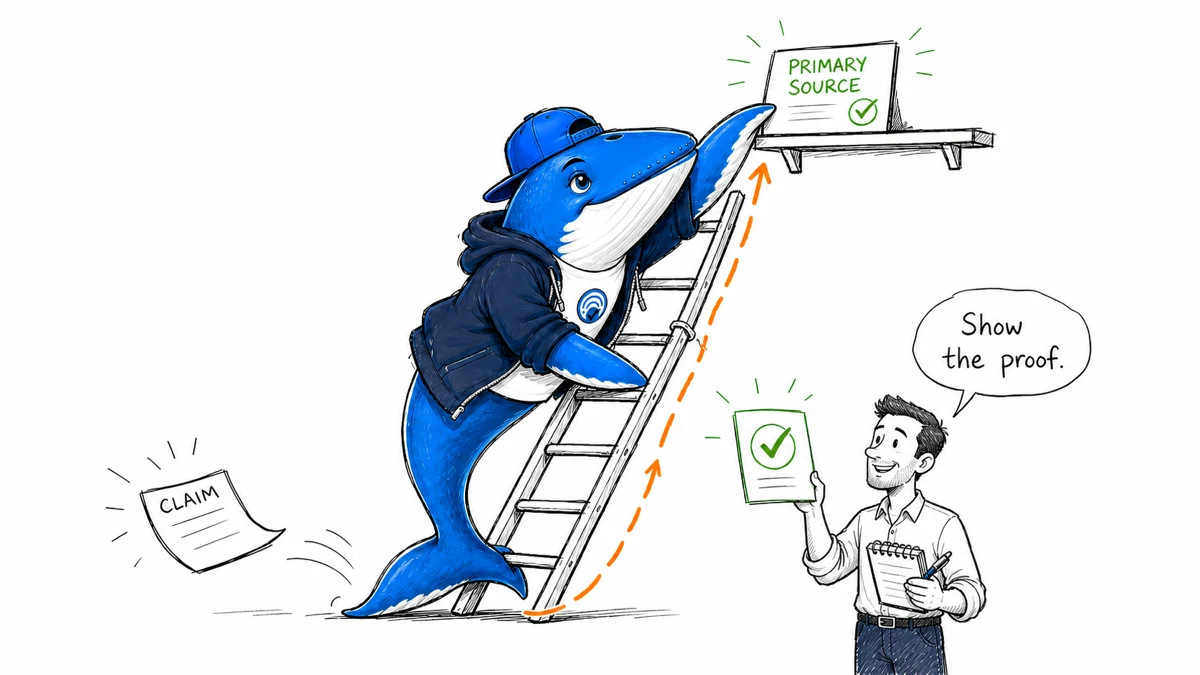
Prefer the source closest to the fact:
- standards, laws, official documentation, original research, datasets, filings, and direct test evidence;
- qualified analysis that links to its underlying evidence;
- reputable reporting for context and chronology;
- community discussion for leads, vocabulary, and edge cases;
- uncited summaries only as prompts for further research.
Source quality is not the only test. Check freshness, scope, conflicts of interest, sample design, and whether the source actually supports the sentence. A highly authoritative page can still be irrelevant to the claim.
4. Maintain a claim ledger
For every material claim, record the source, date, boundary, and status. Use three statuses:
- Verified: directly supported within the stated boundary.
- Qualified: useful but limited, uncertain, or based on indirect evidence.
- Remove: unsupported, obsolete, unnecessary, or impossible to reproduce.
This is especially important when AI assists with research. A fluent sentence is not evidence. If a generated claim cannot be mapped to the ledger, it does not enter the draft.
5. Choose the information-gain layer
A page should contribute more than a rearranged summary of existing results. Choose at least one:
- an original framework, scorecard, or decision tree;
- a first-hand test with a reproducible method;
- a tool, template, checklist, or calculation;
- a comparison under consistent criteria;
- a synthesis that resolves an important contradiction;
- a specific example that exposes a failure state.
The contribution should change what the reader can do. Novel phrasing alone is not information gain.
6. Draft in source proximity
Keep the relevant evidence open while drafting each section. Put citations beside the claims they support. Define an “as of” date inside time-sensitive sentences. Quote sparingly; paraphrase accurately and link to the source.
Write the direct answer before its background. Use a table when the reader needs exact comparison, a numbered list when order matters, and prose when the reasoning needs continuity. Do not turn every sentence into a bullet or every question into a miniature FAQ.
7. Humanize through judgment
Human editing is not adding filler, slang, or fake vulnerability. It is the removal of generic language and the addition of judgment:
- Which step matters first?
- What commonly goes wrong?
- Where does the recommendation stop applying?
- What would change the decision?
- Which evidence is missing?
Vary sentence length naturally, replace empty transitions with logic, and read the page aloud. Delete introductions that merely announce the topic and conclusions that repeat the headings.
8. Run a skeptical review
The reviewer should try to break the draft:
- Open every citation and confirm the claimed support.
- Search for numbers, dates, superlatives, named products, and causal language.
- Separate documented requirements from recommended practice.
- Check whether a first-person sentence reflects real experience.
- Look for missing counterexamples and scope limits.
- Compare the title, introduction, headings, and conclusion for promise drift.
- Test every internal and external link.
For AI-assisted material, also check for invented quotes, sources that exist but do not support the claim, stale product behavior, and repeated phrasing that disguises a lack of substance.
9. Prepare the page for discovery and use
Technical preparation remains ordinary and essential. Use a descriptive title and main heading, a useful meta description, a stable canonical URL, crawlable internal links, accurate structured data, properly sized media, and accessible alternative text.
Google states that content appearing in AI features does not require special schema or an AI-specific file. The page must meet the normal technical requirements for Search and be eligible for a snippet. OpenAI publishes crawler guidance for publishers, and Bing publishes webmaster guidelines. Follow the platform documentation rather than folklore.
Use the citation-ready passage test for important answers and the technical SEO launch checklist for a new release.
10. Publish with a maintenance contract
Assign an owner and an update trigger. Triggers can include product documentation changes, a new standard, a broken source, a material data update, a site migration, or reader feedback that exposes ambiguity.
When a material change is made, add a clear update note, revise the modified date, and preserve the URL where practical. If an error affected the conclusion, use the corrections process rather than silently rewriting history.
11. Measure the page at the right layer
Match evidence to the decision. Search Console can show search observations; analytics can show on-site behavior; a crawler can show technical exposure; browser diagnostics can locate performance problems; platform-specific AI reports may show referrals or citations.
None of these automatically proves causation. Record the release, baseline, time window, confounders, and decision rule. The small SEO experiment method provides a reusable observation card.
The final publication gate
A page is ready when:
- the reader job and boundary are explicit;
- material facts are verified, and citations resolve;
- uncertainty is visible rather than smoothed away;
- the page contributes a usable original layer;
- the prose has survived a human, skeptical edit;
- metadata, links, media, and structured data match the visible content;
- an owner and update trigger are recorded.
Publish only when the page’s reader job, evidence, original contribution, limits, metadata, owner, and update trigger are all visible. That gate is slower than pressing “generate,” but faster than repairing a library whose claims, links, and purpose were never recorded.
Editorial triage
One claim can determine whether an article should publish, wait or become a test
Consider the draft claim “adding an FAQ block increases AI citations.” The wording sounds actionable, but it contains an unproven causal result.
- If first-party before-and-after evidence exists, publish the bounded result with conditions.
- If only documentation exists, explain the feature without claiming a citation lift.
- If the claim matters but evidence is missing, convert it into a preregistered test and wait.
My takeaway: Evidence-led publishing is not about making every article academic. It is about matching the strength of the sentence to the strength of the evidence.
Primary documentation
Keep learning
Continue this topic
Next in this topic
How to Evaluate an SEO or GEO Tool Without Accepting Its Score as Google Data
Earlier in this topic
How to audit a new website: a priority-first SEO checklist
SEO
Ask a question or join the discussion