Google Merchant Center’s AI Report Exposes Shopping Terms and Intent
Interpret Merchant Center AI share of voice, stage and product signals, then test optional conversational attributes without confusing visibility with revenue.
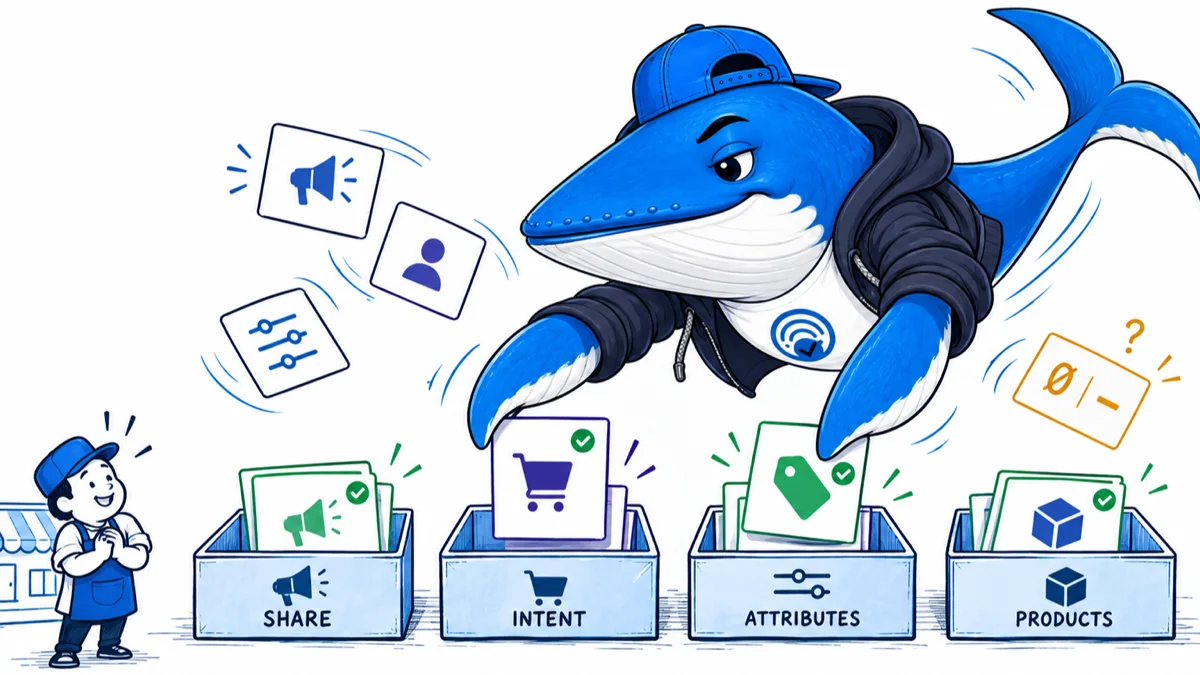
Direct answer: Google Merchant Center’s AI performance view can show how a merchant appears in organic AI shopping experiences through share of voice, visible products, terms, product attributes and shopping stages. It is a directional merchandising report, not a complete sales attribution system.
The highest-value use is to connect a visible demand pattern to a catalog or landing-page decision, then recheck it after the reporting lag. Screenshots without filters and dates are weak evidence.
What Google documents
Google’s Merchant Center help page describes organic traffic insights for AI Mode and AI Overviews. The interface can compare a merchant’s share of voice with a competitor average, show how often products appear and surface terms, attributes and intents associated with AI shopping activity.
Availability is limited by market, language, category and data sufficiency. Record the country, selected category and date range with every observation.
Read each metric as a different denominator
| Metric | Useful question | Do not infer |
|---|---|---|
| Own share of voice | Own AI impressions divided by own plus Merchant Center-defined competitor impressions for the selected view. | Total market share, query volume, clicks or revenue. |
| Competitor average | How did a defined comparison set appear? | A complete list of rivals. |
| Frequency | How often was a term or intent observed? | Exact query volume. |
| Products showing | How many products appeared? | Clicks, orders or product quality. |
Zero, dash and 100% require different treatment
Illustrative calculation: if the report counted 240 impressions for your products and 760 across the comparison set, the share would be 240 divided by 1,000, or 24%. This example explains the denominator; it is not a Merchant Center account result. Because Google defines the competitors, the percentage cannot be read as a market-wide share.
Google’s help text distinguishes unavailable or insufficient data from exact product counts. A dash indicates no impression data. A zero share-of-voice value can reflect insufficient impressions, while zero products is an exact count in that view. A 100% share can occur when no competitors are defined, so it does not automatically mean dominance.
Preserve the UI state in your worksheet. Do not turn a blank, dash and numeric zero into the same database value.
Shopping stages turn terms into tasks
The report groups activity into discovery, evaluation and ready-to-buy stages. Use those labels to ask different content questions. Discovery may expose missing category education. Evaluation may reveal attributes buyers compare. Ready-to-buy may expose availability, delivery, price or compatibility requirements.
A stage is a modelled classification, not a transcript of an individual’s intent. Validate it against the actual page, product feed and customer support language.
Use conversational attributes as a controlled catalog intervention
Google now documents six optional conversational attributes: question_and_answer, document_link, related_product, item_group_title, variant_option and popularity_rank. Google recommends a supplemental data source, although the fields can also be added to a primary source or sent through the Merchant API.
| Observed gap | Candidate field | Acceptance check |
|---|---|---|
| A recurring product question has no structured answer | question_and_answer |
The answer is factual, product-specific and consistent with the landing page. |
| A manual, size chart or policy page carries decisive detail | document_link |
The URL is public, current and directly relevant to that product. |
| Compatibility or accessory choice is unclear | related_product |
The relationship type and identifier resolve to the intended item. |
| Variants are difficult to compare | item_group_title and variant_option |
The group identity and option values match the primary feed and page. |
| The merchant wants to express internal relative popularity | popularity_rank |
The percentage is based on the merchant’s own inventory, not a market claim. |
These fields are optional and Google says they do not change product approval. That is not a ranking guarantee. Add the smallest field set that addresses the observed gap, preserve the previous feed state and compare the same country, category and date window after the reporting lag.
Google’s conversational-attributes guide also warns against duplicating details already supplied through description, product highlight or product detail fields.
Connect an observation to one controlled change
- High term frequency, low product coverage: inspect feed eligibility and category mapping.
- Strong discovery visibility, weak evaluation: improve comparable attributes and evidence.
- Products show but landing pages mismatch the offer: reconcile price, availability and canonical URL.
- Own and competitor averages both rise: avoid calling it a competitive win without the denominator.
- No data: widen the date range or wait for sufficient activity before editing.
Change one important layer at a time. A simultaneous feed rewrite, page redesign and promotion leaves no interpretable result.
A practical weekly workflow
- Select one country and one product category.
- Save the date range and report update time.
- Capture share, competitor average, frequency and product count.
- Record the top term, intent or attribute behind the decision.
- Open the affected products and verify feed-to-page consistency.
- Assign one change, an owner and a recheck date.
- Compare matched filters after the documented reporting lag.
For broader measurement, pair this with our AI search analytics framework and product-data guidance.
What the report cannot settle
The view does not prove why a product was selected, whether a user noticed it, or whether an AI appearance caused a purchase. Google also controls the competitor set, and the interface does not provide an all-category comparison. Daily updates can arrive several days late.
Treat the report as a hypothesis generator. Revenue attribution still needs analytics, clean campaign logic where available, order evidence and a realistic observation window.
Download the Merchant Center AI worksheet
Download the CSV worksheet. It preserves filters, shopping stage, UI state, metric values, decision, owner and recheck date.
All sample rows are marked EXAMPLE-REMOVE. Replace them with dated observations from your own account.
September rollout: five countries now have AI performance insights
Google’s September 16 shopping update lists Merchant Center AI performance insights in Australia, Canada, India, New Zealand and the United States. Availability is still a product and account question, so merchants should record whether the report is present before treating a missing card as zero visibility.
| Release | Market status | Measurement unit |
|---|---|---|
| Merchant Center AI insights | AU, CA, IN, NZ and US | Organic shopping visibility metrics inside Merchant Center. |
| Business Agent for YouTube ads | Beta in the US | Agent interaction after the advertising surface. |
| UCP cart transfer and checkout-flow tests | Rolling out in the US; AU and CA planned for early 2027 | Checkout eligibility, transfer and completion. |
Do not combine these rows into one AI-commerce score. One is an organic visibility report, one is an advertising agent, and one is a transaction flow.
Evidence note
This guide uses Google’s AI performance insights documentation, conversational-attributes guide and September 16 shopping announcement. SearchEngineAnswer did not access a merchant’s private report and does not claim account availability, ranking improvement or revenue lift.
Keep learning
Continue this topic
Next in this topic
Mistral Agentic Search Investigates Documents Beyond the First Chunks
Earlier in this topic
WebMCP Site Tools: What ChatGPT Can Discover and What It Cannot
Tools & Workflows
Ask a question or join the discussion