Mistral Agentic Search Investigates Documents Beyond the First Chunks
Mistral's agentic retrieval layer can search, open, navigate, read and grep across ingested documents. Its benchmark claims are promising but vendor-reported.
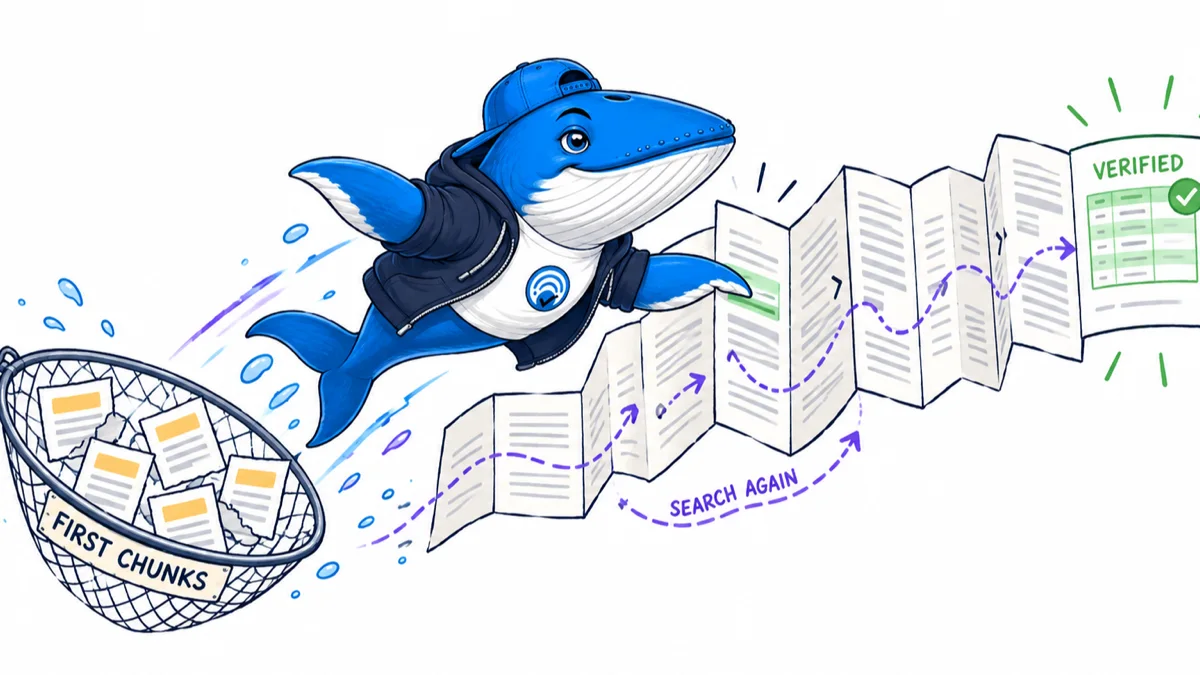
Direct answer: Mistral Agentic Search gives a model a loop for finding evidence inside document collections. Instead of accepting one fixed top-k retrieval result, the agent can search, open, navigate, read and grep, then refine the search when the first chunks do not answer the question.
This is most useful for cross-document and distant-section questions. It can be unnecessary overhead for a simple lookup that conventional retrieval already answers well.
What Mistral launched
Mistral announced Agentic Search on August 20, 2026. Its documentation describes tools for search, open, navigate, read, grep, ingest and delete. The agent can iterate and exclude chunks it has already examined.
The distinction is control flow. Traditional RAG usually retrieves a set of chunks before generation. Agentic retrieval can decide that the evidence is incomplete and perform another targeted action.
The best candidates require investigation
- A policy answer that combines a definition, exception and later amendment.
- A financial question that joins values across filings or tables.
- A support answer where product version and date determine the instruction.
- A comparison that needs the same field from several long documents.
A short FAQ, exact identifier lookup or single clearly titled paragraph is a weaker candidate. Use the simplest retrieval method that meets the support requirement.
The benchmark gains are vendor-reported
| Benchmark or measure | Reported change |
|---|---|
| FinanceBench | 26.7% to 86% |
| OfficeQA Pro | 6.3% to 51.9% |
| p90 latency | Reduction of up to 39.6% |
| Token use | Reduction of up to one-third |
SearchEngineAnswer has not rerun these benchmarks. Dataset setup, baseline configuration, model choice and stopping policy can materially change the comparison.
Count tool steps, not only answer tokens
An agentic system can save tokens if it avoids stuffing many irrelevant chunks into context. It can also add latency and calls when it searches repeatedly. Measure input and output tokens, retrieval calls, tool steps, wall time and failed paths on the same question set.
Cost should be evaluated per supported answer, not per call. A cheaper answer that cites the wrong section is not a successful optimization.
A matched evaluation needs a gold evidence set
- Select questions that represent real user work, not only easy lookups.
- Record the exact passages required for a supported answer.
- Run the same model and documents with one-shot and agentic retrieval.
- Blind-review answer correctness and evidence support.
- Log latency, tokens, tool steps and failure type.
- Separate retrieval failure from reasoning and citation failure.
- Repeat after changing chunking, model or stopping rules.
Operational risks move with the agent
An iterative retriever needs authorization boundaries for document sets, protection against prompt injection in retrieved content and logs that explain which tools and passages affected the answer. Deleting or re-ingesting a document should not silently leave stale evidence in a cache.
For public-site retrieval, pair the test with our AI crawler log verification guide. For numerical answers, use the four-state citation check.
Download the retrieval evaluation sheet
Download the matched evaluation CSV. It records question type, gold answer, support result, latency, tokens, tool steps and failure type for both methods.
Rows marked EXAMPLE-REMOVE illustrate the schema and are not Mistral benchmark observations.
Evidence note
Feature behavior and benchmark figures come from Mistral’s announcement and documentation. We mapped them to an independent evaluation design but did not reproduce the vendor benchmark or inspect a private production deployment.
Keep learning
Continue this topic
Next in this topic
ChatGPT Data Agent Makes Metric Definitions Part of SEO Reporting
Earlier in this topic
Google Merchant Center’s AI Report Exposes Shopping Terms and Intent
Tools & Workflows
Ask a question or join the discussion