You.com Machine Payments: Choose x402, MPP, or an API Key
Choose a You.com API key, x402 or MPP by comparing endpoint and method support, live terms, receipts, retry safety, operating cost, ownership and the ZDR boundary.
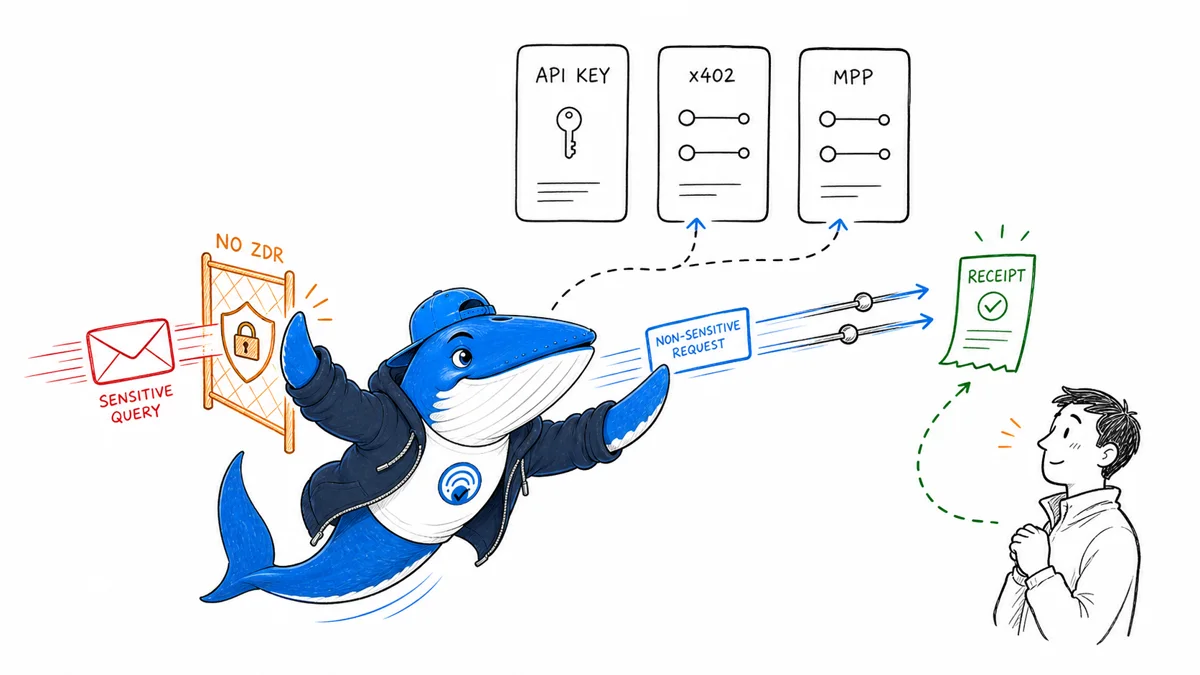
Direct answer: use a You.com API key when a managed organization needs team controls, account analytics or contractual Zero Data Retention. Use x402 or MPP when a programmatic caller genuinely needs per-request payment without an account, and only after the client can preserve the payment challenge, prevent unsafe retries, reconcile the receipt and keep sensitive queries outside a path that does not provide ZDR.
As retrieved on August 31, 2026, You.com’s machine-payment documentation advertises Web Search and Finance Research through x402 and MPP. It says the search index, latency and response shape are the same as key-authenticated requests; the access and payment contract changes, not the search-quality promise.
Choose an access contract, not a fashionable protocol
Start with the operator and data boundary. A person provisioning repeat access for a team usually benefits from an API key, usage records and organization controls. A wallet-bearing automated caller may benefit from a challenge-based payment path when account creation and prepaid credits are the real constraint.
The current Machine Payments overview explicitly recommends API keys for human-provisioned recurring use and states that ZDR is not available on keyless requests. Avoid describing keyless access as anonymous, private or retention-free merely because it carries no You.com account key.
Compare API key, x402 and MPP side by side
| Field | API key | x402 | MPP |
|---|---|---|---|
| Provisioning | Account, credits and key | Wallet on an advertised rail | Wallet on the advertised method |
| Exchange | Authenticated API request | 402 terms, payment proof, response | Challenge, Credential and Receipt |
| Web Search price* | Current credit price | $0.005 per call | $0.01 per call |
| Organization analytics | Available | Not inherited | Not inherited |
| ZDR | Available by eligible agreement | Not available | Not available |
*Prices are a retrieval-date snapshot, not a permanent quote. Read the live challenge and current documentation before deployment.
Verify endpoint and method before building the client
The current docs list Web Search and Finance Research as machine-payment surfaces, but method support matters. The MPP documentation warns that POST /v1/search does not accept machine payments and points POST callers to /v1/agents/search. It also notes that the older livecrawl parameter still works while POST callers should prefer the newer extraction path.
Save the exact HTTP method, endpoint, parameters and documentation retrieval time. Do not assume that another You.com endpoint, an SDK convenience method or a future parameter inherits the same payment contract.
Record the complete payment exchange
Preserve the initial 402 response, offered methods, price, currency, expiration, safe request fingerprint, proof reference, retry number, final status and receipt reference. Never copy a private key, seed phrase, full authorization credential or sensitive query into a shared debugging ledger.
| Stage | Keep | Failure class |
|---|---|---|
| Challenge | Request fingerprint, terms, amount and expiry | No offer, unsupported method or rate limit |
| Payment | Rail, currency and non-secret proof reference | Insufficient funds, stale proof or settlement failure |
| API response | Status, receipt reference and response time | Provider error, empty result or invalid request |
| Application | Parser result and acceptance rule | Schema, storage, rendering or business-rule failure |
Design retries around uncertainty after payment
A timeout can occur after funds move but before the client receives a usable response. Replaying the whole flow without checking the original challenge or receipt can create duplicate spend. Use provider-documented single-use and replay semantics, hold the challenge you were issued and define when a human or reconciliation job must intervene.
The current MPP guide says challenges are single use, describes an issuance rate limit and notes that stablecoin settlement is final with no testnet. Those constraints make a non-sensitive, low-spend canary more important than a happy-path code example.
Calculate observed cost rather than the headline price
The current overview lists Web Search at half a cent through x402 and one cent through MPP; Finance Research prices vary by effort tier but are the same across the two advertised protocols. MPP’s one-cent Web Search floor comes from its currently enabled settlement path. That is a current product detail, not a general truth about the protocol.
Model paid retries, live-content extraction, result count, wallet funding, rail fees where applicable and operator reconciliation. Report total observed cost per accepted request. A cheap payment that produces a rejected or duplicate application result is not a cheap successful task.
Put the privacy decision before the wallet decision
You.com documents ZDR as an account-level enterprise configuration that cannot attach to an MPP request without an organization identity. Treat the same no-ZDR boundary as decisive for keyless routing. A payment credential’s wallet or account identifier is not a You.com organization and does not carry its contract.
Map what the client, payment rail, destination API, application logs and downstream store each retain. If the caller handles regulated, confidential or client-bound queries, default to the approved organization path until legal and security owners explicitly accept another contract.
Run a bounded non-sensitive canary
| Test | Expected evidence | Stop condition |
|---|---|---|
| Valid payment | Challenge, proof reference, response and receipt reconcile | Amount or receipt cannot be matched |
| Expired challenge | Clear rejection without accidental spend | Client loops or pays stale terms |
| Timeout after payment | Deterministic reconcile-or-escalate path | Blind replay can double charge |
| Provider or parser failure | Payment and application failures remain distinct | Monitoring labels every failure as payment |
| Sensitive query guard | Policy blocks the keyless route | Query can bypass the retention rule |
Assign treasury and incident ownership
A production keyless client needs more than a wallet. Name who funds it, who approves rail and currency exposure, who reconciles receipts, who investigates a disputed or duplicate payment, and who can disable the route. Set a per-request ceiling, a time-window ceiling and an alert for repeated challenges before connecting unattended traffic.
Keep payment operations separate from search acceptance. The treasury record can prove that a charge settled, while the application record shows whether the response passed schema, content and business rules. Reconcile them with a safe request fingerprint rather than copying the full query or credential into both systems.
Document the fallback too. If a payment rail is unavailable, decide whether the caller may switch to another advertised protocol, use an organization key, queue the request or fail closed. An automatic fallback that bypasses the approved retention contract is not resilience.
Download the decision ledger
Download the You.com machine-payment decision ledger (CSV). Its example row is labelled EXAMPLE-REMOVE; replace it with observed challenge and receipt data. Use references instead of secrets.
Use the separate You.com citation-audit workflow to test answer support. Changing authentication and payment does not demonstrate a different index, citation pattern or result quality.
Limits and recheck points
SearchEngineAnswer did not make a machine payment or benchmark the endpoints for this rebuild. Current prices, rails, methods, parameters, endpoint coverage and retention terms can change. Reopen the official documentation and inspect the actual challenge immediately before procurement, publication and production release.
For the broader buy-versus-build decision, use the lean SEO tool-stack framework.
Primary documentation
Keep learning
Continue this topic
Next in this topic
Gemini 3.6 Flash Deprecates Sampling Controls: Update Grounded-Answer Test Harnesses
Earlier in this topic
Claude Web Search HTTP 200 Errors: Parsing and ZDR
Tools & Workflows
Ask a question or join the discussion