Are People Also Ask Answers Becoming AI-Generated?
A third-party report says AI-generated People Also Ask answers reached 97% of its English-language sample. Here is what the number can support and how to audit it.
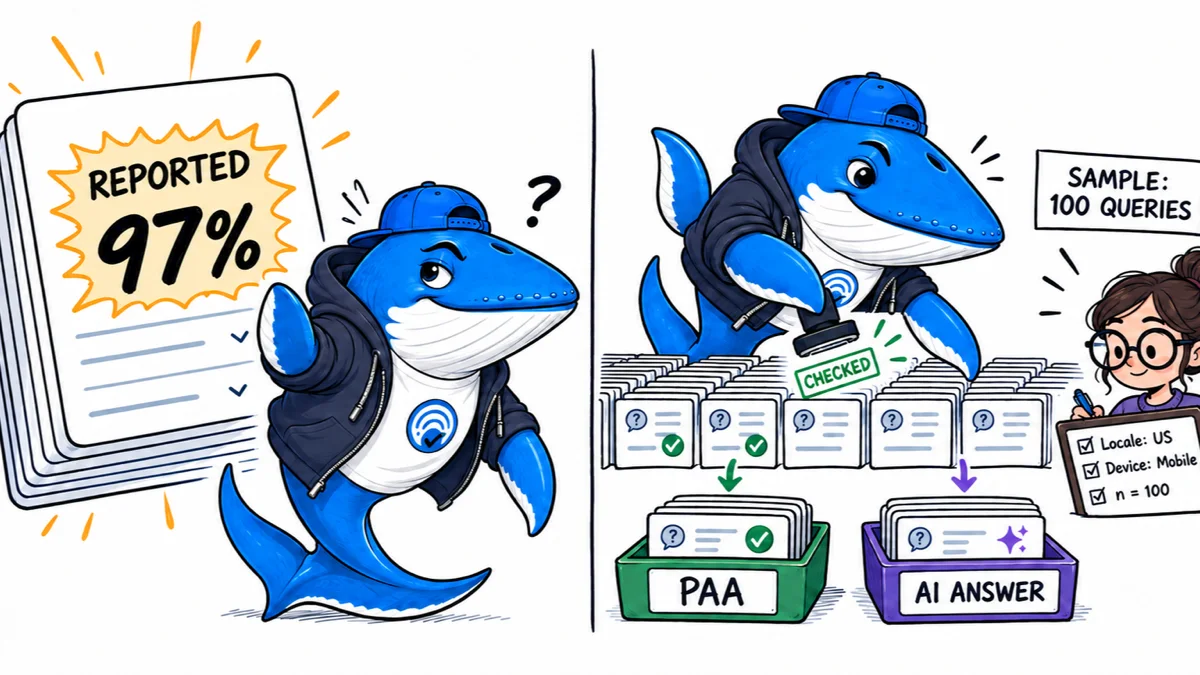
Direct answer: A third-party analysis reported that 97% of visible People Also Ask answers in its early September English-language sample were AI-generated, up from 86% in August. Google has not confirmed that percentage, and the underlying classification rule and raw observations are not public enough for us to treat it as a platform-wide fact.
The useful response is a reproducible panel: track the same questions, record whether PAA appears, expand the same position and save the exact cue used to classify the answer.
What was reported
Search Engine Roundtable summarized data attributed to AlsoAsked and Allintitle. The AlsoAsked sample was described as 19.2 million English-language searches in 2026, with 97% of PAA answers classified as AI-generated in the first week of September and 86% in August.
That is a report about a provider’s observed sample. It is not a Google product announcement, a random sample of all searches or proof that every PAA answer uses the same generation system.
Four denominators can produce four percentages
| Denominator | Question |
|---|---|
| Tracked queries | How many monitored searches showed an AI-classified PAA answer? |
| Queries with PAA | Among searches containing the feature, how often did classification occur? |
| Expanded questions | Among opened questions, how many answers met the rule? |
| Answer observations | Across repeated dates, devices and locations, how many observations met it? |
These rates are not interchangeable. A high answer-level rate can coexist with a falling share of queries that show PAA at all.
The classification rule is the central missing detail
An auditor needs an observable rule: a visible AI label, an interface pattern, a source treatment or a documented response marker. Similar prose style is not enough. Search snippets can be rewritten, and an unfamiliar answer is not automatically generated.
Record the exact cue as text and preserve a screenshot identifier. If the cue is absent, use unknown instead of guessing.
Build a 100-query matched panel
- Select 25 informational, 25 commercial, 25 local and 25 current-event queries.
- Fix locale, language, device and signed-in state.
- Record whether PAA appears before expanding anything.
- Expand a predefined position, such as the first visible question.
- Apply the written classification rule and record citations.
- Repeat weekly without changing the panel.
- Report query, PAA and answer denominators separately.
This does not reproduce a 19.2 million-query crawl. It creates a smaller panel whose evidence and changes you can inspect.
Publishers should inspect source behavior, not just prose
If the answer format changes, watch whether cited domains, source positions and click paths change with it. Save which pages are cited, whether the link is visible before expansion and whether the answer supports the wording it attributes to the source.
Our citation-support audit shows why a visible link and a supported claim are separate checks. The Google AI citation audit provides a second model for preserving a matched query panel. The same discipline applies to PAA observations.
Three claims the current evidence cannot support
- “Google replaced every PAA answer with AI.” The sample and product scope do not establish that.
- “AI-generated PAA caused a traffic decline.” No matched click analysis is supplied.
- “This is an algorithm update.” A surface change and a ranking-system update are different claims.
A careful headline can still be interesting. It should tell readers that the percentage is reported and that the article tests what would make it verifiable.
Download the PAA observation ledger
Download the 100-query audit CSV. It includes locale, device, account state, PAA presence, expansion state, classification cue, citations and screenshot ID.
The two starter rows are marked EXAMPLE-REMOVE. They are schema examples, not observations.
Evidence note
This article reports a secondary account of AlsoAsked and Allintitle data and does not claim independent reproduction. Google documents AI features and website controls, but we found no official confirmation of the reported PAA percentage. The downloadable protocol is our original contribution.
Keep learning
Continue this topic
Next in this topic
What 7,473 AI Citations Can and Cannot Tell Us
Earlier in this topic
Agentic Commerce Standards Split Across Protocols, Data and Trust
Research
Ask a question or join the discussion