Does Replying to Google Reviews Faster Improve Local Rankings?
Google recommends useful review replies but does not document reply speed as a local-ranking factor. Here is a service policy and a cautious test design.
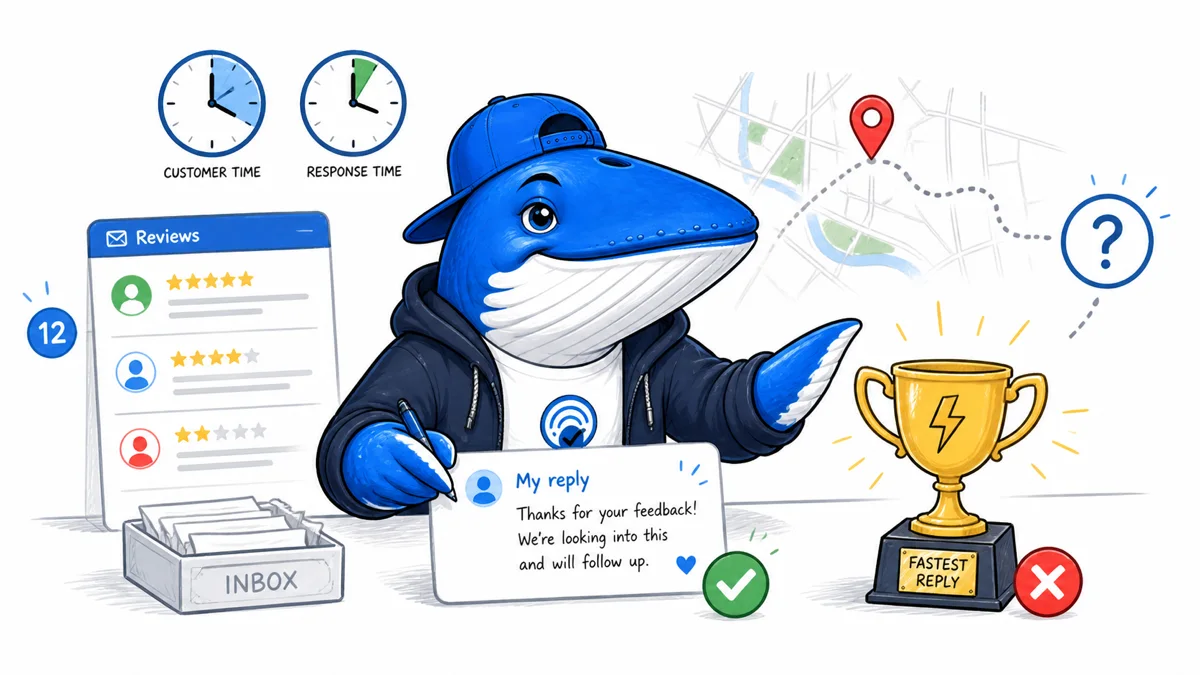
Verdict: reply to reviews promptly for customers, not for an undocumented speed boost
Google encourages businesses to reply to reviews and says replies show that a business values customer feedback. Google’s published local-ranking guidance names relevance, distance, and prominence, and notes that review count and rating can help local ranking. It does not document response speed as a ranking factor.
A faster reply can still be valuable: it can resolve problems, show prospective customers that the business is active, and improve operational follow-up. Those are real reasons to establish a response target. They are not evidence of a direct ranking effect.
What Google says—and what it does not
| Claim | Evidence status | Practical conclusion |
|---|---|---|
| Businesses should respond to reviews | Documented in Google’s review-reply guidance. | Create an owned process and answer constructively. |
| Replies should be useful and appropriate | Google recommends positive, relevant, concise, and personalized responses in its review tips. | Do not trade accuracy or privacy for speed. |
| Reviews can relate to prominence | Google says more reviews and positive ratings can help local ranking. | Earn legitimate reviews; do not manipulate them. |
| Replying within 24 hours raises rankings | Not documented in Google’s published local-ranking factors. | Treat it as an unproven hypothesis. |
The current discussion comes from an r/localseo anecdote comparing two clients. Similar-looking businesses are not controlled experiments: location, category, review velocity, rating, demand, competition, profile completeness, website relevance, links, and user behavior can differ.
A sensible review-response policy
- Triage quickly: flag safety, legal, privacy, discrimination, and urgent service complaints for the appropriate owner.
- Reply on a declared service target: for example, one business day for ordinary reviews and faster escalation for urgent issues.
- Personalize the substance: acknowledge the actual feedback without exposing private account, medical, employment, or transaction details.
- Avoid templated keyword stuffing: a reply is customer communication, not a place to repeat city and service terms.
- Measure customer outcomes: resolution time, reopened issues, sentiment, calls, bookings, and repeat business are more direct service measures than local rank.
Google’s local ranking explanation says results are mainly based on relevance, distance, and prominence. That public model should anchor the interpretation until stronger evidence exists.
How to test the hypothesis without manufacturing certainty
1. Pre-register the question
Write the claim before looking at the result: “Reducing median owner-response time from X to Y is associated with a change in defined local-pack visibility, after controlling for review acquisition and other planned changes.” State the locations, queries, grid, dates, metric, minimum observation window, and stop rules.
2. Use matched locations where possible
Choose businesses with comparable categories, markets, baseline ratings, review counts, review velocity, profile completeness, and website support. Randomly assign the response-time policy if operationally possible. Never delay an urgent customer response for an SEO test.
3. Freeze or record competing work
Document website releases, categories, services, photos, posts, citations, links, advertising, promotions, and major competitor changes. Track new-review volume and rating because those are obvious confounders.
4. Measure a stable local grid
Use the same query set, coordinates, language, device assumptions, and schedule. Report distributions rather than one screenshot. A single position at one coordinate is not a market-wide ranking.
5. Report association, not a factor declaration
If the test group moves, examine whether the effect is consistent, large enough to matter, and durable. A result from a small set of locations remains a local observation. A null result also does not prove that no indirect customer effect exists.
What to do now
Set a response service level that your team can meet without sacrificing quality. Use alerts and ownership rules, train staff on privacy, and review unresolved themes monthly. If you test ranking effects, preserve the protocol and raw observations. Do not sell “reply within 24 hours” as a proven local SEO tactic based on two clients.
Sources and evidence limits
We checked Google’s Business Profile ranking and review guidance on August 29, 2026. The Reddit post is cited as the origin of the hypothesis, not evidence of causality. We found no Google documentation naming owner-response latency as a direct local-ranking factor.
Keep learning
Continue this topic
Next in this topic
Two GEO defense papers test different failures in AI answers
Earlier in this topic
Do AI Crawlers Request Markdown? Test the Accept Header First
Research
Ask a question or join the discussion