Google Election Answers Across Search and Gemini: Source Audit
Google is adding U.S. election information across Search and Gemini. This privacy-safe audit separates official authorities, answer sources and media provenance.
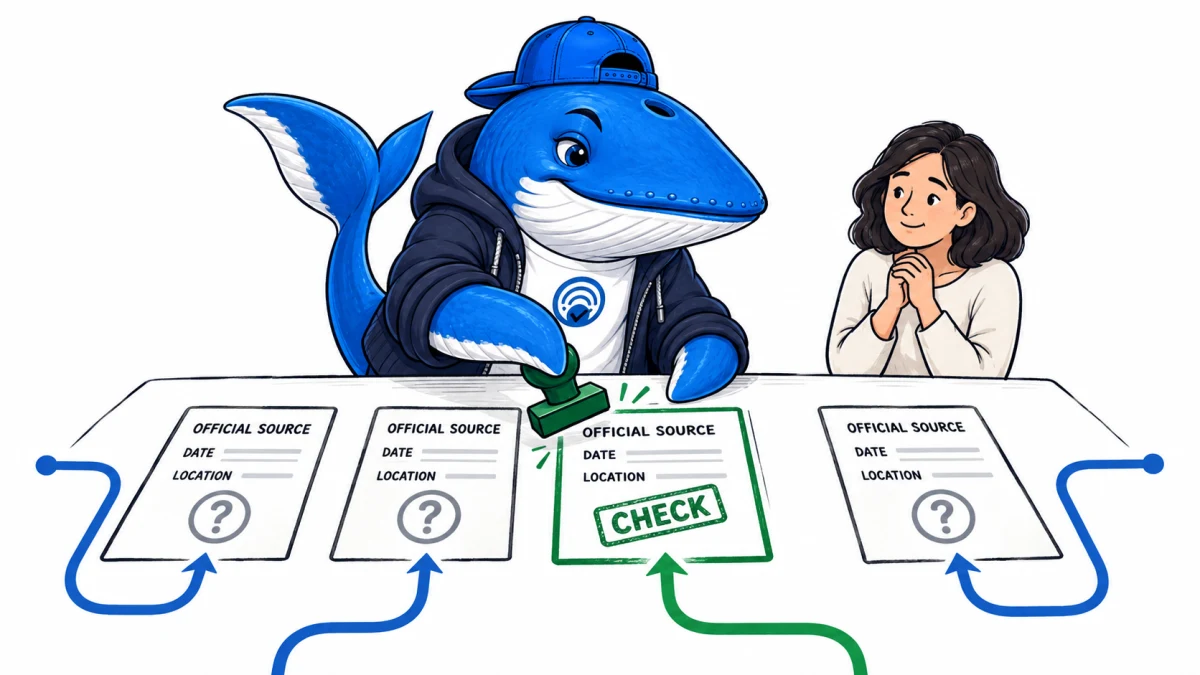
Direct answer: Google says it is rolling out U.S. election-information tools across Search, AI Overviews, AI Mode and Gemini. The announced experiences can use state and local government information, Democracy Works data and Associated Press results. Readers should still confirm voting instructions with the official election authority for their jurisdiction.
This guide helps newsrooms and researchers distinguish the answer shown by Google, the source cited for a claim and the authority responsible for the underlying election rule or result.
What Google announced
Google’s September 9 election announcement describes interactive information across Search, including AI Mode and AI Overviews, and Gemini. Examples include registration deadlines, polling locations and election results.
Google identifies state and local governments and Democracy Works for voting information, and the Associated Press for real-time results. It also describes political-ad disclosures, protections for high-risk users and provenance systems including SynthID, C2PA and Backstory. These systems solve different problems. A provenance cue does not prove that an election answer is complete.
Treat each Google surface as a separate observation
| Surface | Observable evidence | Do not assume |
|---|---|---|
| Search result | Dedicated module, source link, update time | Every user receives the same module. |
| AI Overview | Summary, citation placement, linked authority | One citation supports every sentence. |
| AI Mode | Conversation, follow-up context, source panel | Location context is complete. |
| Gemini | Answer, source owner, link and warning language | Search and Gemini use identical retrieval. |
Use an authority ladder for each claim
The best source depends on the question. A state election office can own a statewide registration deadline, while a county or municipal authority may own the address and hours for a local polling place. The Associated Press can report a race call, but the responsible election authority owns certification.
| Question type | Preferred authority | Common mismatch |
|---|---|---|
| Registration rule or deadline | State election authority | National summary omits a state exception. |
| Polling place or local hours | Local election authority | State page lacks precinct detail. |
| Voting method | Authority that administers the method | General guidance misses eligibility rules. |
| Live result or race call | Named results provider | A projection is described as certified. |
| Certified result | Responsible election authority | A media tally is treated as the legal result. |
Run the official-source check
For registration, deadlines and polling locations, confidence of tone is irrelevant. Check whether the answer identifies the correct jurisdiction, links to an appropriate election authority or named data provider, and shows a freshness cue that fits the question.
- Record the exact query without adding personal voter data.
- Record state or locality only at the level required for the public test.
- Open the cited destination and identify its owner.
- Compare the answer’s date, place and instruction with the destination.
- Classify missing jurisdiction, stale date or unsupported detail separately.
A worked source-matching example
Consider the public query, “What is the voter-registration deadline in Fulton County, Georgia?” The answer must first resolve the state because Georgia sets the registration rule. A county destination can still be useful for local administration, but it should not replace the state authority for the deadline unless the page clearly republishes the current state rule.
Record the answer’s stated date, the cited page owner, the destination’s own update date and whether the page applies to the named election. If the answer gives a date but the citation opens only a generic election homepage, mark the claim as unverified until the specific rule is found. This is an illustrative review pattern, not a reported Google result.
A bounded 30-query audit
An initial audit can use six questions in each of five families: registration, voting methods, polling location, deadlines and results. Run only public, non-personal queries. Freeze the date, device, locale, signed-in state and surface. When a surface is unavailable, record “not available” instead of substituting a different product.
The sample can reveal failure modes and provenance patterns. It cannot establish nationwide accuracy, neutrality, completeness or political bias. Preserve a disputed or missing result with a screenshot, then verify the claim with the responsible authority before reporting it.
Triage errors by reader risk
| Failure | Reader risk | Action |
|---|---|---|
| Wrong date, place or eligibility rule | High | Do not repeat it. Link the official correction and retain evidence. |
| Projection labeled as final | High | Correct the status and name the results owner. |
| Citation supports only part of the answer | Medium | Split the claims and verify each one. |
| Generic destination | Medium | Find the precise official page before publishing. |
| Missing provenance badge | Context dependent | Do not treat absence as proof that media is false. |
Provenance tools answer a different question
SynthID, C2PA credentials and Backstory can help identify the origin or editing history of some media. They do not verify that a claim about a candidate, deadline or result is true. An ad disclosure explains who paid for an advertisement; it does not turn the ad into an official election record.
Use three fields: content origin, claim source and official authority. Keeping them separate prevents a media credential from being mistaken for factual validation.
A publish gate for newsrooms and civic publishers
- Put jurisdiction, effective date and source owner beside every voting instruction.
- Link to the precise official page, not only a government homepage.
- Separate projected, called, certified and final results in text and structured data.
- Publish corrections with a visible timestamp and explanation.
- Do not collect addresses or voter records merely to reproduce a public interface test.
Hold the story if a high-risk claim lacks a matching authority, if the election date is ambiguous or if the result status cannot be distinguished. Our editorial policy and corrections policy describe the publication-level controls.
Download the source-provenance worksheet
Download the 30-query CSV template. Its rows are placeholders marked EXAMPLE-REMOVE. Avoid names, street addresses, voter-registration records and other personal information.
Official reference
Current product details come from Google’s 2026 U.S. midterm elections announcement, checked September 9, 2026. Confirm voting details with the responsible state or local election authority.
Keep learning
Continue this topic
Next in this topic
Google AI Mode Travel: The Booking and Publisher Handoff Map
Earlier in this topic
ChatGPT Voice Can Switch Models for Search: What to Audit
AEO & AI Search
Ask a question or join the discussion