French News Publishers and AI: Google News & Discover Guide
French news publishers can use AI to accelerate document review, transcription, accessibility, quality control and format adaptation—while keeping human accountability and original reporting at the center. This guide maps the technical, editorial and measurement work required across Google News, Discover, AI answers and direct readership.
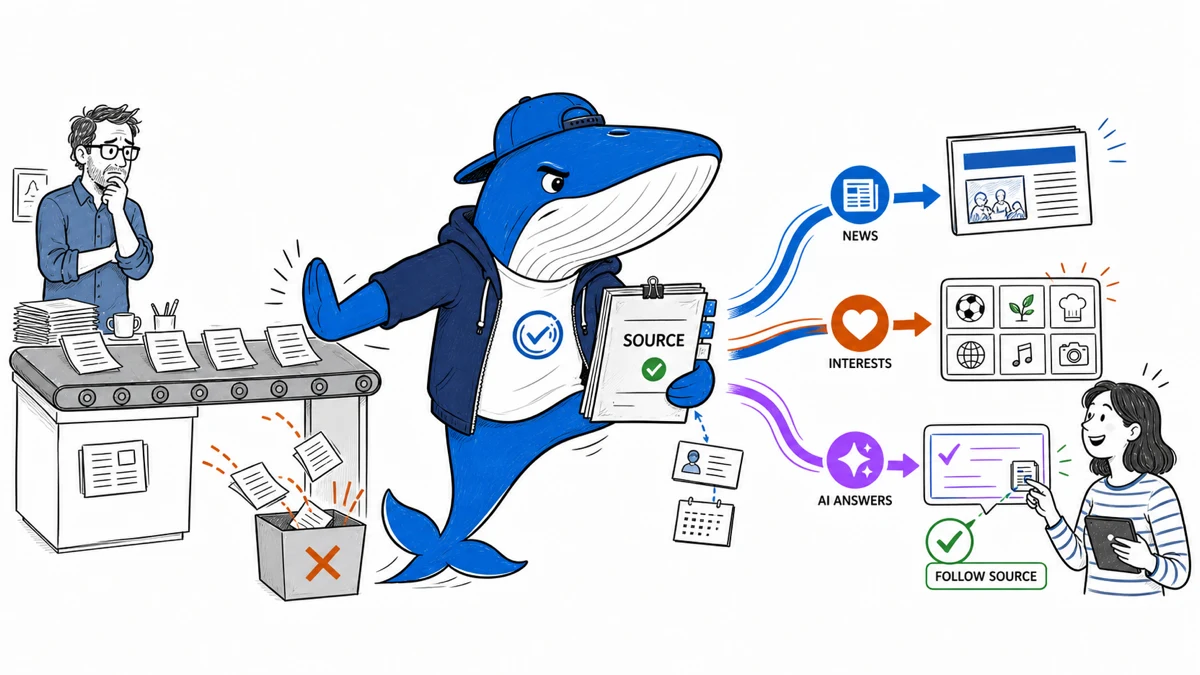
Direct answer: French news publishers should adapt to AI by protecting the parts of journalism that create unique value and modernizing the systems that distribute that work. The practical strategy is not to fill a site with AI-written summaries. It is to use AI under human supervision for document review, transcription, translation, archive retrieval, accessibility, quality control, and format adaptation;then make the resulting original reporting eligible for Google Search, Google News, Discover, AI answers, social and video discovery, and direct reader relationships.
No individual change guarantees more traffic. Google says its AI features require no special AI schema or new technical standard, and Discover traffic can be unpredictable. The opportunity is to remove avoidable access failures, publish information that is worth retrieving, package it for several discovery surfaces, and measure each surface separately.
French publishers face more than one traffic problem
The complaint reportedly filed by French newspaper groups against Google over AI summaries raises serious questions about publisher rights, attribution, compensation, competition, and the economic effect of answers that may satisfy a reader before a click. Those questions should not be reduced to an SEO tactic.
They also should not become a reason to ignore distribution. A news site can lose visits through at least three different mechanisms:
- Answer substitution: a search or AI interface answers enough of the question that fewer people visit the source.
- Access failure: a crawler is denied by
robots.txt, a CDN, a web application firewall, a consent wall, an outage, or a challenge page. - Readiness failure: the publisher remains indexed but produces commodity rewrites, exposes weak authorship or dates, hides evidence, uses poor media, or cannot measure new discovery surfaces.
These mechanisms require different evidence. A decline in clicks does not prove that Google stopped indexing the site. A crawler request does not prove that an article was cited. Blocking a training crawler does not automatically block search, while blocking Googlebot can remove the upstream Search eligibility used by Google News, Discover, AI Overviews, and AI Mode.
The frequently repeated “38% traffic loss” also needs a boundary. The number reported in coverage of the French complaint traces to an aggregate referral decline observed across a sample of U.S. news and media sites, not a controlled estimate of losses caused by AI summaries for French publishers. A separate experiment found fewer outbound organic clicks when an AI Overview appeared, but that experiment had its own U.S. desktop and query boundaries. These findings justify concern; they do not establish one universal loss rate for French media.
What adapting to AI should mean in a newsroom
Adaptation should begin with a newsroom operating model, not a publishing quota. France already has a useful professional foundation. The Paris Charter on AI and Journalism places editorial ethics and human agency above the technology, calls for transparency when AI materially affects journalistic production, and treats provenance and the distinction between authentic and synthetic material as editorial responsibilities.
The SpinozAI work led by Reporters Without Borders and l’Alliance points to a productive use of AI: help journalists work through complex documents while preserving access to sources. That is a better model than asking a generator to paraphrase the same press release every competing outlet received.
Every proposed newsroom use should pass five questions:
- What task is being accelerated?
- Which human remains accountable for the published result?
- Which sources can a reviewer reopen?
- What private, copyrighted, confidential, or personal data enters the system?
- What failure would stop publication?
If the team cannot answer those questions, the workflow is not ready for a live newsroom.
Use AI to increase reporting capacity, not content volume
AI can help a French newsroom reach more readers when it reduces low-value production work and returns time to reporting. Useful bounded applications include:
- transcribing an interview while the journalist checks names, numbers, quotations, and time codes;
- extracting people, dates, organizations, and claims from a long public report, with every output linked back to a page or passage;
- comparing versions of a bill, court decision, regulator notice, budget, or corporate filing;
- translating source material or adapting a story between French and another language, followed by a fluent human review;
- finding relevant material in the publication’s archive and suggesting internal links;
- drafting captions, transcripts, alternative text, summaries, and social variants for an editor to verify;
- checking whether a headline, deck, byline, date, image, caption, correction note, and structured data agree;
- identifying unanswered reader questions that merit a reported follow-up.
Do not delegate the final factual judgment, allegation review, legal interpretation, source protection, correction decision, or sensitive-news framing to a model. Do not assign the model an author byline. Google’s guidance says using automation, including AI, is not inherently against its policies, but mass production intended primarily to manipulate rankings can violate spam policies. More importantly, a generic generated recap gives the reader little reason to choose the publisher.
The French advantage is specific knowledge
French publishers do not need to compete with a general answer engine at being general. Their strongest assets are the information and relationships an answer engine does not originate:
- reporting from a commune, département, region, court, ministry, regulator, union, school, hospital, company, or cultural institution;
- French-language interpretation of laws, administrative procedures, public datasets, and European decisions;
- named local sources and beat expertise built over time;
- original photographs, audio, video, maps, databases, and public-document archives;
- clear service journalism that shows how a national change affects a specific person or place;
- follow-up reporting that tests whether an announcement became reality.
That work can travel across several surfaces, but each surface has a different reader job.
| Surface | Reader behavior | Publisher priority | Important limit |
|---|---|---|---|
| Google Search | The reader expresses a question or need | Crawlable pages, clear page jobs, useful answers, original evidence | Ranking and clicks are not guaranteed |
| Google News and Top Stories | The reader follows current events and sources | Fresh original reporting, clear headline, byline, dates, publisher transparency, crawlable images | Policy and technical compliance do not guarantee inclusion |
| Google Discover | The reader encounters stories related to interests without typing a query | Strong story selection, unique insight, honest headline, excellent large image, page experience | Traffic is supplemental and can change independently of keyword demand |
| AI answers | The reader asks a complex or follow-up question | Index eligibility, attributable evidence, portable passages, distinctive reporting | No special schema forces citation or a visit |
| Social and video discovery | The reader encounters a person, event, clip, or explanation in a feed | First-hand formats, visible source identity, useful destination, rights and context | Platform reach is not owned traffic |
| Newsletter, app, browser extension, membership | The reader intentionally returns to the publisher | A recognizable editorial promise, consent, frequency, and reader value | Acquisition is wasted when the product gives no reason to return |
Build one technical foundation for Search, News, Discover, and AI answers
Google says content shown in AI Overviews and AI Mode still depends on ordinary Search eligibility. It does not require a special AI schema, an llms.txt file, artificial “chunking,” or AI-written copy. The technical foundation remains familiar:
- the canonical article returns a stable successful response;
- Googlebot can fetch the article body, essential resources, and representative images;
- the visible headline, author, publication date, material update date, canonical, and Article data agree;
- important links use ordinary crawlable anchors;
- a news sitemap contains the appropriate recent article URLs and accurate publication data;
- the mobile page is fast, readable, accessible, and free of an interstitial that hides the story;
- paywall or registration markup accurately describes what the reader can see;
- CDN and WAF rules allow the search crawlers the publisher has decided to permit.
Training, search discovery, and user-triggered retrieval should be separate policy decisions. For example, OpenAI documents OAI-SearchBot for search discovery and GPTBot as a separate training control. Google documents Google-Extended as a control token for specified Gemini uses, not as a way to leave Google Search. The newsroom should record the legal and commercial decision for each purpose, then verify that the same decision exists in robots.txt, the CDN, and the WAF.
The companion AI crawler guide provides a bot-by-bot control model. Its central rule matters here: a bot name in a log is not proof of indexing, training, citation, or a referral.
Prepare article pages for Google News
Google News does not require a separate Publisher Center submission path for ordinary web eligibility, and no setting guarantees placement. The article page still needs to identify the work cleanly.
On each article template, verify:
- one accurate headline near the article body;
- a visible human byline linked to a useful author page;
- a visible publication time and a meaningful update time when the story materially changes;
- clear separation between news, analysis, opinion, review, live coverage, and sponsored material;
- publisher identity, contact information, editorial standards, corrections, ownership, and relevant commercial disclosures;
- a relevant, crawlable lead image with a stable URL and a caption when context or attribution matters;
- Article or NewsArticle data that matches the visible page rather than inventing missing facts.
Do not refresh a date only to make an old article look new. Do not create a new URL for every small development in a continuing story. Preserve one stable canonical when it serves the same reader job, record material updates, and create a new article when the event or question is genuinely different.
Design stories for Google Discover and other interest-driven media
“Interest media” is not an official Google product category. It is a useful editorial description for distribution where a reader encounters material because it matches an ongoing interest rather than a typed query. Google Discover, personalized news feeds, social and video feeds, newsletters, and app notifications all fit parts of that model.
Google’s Discover guidance says indexed content that meets Discover policies can be eligible without special tags or structured data. Eligibility does not guarantee appearance. Google recommends timely material, a strong story, unique insights, non-misleading headlines, a good page experience, and relevant high-quality images. For large-image treatment, the image should be at least 1,200 pixels wide and the page should permit large previews, commonly through max-image-preview:large.
A Discover plan should therefore start before the headline is written:
- Select an interest, not only a keyword. Identify the community, place, team, technology, cultural subject, public service, or continuing issue that makes someone care.
- Find the reported turn. Show what changed, who is affected, why it matters now, and what the newsroom learned that was not already obvious.
- Commission the image as reporting. Use first-hand photography, a clear documentary image, an accurate map, or an original explanatory visual rather than a logo or generic stock art.
- Keep the promise honest. The headline and image may create curiosity, but the article must resolve it without withholding the central fact or exaggerating the stakes.
- Build the follow-up. Link the current story to a durable explainer, timeline, data page, newsletter, topic page, or alert that gives the reader a reason to continue.
Discover should be treated as supplemental demand, not a predictable replacement for Search or direct readership. A publisher should analyze winning and losing story clusters, images, countries, and devices in the Discover report, but should not turn a few high-performing headlines into a universal ranking theory.
Make reporting usable in AI answers without writing for a machine
An AI answer can retrieve a paragraph far from its original context. That makes evidence placement an editorial issue. The strongest factual passage should normally preserve:
- the direct finding;
- the relevant date, place, population, product, or jurisdiction;
- the source, document, observation, or calculation;
- the distinction readers commonly miss;
- the limitation or unresolved question.
This does not mean converting every article into disconnected FAQs. It means keeping the denominator close to the percentage, the attribution close to the allegation, the jurisdiction close to the legal claim, and the uncertainty close to the conclusion. The citation-ready passage test provides a concise review method.
Original reporting remains the differentiator. A model can rewrite a press release cheaply. It cannot independently replace a documented interview, a local observation, a verified photo, a source document, a reproducible calculation, or the judgment of a journalist who knows the beat. Publishers should make those evidence assets visible, crawlable, attributable, and easy to reopen.
Turn one reported story into several verified formats
A modern distribution desk should adapt a story, not duplicate it blindly. One reported investigation or service article can produce:
- the canonical article containing the full evidence and correction record;
- a short vertical video that shows the reporter, place, document, or method;
- an audio explanation or interview excerpt with a reviewed transcript;
- a graphic that explains one verified number or sequence;
- a newsletter edition that adds editorial context and links to the reporting;
- a live or follow-up module that records what changed after publication.
AI can propose versions, captions, chapters, transcripts, and translations. A human editor must check that the adapted format preserves the same conclusion, caveat, rights, attribution, and destination. The canonical article should remain the evidence record; a social post should not become the only place where an important correction exists.
Google’s Search Console platform properties can now report supported Instagram, TikTok, X, and YouTube discovery in Search, Discover, and Google News. That data helps connect off-site formats to Google discovery, but it is not total platform analytics and does not reveal a ranking formula.
Ask loyal readers to identify the source they trust
AI-era distribution increases the value of a recognizable publication. Google’s Preferred Sources feature lets a reader select a domain that they want to see more often in Top Stories, with support on specified AI surfaces where available. A publisher can add Google’s documented preference deep link to a subscription or loyalty prompt. Selection makes the source more likely to appear for that user; it does not guarantee a result.
The larger lesson is independent of Google. Every strong landing page should offer a next relationship appropriate to the story: follow the topic, receive a morning briefing, install the app, subscribe to a newsletter, register for an alert, support the newsroom, or return to a maintained tracker. The call to action should explain the editorial value, not merely ask for an email address.
Measure discovery as a portfolio
A newsroom cannot manage AI-era distribution from one “organic traffic” total. Keep the following layers separate:
| Layer | Question | Evidence |
|---|---|---|
| Access | Did the intended crawler receive the correct article and image? | Verified bot identity, CDN/server logs, status, bytes, latency |
| Index and freshness | Is the canonical page indexed and updated correctly? | Search Console, URL Inspection, sitemaps, crawl timestamp |
| Google News | Which articles earned News visibility and visits? | Search Console News performance and landing pages |
| Discover | Which interest-led stories and images earned impressions and clicks? | Search Console Discover report, page, country, device, date |
| AI visibility | Was the page shown or cited in a supported AI report or a preserved sample? | Google generative-AI reporting where available, Bing AI Performance, dated manual audits |
| Referral | Did a person visit from the surface? | Analytics source/medium, documented UTM, landing page |
| Reader value | Did the visit produce engaged reading, return, registration, subscription, or support? | First-party analytics and subscription cohorts |
Segment the data by original reporting versus rewrite, breaking news versus evergreen service content, country, language, device, signed-in state where known, and AI-exposed versus comparable non-exposed queries. Save publication changes and incidents on the same timeline. A citation is not a ranking, an impression is not a visit, and a visit is not a subscription.
A 90-day adaptation plan for a French publisher
Days 1–30: establish control
- Name editorial, product, technical, legal, audience, and data owners.
- Publish or revise the newsroom AI policy, correction policy, author pages, ownership, contact, and commercial disclosures.
- Map search, training, and user-fetch crawler decisions; audit
robots.txt, CDN, WAF, sitemaps, representative article templates, images, and paywall behavior. - Build a baseline for Search, Google News, Discover, AI visibility where available, referrals, subscriptions, and server access.
Days 31–60: improve the product
- Select two beats where the newsroom owns primary sources or local expertise.
- Create an original-reporting requirement for each commissioned story.
- Run one supervised AI pilot, such as document comparison or transcription, with saved sources and a stop rule.
- Repair article templates, date/byline consistency, large-image delivery, transcripts, captions, internal links, and topic destinations.
- Add a useful preferred-source or direct-subscription prompt after the article value has been delivered.
Days 61–90: test distribution
- Choose a fixed group of stories and adapt them into verified article, image, video or audio, newsletter, and social formats.
- Record the baseline, release date, distribution surface, owner, primary metric, guardrail, and observation window.
- Compare content types rather than celebrating one viral story.
- Keep the workflows that improve speed, accuracy, accessibility, qualified reach, or subscriber value. Remove the ones that only increase output.
Use the interactive news publisher AI readiness checklist to assign owners, record evidence, and repeat these 24 checks after a major platform, crawler, policy, or newsroom workflow change.
The publication gate
A news publisher is adapting responsibly when the technology produces a better verified article, a faster accountable workflow, a clearer destination, or a stronger reader relationship. It is not adapting merely because an AI tool was purchased or a generator produced more pages.
Before a story enters the multi-surface distribution workflow, confirm that:
- the reporting contains a source, observation, document, dataset, photograph, interview, or synthesis that adds value;
- a named human owns every factual and editorial judgment;
- the canonical page exposes accurate authorship, dates, provenance, media, corrections, and disclosures;
- approved search crawlers receive the correct page without a challenge or accidental block;
- the Discover headline and image are compelling without misleading the reader;
- the strongest extracted passage keeps its scope, evidence, distinction, and limit;
- each format preserves the source and has a useful destination;
- measurement separates access, visibility, visits, and reader outcomes.
The wider evidence-led publishing guide provides the claim classification, source ladder, skeptical review, and maintenance workflow behind this gate.
French publishers can continue to contest unfair uses of their work while modernizing how that work is created, delivered, measured, and converted into loyal readership. Those are compatible strategies. Rights enforcement protects the value of journalism; adaptation makes that value easier for readers to find and harder for a generic summary to replace.
Publisher decision
News, Discover and AI answers require different operating assumptions
A single “Google visibility” workflow hides important differences between surfaces.
- News
- Prioritize clear publication identity, dates, bylines and timely reporting.
- Discover
- Invest in strong original imagery and reader interest without relying on query demand.
- AI answers
- Make claims, entities and supporting evidence easy to identify and verify.
My takeaway: French publishers should keep one editorial standard but measure each surface independently. Eligibility is not guaranteed distribution, and distribution is not the same as a loyal audience.
Primary documentation
- Google: Optimizing a website for generative AI features
- Google: AI features and your website
- Google: Discover and your website
- Google News: Article-page guidance
- Google News policies
- Google: Preferred Sources publisher guide
- Google: Search Console platform properties
- Google: Measure social and video discovery
- Google France: AI Overviews and AI Mode launch
- Reporters Without Borders: Paris Charter on AI and Journalism
- Reporters Without Borders and l’Alliance: SpinozAI report
- OpenAI: Publishers and developers FAQ
Keep learning
Continue this topic
Next in this topic
Google AI Impressions Are Not AI Traffic: Reconcile Search Console With GA4
Earlier in this topic
How to Track AI Search Referrals in GA4
AEO & AI Search
Ask a question or join the discussion