Yandex News RSS Feed Validation: A 22-Point Audit
Validate a Yandex news RSS feed with a 22-point worksheet and a real SearchEngineAnswer feed audit covering access, XML, full text and page parity.
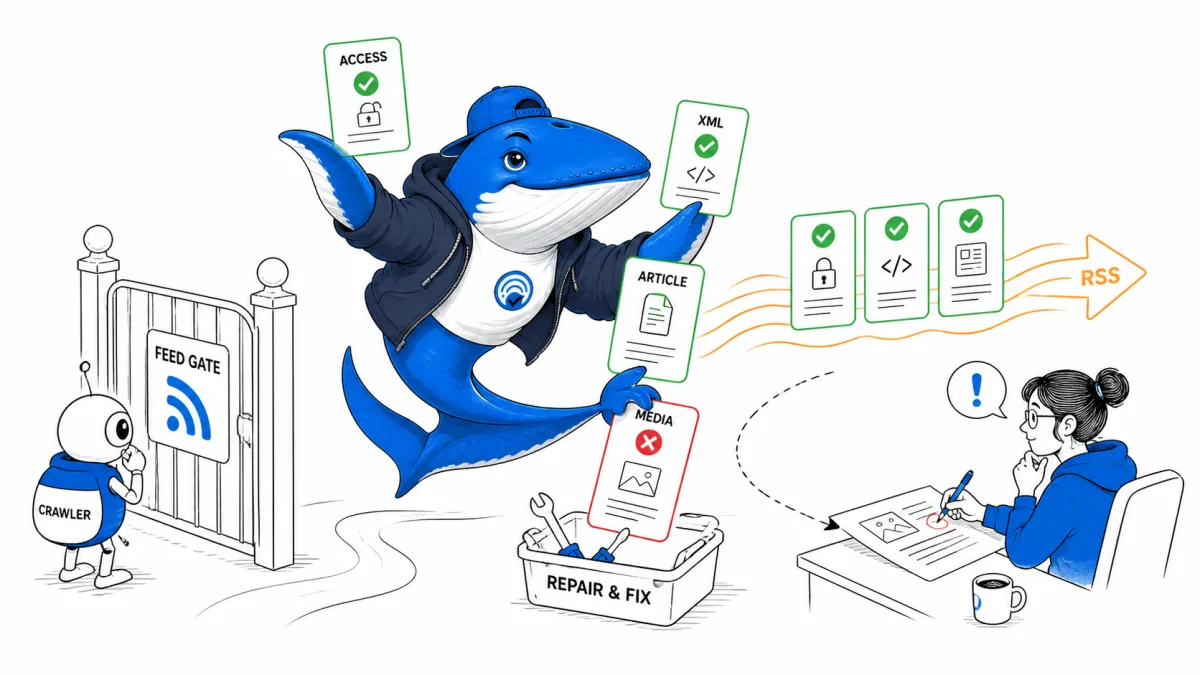
Direct answer: a normal WordPress RSS feed is not automatically ready for Yandex’s fresh-content workflow. Yandex documents four required item fields: title, article URL, publication date and full article text in yandex:full-text or content:encoded. Validate those fields, page parity, public access and editorial eligibility before uploading the feed in Yandex Webmaster.
We tested SearchEngineAnswer’s public feed on August 29, 2026. The XML was healthy, but the test found a decisive gap: all 10 items had titles, links, valid dates, descriptions, authors and categories, while none contained a full-text field. That feed is suitable for ordinary subscribers; it should not be submitted as a Yandex news feed in its current form.
Start with eligibility, not XML
Yandex describes this feature for sites that publish fresh content about current events. Its recommendations exclude several kinds of material, including forum posts, advertising and digest-style roundups, and require new feed publications at least weekly while the feed is active. Publications must be freely accessible, mobile friendly and hosted on a stable site with publication details and contact information.
This means a technically valid feed can still be the wrong submission. A mixed site should create a dedicated feed for the eligible news section instead of exporting every post. For SearchEngineAnswer, a future candidate would need to contain only timely reporting and analysis that meets those requirements. Evergreen guides, tools and unfinished research protocols should not be included simply because WordPress places them in the default feed.
| Question | Pass condition | Failure response |
|---|---|---|
| Is the source eligible? | It regularly publishes freely accessible current-event coverage. | Do not submit an all-post feed; define an eligible section or stop. |
| Is the feed scoped? | Only appropriate current publications are exported. | Create a separate endpoint or category feed. |
| Can the feed stay current? | New items appear at the stated publishing frequency. | Delay submission until the operation can be maintained. |
| Can fields match the page? | Title, date and full text update with the public article. | Fix the publishing template, not individual XML records. |
What we found in SearchEngineAnswer’s live feed
We fetched https://searchengineanswer.com/feed/ without a logged-in session and parsed it as XML. The audit recorded the final URL, HTTP status, content type, response size, RSS version, encoding, item-field coverage and link uniqueness. It also fetched the first three article URLs to compare each feed title with the visible H1 and canonical.
| Check | Observed | Interpretation |
|---|---|---|
| Access | HTTP 200; no login; 12,755 bytes | Passes the mechanical access and size checks. |
| Format | Well-formed RSS 2.0; UTF-8 | Passes the base XML format check. |
| Items | 10 unique article links | No duplicate item URL found in this snapshot. |
| Core metadata | 10/10 title, link, date, description, author and category | The ordinary feed metadata is complete. |
| Full article text | 0/10 yandex:full-text or content:encoded | Fails a required Yandex item field. |
| Media groups | 0/10 | Not automatically a failure; media groups are optional. |
| Page parity sample | 3/3 HTTP 200, matching H1 and self-canonical | Passes the limited three-item sample, not the entire feed. |
The machine-readable result is preserved with this revision. This is a first-hand mechanical audit, not a Yandex Webmaster acceptance result. We did not submit the feed, and the test does not establish editorial eligibility or predict search appearance.
Validate the required item fields
Every exported item needs a current title, a unique URL for one publication, an RFC-822 publication date and the complete current text. Yandex says content:encoded can replace yandex:full-text; one of them becomes the required full-text source. The feed title must match the article title, and changes to the public article should be reflected in the feed.
Do not solve the SearchEngineAnswer gap by copying the excerpt into a full-text element. An excerpt is not the complete publication. Generate full text from the same stored article body that renders the page, then strip scripts, controls, ads, related-content blocks, author labels, contact details and media URLs that Yandex says should not appear inside the full-text field.
<item>
  <title>The current article title</title>
  <link>https://example.com/news/article/</link>
  <pubDate>Sat, 29 Aug 2026 12:34:00 +0000</pubDate>
  <content:encoded><![CDATA[Complete current article text…]]></content:encoded>
</item>
The exact template will depend on the CMS and which namespace is used. The control that matters is provenance: page HTML and feed full text should be generated from the same approved revision, with a repeatable transformation for elements that must be excluded.
Compare every feed item with its public article
A feed validator that stops at XML misses the most important relationship. For each item, fetch the linked article and compare:
- feed title against the visible H1;
- item URL against the final URL and canonical;
- publication time against the visible or structured publication time;
- author and category against the visible byline and section;
- full text against the current reader-visible article;
- access and layout at desktop and mobile dimensions.
Record exact values and evidence URLs. “Looks fine” is not a result. A useful report says which item failed, which field differed, what source generated each value and whether the fix belongs in editorial data, the feed template, the article template or caching.
Yandex considers messages from the last eight days relevant to this workflow. That makes update timing operationally important. If a headline or body changes, update the feed with the page rather than waiting for a periodic manual export.
Treat media as an optional, rights-aware layer
A publication without video does not need a fabricated media group. When media is included, Yandex’s documented group structure requires a thumbnail plus at least one media:content or media:player element. Its video guidance specifies a thumbnail at least 800 by 400 pixels for indexing.
Test media URLs independently for public access, HTTPS, stable content type and rights. Keep captions, authorship and expiration consistent with the article. A validator should fail closed when a licensed asset has expired or a player is restricted to a logged-in session.
Build a dedicated feed, then test the template
- Define the eligible collection. Name the category, content type or editorial flag that may enter the feed.
- Generate full text from the approved article revision. Use either the Yandex field or
content:encoded, not an excerpt disguised as full text. - Separate content from template furniture. Remove ads, navigation, social links, related-post blocks and other prohibited material from the export.
- Run fixture tests. Include ampersands, quotes, non-ASCII text, updates, deleted items, multiple categories and a post without media.
- Run live parity checks. Fetch every item and compare page title, canonical, date, author and body.
- Save the report. Preserve the feed hash, item count, failures, sample pages, time and validator version.
Download the Yandex RSS feed audit worksheet (CSV). It contains 22 checks across eligibility, access, format, item fields, page parity, media and operations.
Submit only after a clean, maintainable result
After the site is added and ownership is verified in Yandex Webmaster, the documented path is Display in search → Latest and most important news → Upload feed. Record the submitted endpoint, account owner, validation report and time. Yandex lists “Checking,” “Errors found” and “Uploaded” as processing states and explicitly says display is not guaranteed.
If errors appear, correct the source template and request a recheck. Keep feed fetches, Webmaster processing, search appearance and traffic as four separate observations. A 200 response proves access; an uploaded status proves processing; neither proves that a publication appeared or earned traffic.
Limitations of this audit
The SearchEngineAnswer observation covered one feed snapshot and a three-page parity sample. It did not test YandexBot from Yandex infrastructure, mobile first-screen visibility, every article body, Webmaster ownership or editorial acceptance. The result can change when new items enter the feed or the WordPress feed template changes, so it should be rerun immediately before any submission.
Feed failure map
A valid RSS document can still be a weak news feed
Syntax is only the first gate. A publisher also needs stable identity, complete item metadata and URLs that resolve consistently.
- Document
- Well-formed XML, expected encoding and reachable response.
- Channel
- Stable title, site URL, language and update metadata.
- Item
- Unique identifier, publication date, headline and canonical destination.
- Operations
- Freshness, duplicate control and monitoring for failed URLs.
My takeaway: I would validate a sample of live item destinations after every feed change. Passing XML validation does not prove that the publication path works.
Primary documentation
Keep learning
Ask a question or join the discussion