Article Comments vs Discussion Forum Schema: Choose Correctly
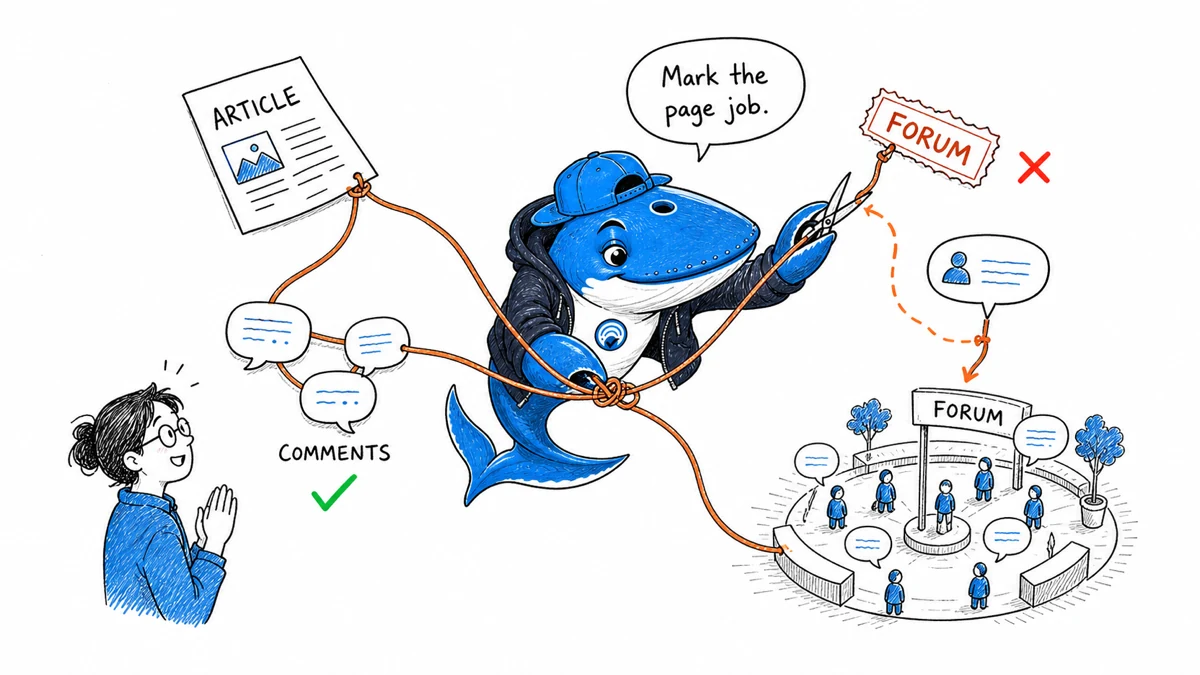
Keep publisher-written pages typed as Article even when they have comments. Use DiscussionForumPosting or QAPage only when the primary visible content fits those page jobs.
Published August 9, 2026: This schema boundary follows Google’s current Article, DiscussionForumPosting, and QAPage guidance.
A publisher-written article does not become a DiscussionForumPosting because readers can comment underneath it. Keep the main page typed as an Article and represent individual replies as comments when appropriate. Use DiscussionForumPosting only when the page’s primary content is a user-generated discussion post.
Use QAPage for a question page where users submit answers and one or more answers are present. Schema should describe the visible page job, not the rich result a publisher wants.
The primary-content test
Ask what a visitor came to read before the comments load. If the answer is “an editor’s guide, report, review, or news article,” Article is the main type. If the answer is “a community member’s post and the replies around it,” DiscussionForumPosting may fit. If it is “one question with community answers,” evaluate QAPage.
| Page job | Primary author | Likely main type |
|---|---|---|
| Editorial article with replies | Publisher or named editorial author | Article; replies can be Comment objects |
| Forum thread | User or community participant | DiscussionForumPosting |
| Question with answers | Question author plus answering users | QAPage with Question and Answer |
| Publisher FAQ | Publisher | Article or WebPage; not QAPage |
Why comments do not change the page type
Google’s DiscussionForumPosting documentation explicitly excludes publisher-authored articles even when those articles include comments. A comment area is a supporting feature. It does not replace the author, headline, date, body, and editorial purpose of the article.
Schema.org provides a comment property and the Comment type. A publisher can connect visible replies to the Article without reclassifying the whole page. The exact graph should match the site’s structured-data system and only include content visible to users.
For SearchEngineAnswer, the main article remains Article. The reader forum below it supports participation, helpful votes, and an accepted answer, but it does not turn the editor’s article into a community-authored thread.
When DiscussionForumPosting fits
- The primary post is created by a user, not the site’s editorial team.
- The page is designed around a conversation or community statement.
- Author, dates, text, interaction counts, and replies are visible and accurate.
- Deleted, moderated, or paginated replies are handled consistently.
- The markup does not invent votes, authors, or accepted answers.
A separate community thread linked from an article could qualify if it meets those conditions. The article page itself should not borrow that type merely because the linked discussion exists.
When QAPage fits
Google limits QAPage markup to pages focused on one question where users can submit answers. At least one answer must be present for the page to be eligible. A publisher-written article that happens to ask a question in its heading is not a QAPage, and a page containing several editorial questions is not automatically a community Q&A surface.
If an administrator can mark an answer as accepted, the visible accepted state and the structured data must agree. Helpful-vote counts also need to come from real interactions. Do not prefill positive counts or invent community activity to complete a schema field.
A template-level audit
- List each content type and state its primary reader job.
- Inspect the rendered JSON-LD, not only the plugin settings.
- Compare the main type, author, dates, headline, comments, and interaction counts with visible content.
- Test empty, one-reply, accepted-answer, moderated, and paginated states.
- Remove duplicate graphs emitted by the theme, SEO plugin, and discussion plugin.
- Revalidate after template or plugin updates.
Structured data is a description, not a content strategy. Build the reader experience first, then make the graph describe it accurately. The technical SEO launch checklist provides a broader release sequence.
Primary documentation
Keep learning
Continue this topic
Next in this topic
Cloudflare AI Crawler Controls and Googlebot 403s: What to Verify
Earlier in this topic
FAQ Rich Results Ended: What Publishers Should Remove, Keep and Re-measure
SEO
Ask a question or join the discussion