llms.txt and Google Search: What the File Does Not Change
Google says llms.txt is not needed and has no effect on Search visibility or rankings. Learn what the proposal is and how to test it without replacing established controls.
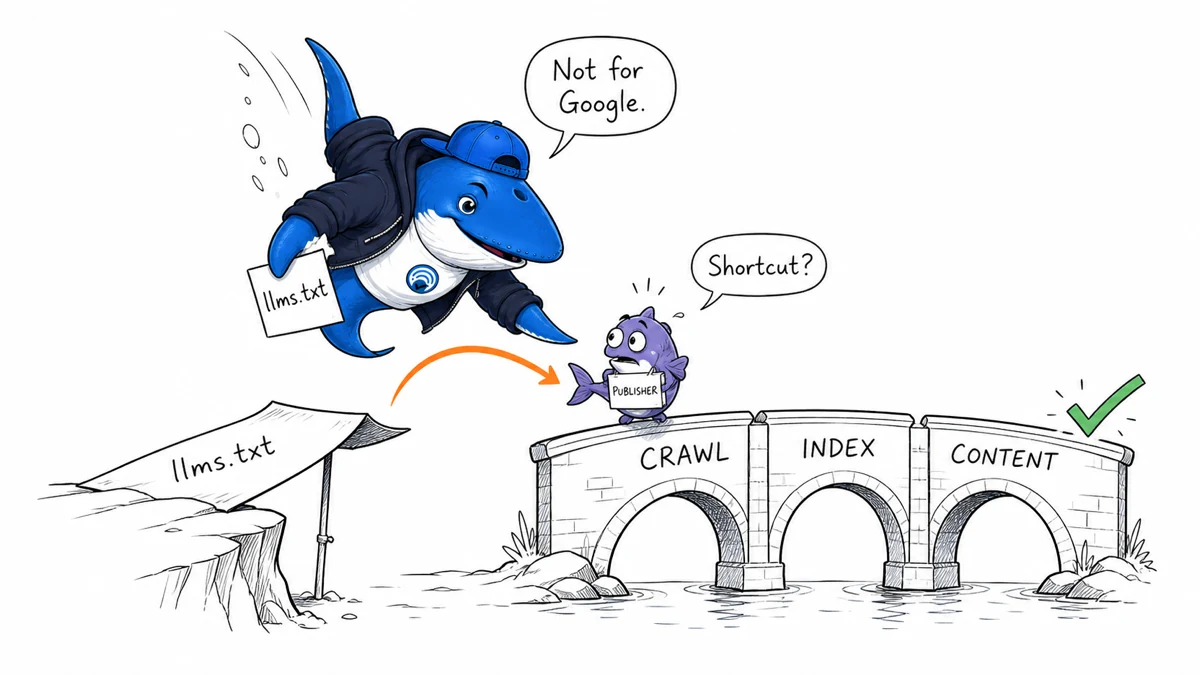
Published August 9, 2026: Google’s June 15, 2026 documentation update says llms.txt is not needed for Google Search or its AI features.
Adding an llms.txt file does not improve or reduce a site’s visibility or rankings in Google Search. Google says its systems do not use the file. A publisher may still experiment with the proposal for other consumers, but it should not replace crawlability, indexing, useful content, or established metadata.
The distinction is simple: the llms.txt proposal offers an LLM-oriented content map. Google Search uses its documented crawling, indexing, and serving systems. Those are different mechanisms.
What the proposal is
The llms.txt proposal describes a Markdown file at a site’s root. It can summarize the project and link to important pages or cleaner Markdown resources. Its stated goal is to help language models use website information at inference time when normal pages contain navigation, scripts, and presentation markup.
That can be a useful publishing experiment. It is not a web standard equivalent to robots.txt, not a sitemap replacement, and not a guaranteed instruction channel for every model or search engine. Adoption has to be checked platform by platform.
What Google said
Google added a direct answer to its Search documentation updates: publishers do not need to create llms.txt files or other AI-specific text files to appear in Google Search results or AI features. Google says its systems do not use these files, and adding one has no positive or negative effect on visibility or rankings.
Google’s AI-features guidance gives the same practical direction. A page needs to meet the normal technical requirements for Search and be eligible to appear with a snippet. Google does not require special schema or an AI-specific file for AI Overviews or AI Mode.
This statement applies to Google. It does not prove that no other tool can read an llms.txt file. It does remove the basis for selling the file as a Google ranking requirement.
Keep the controls separate
| Mechanism | Primary job | What it does not guarantee |
|---|---|---|
| llms.txt | Proposed LLM-oriented content map | Google use, crawling, indexing, ranking, or citation |
| robots.txt | Crawler request policy | Confidentiality, deindexing, or compliant behavior by every client |
| XML sitemap | URL discovery and metadata hints | Indexing or ranking |
| Structured data | Machine-readable description of visible content | A rich result or AI appearance |
Use the search, agent, and training bot policy to decide access. Use established Search controls for Google. Treat llms.txt as a separately measured experiment only when a target consumer documents or demonstrates support.
A safe experiment
- Name the consumer. Do not test “LLMs” as one invisible audience.
- Record the documented behavior. Save the source, date, file path, and expected outcome.
- Keep the file factual. Link only to canonical, maintained pages and avoid claims that exceed the visible content.
- Do not weaken existing controls. Preserve robots, authentication, canonicals, sitemaps, and normal internal links.
- Measure an observable result. Use logs, referrals, or a documented platform report; do not infer adoption from the file existing.
- Set a review date. Remove stale links and revise the hypothesis when platform guidance changes.
The test can still produce information: whether a named client requests the file, whether maintained summaries reduce retrieval errors in a controlled workflow, or whether no observable use occurs. None of those results should be translated into a Google ranking claim.
What to prioritize first
Before creating another machine-facing file, fix pages that cannot be crawled or indexed, unclear canonical signals, thin answers, inaccessible navigation, slow templates, and unsupported claims. Make authorship, sources, update dates, and corrections visible. Those improvements help people and align with Google’s documented requirements.
If the goal is AI citation-worthiness, run the citation-ready passage test. It gives the answer a boundary, visible support, a useful distinction, and an honest limit—without claiming a special file can force selection.
Primary documentation
Keep learning
Continue this topic
Next in this topic
OpenAI Publisher Controls: Crawl Access, Citations and Referrals Are Different Outcomes
Earlier in this topic
Search, Agent and Training Bots: A Practical Access Policy for Publishers
AEO & AI Search
Ask a question or join the discussion