How to run small SEO experiments without overclaiming
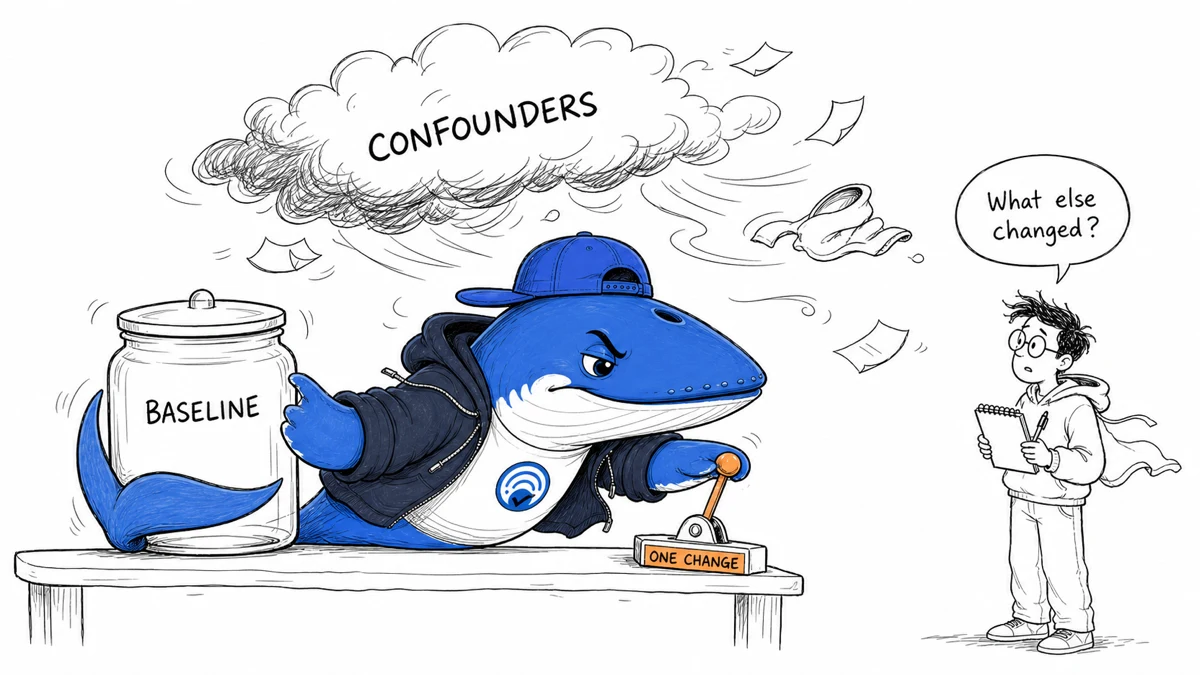
Treat most small-site tests as structured observations: define one falsifiable question, save the baseline, change one material variable, log confounders, and prewrite the decision.
Updated August 9, 2026: Re-edited around a direct observation protocol, closer documentation, and an explicit stopping decision.
Treat most small-site SEO tests as structured observations, not controlled experiments. Make one bounded change, preserve the before state, choose the decision rule in advance, and do not claim more than the evidence supports.
That distinction is useful, not discouraging. A modest test can still prevent random editing and reveal whether a change deserves a broader rollout.
1. Write a falsifiable question
“Improve SEO” cannot fail, so it cannot guide a test. Use this form:
If we change X for these pages, then Y should move in this direction over this window, unless these confounders dominate.
Example: “If five glossary pages receive contextual links from the relevant guide, their crawl frequency and impressions should become more consistent over eight weeks, unless seasonality or a major search-system change dominates.” This does not promise rankings. It defines what to observe.
2. Select one unit and one material change
The unit may be one page, a matched group, or a template. Choose pages with a similar job and enough historical stability to interpret. Avoid mixing a title rewrite, content expansion, new internal links, and a design launch in the same test. If performance moves, you will not know which change mattered.
Some changes cannot be isolated safely. A site-wide accessibility fix or broken canonical should be repaired everywhere. Document it as a release, not an experiment.
3. Preserve the baseline
Before changing anything, save:
- the exact affected URLs and current HTML or screenshots;
- the change date, time, owner, and deployment reference;
- the comparison window and relevant query/page exports;
- indexing, canonical, crawl, and analytics observations;
- known campaigns, outages, migrations, or seasonal events.
Use comparable weekdays and periods when that matches the site’s traffic. Google’s guidance on analyzing search-traffic changes notes that causal diagnosis is difficult and recommends comparing appropriate periods. A saved annotation is what lets you reconstruct the test later.
4. Define primary, guardrail, and diagnostic metrics
The primary metric should be closest to the hypothesis. Guardrails reveal unacceptable side effects. Diagnostic metrics help explain what happened.
| Layer | Purpose | Example |
|---|---|---|
| Primary | Tests the expected movement | Impressions for the selected pages |
| Guardrail | Protects against harm | No drop in qualified conversions |
| Diagnostic | Explains the mechanism | Indexing state, selected canonical, crawl response |
Do not combine unrelated metrics into a homemade score unless the weighting has a defensible reason. It usually hides the signal.
5. State the decision rule before the result
Choose one of three outcomes:
- Expand: the primary signal moves as expected, guardrails remain healthy, and no major confounder explains the movement.
- Hold: the result is too noisy, the window is too short, or the page has not reached a stable state.
- Reverse or revise: guardrails deteriorate, the implementation is wrong, or the hypothesized mechanism is not observed.
A decision rule is not necessarily a universal percentage. Low-volume sites may need a longer window and a qualitative threshold. The important part is to avoid inventing the standard after seeing the chart.
6. Log confounders while the test runs
Record algorithm announcements, news events, seasonality, paid campaigns, email sends, competitor launches, server incidents, consent changes, and unrelated page edits. A movement that affects the test group, comparison pages, and the whole site at once is less likely to come from the isolated change.
Where the sample permits, compare a similar group that did not receive the change. It is not a perfect control, but it can reveal site-wide or market-wide movement.
7. Interpret Search Console carefully
Search Console is useful for page and query observations, but its documented tables do not contain every query. Anonymized queries are omitted for privacy, performance is commonly attributed to canonical URLs, and recent data can change as it settles.
Export the same dimensions and filters for both periods. Separate brand and non-brand patterns where meaningful. Inspect page-level and query-level views, then compare them with indexing and analytics evidence. Do not turn a short-lived average-position change into a causal verdict.
8. Write the result as an evidence record
Use four paragraphs:
- Question: what changed, where, and why?
- Observation: what did the selected signals do?
- Limit: what alternative explanations remain?
- Decision: expand, hold, reverse, or run a narrower follow-up?
End with one decision: expand, hold, revise, or stop. “Inconclusive” is a valid result when the evidence cannot support a stronger choice; it is more useful than a confident story built from noisy data.
A compact experiment card
Question: Pages or template: Single material change: Start date and release reference: Primary metric: Guardrails: Diagnostics: Comparison period or group: Known confounders: Decision date: Expand / hold / revise rule: Result and limitations:Use the question-to-tool map to collect the right evidence, and review the evidence-led publishing guide before turning a result into a public case study.
Small-test design
Change one important variable and predefine the decision
A useful small SEO experiment can be run on a limited set of comparable pages without pretending to be a universal study.
- Question: will adding a tested internal-link module improve discovery of orphaned help pages?
- Baseline: preserve crawl depth, internal-link counts and indexing state.
- Change: add the same module to the selected treatment pages only.
- Decision: define the minimum result and observation period before launch.
My takeaway: The value comes from a clean decision trail. If the test cannot change an action, it is probably measurement theater.
Primary documentation
Keep learning
Continue this topic
Next in this topic
AI Visibility Metrics: Google, Bing and ChatGPT Reporting Crosswalk
Earlier in this topic
Building SearchEngineAnswer.com from zero: 7 Google indexing lessons
Research
Ask a question or join the discussion