Topic clusters without keyword cannibalization: a page-job framework
Shared keywords do not prove harmful overlap. Diagnose page jobs, evidence, internal links, and search behavior, then keep, reposition, merge, or retire each URL.
Updated August 9, 2026: Re-edited for a direct diagnosis, clearer evidence boundaries, and a firmer keep, reposition, merge, or retire decision.
Do not merge pages merely because they mention the same query. Investigate overlap when several URLs perform the same job for the same reader and the site provides no clear reason for all of them to exist.
A useful topic cluster starts with page jobs, evidence, and next actions—not a spreadsheet of keyword variations.
Define the reader’s decision before the keyword
For every proposed page, complete this sentence: “After reading this page, the visitor can ___.” If two pages produce the same answer, comparison, or action for the same audience, investigate the overlap before drafting.
Broad subjects can support several distinct jobs. “SEO audit” could justify a conceptual guide, a pre-launch checklist, a tool, and a case study. Those pages may share vocabulary while serving different moments. By contrast, “complete SEO audit checklist” and “ultimate SEO audit steps” may simply be two titles for one resource.
Build a page-job matrix
| URL | Reader job | Format | Unique evidence | Next step |
|---|---|---|---|---|
| Pillar | Understand the subject | Guide | Original framework | Choose a task |
| Task page | Complete one procedure | Tutorial | Steps and failure states | Verify the result |
| Comparison | Choose between options | Decision table | Consistent test criteria | Select an option |
| Definition | Resolve one term | Reference | Boundary and examples | Return to the task |
| Case study | See an application | Evidence record | Dated observations | Adapt the method |
The “unique evidence” column is the pressure test. A page with no distinct evidence, method, or decision may not deserve a separate URL.
Choose one canonical home for each primary job
Make one page the clearest destination for each central task. Support pages should deepen or apply that page rather than paraphrase it. Use descriptive internal links that explain the relationship: “run the priority-first SEO audit” is more useful than “read more.”
A canonical tag is not a substitute for this editorial decision. Google describes canonicalization as selecting a representative URL among duplicate or very similar pages. It is not a general tool for telling search engines which of several genuinely different articles should rank for a phrase.
Audit overlap with more than one signal
Use four layers of evidence:
- Editorial similarity: compare the promised outcome, outline, examples, and call to action.
- Internal signals: check titles, headings, anchor text, breadcrumbs, canonicals, and sitemap inclusion.
- Search observations: review which URLs receive impressions for a query family and how that changes over time.
- User behavior: look for confusion, repeated pogo paths, or support questions that reveal an unclear choice.
Search Console can help identify multiple pages appearing for related queries, but its data is not a complete rank log. Its documented limits include omitted anonymized queries and differences between table and chart totals; performance is also commonly assigned to canonical URLs. Use it as evidence of a pattern, not proof of an algorithmic “cannibalization penalty.”
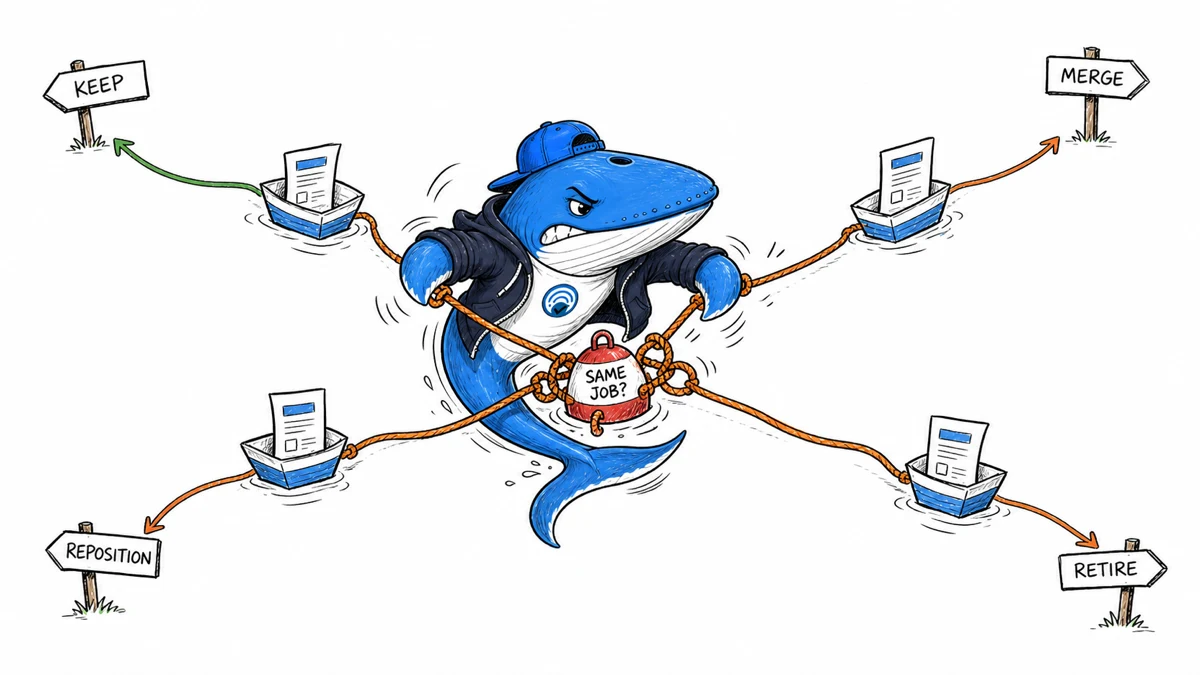
Use the keep, reposition, merge, or retire decision
Keep
Keep both pages when their reader jobs, evidence, and next steps are genuinely different. Sharpen the titles and introductions so that distinction is obvious.
Reposition
Reposition a page when it has useful material but a vague promise. Narrow the audience, scenario, format, or decision. Update internal anchors so the new role is reinforced across the site.
Merge
Merge when two URLs satisfy the same need and neither earns its own maintenance cost. Combine the best evidence into the stronger destination, add a permanent redirect from the retired URL, update internal links, and remove the old URL from the sitemap.
Retire
Retire a page when it is obsolete and has no appropriate replacement. Return an honest missing or gone response rather than forcing an unrelated redirect.
Design the cluster as a reader journey
A cluster should answer “what next?” The pillar explains the map. Task pages help the reader act. Comparisons help them choose. Tools reduce effort. Case studies show constraints and consequences.
Link in both directions when the relationship helps: the pillar routes readers to the task, while the task links back to the broader model. Avoid mechanically linking every page to every other page. A dense web of irrelevant anchors makes the structure less legible, not more authoritative.
Review after publication
Record the launch date and page job, then review the cluster after it has enough data for the site’s normal traffic level. Look for unstable URL selection, a page receiving demand that belongs to another job, or a support page becoming strong enough to expand.
End each review with one recorded decision: keep, reposition, merge, or retire. When changing a cluster, alter one material variable at a time where practical and log the change. The small SEO experiment method provides a cautious way to interpret the result.
Keep learning
Ask a question or join the discussion