A Court Filing Reports 51% to 94% Lower Publisher CTR in Copilot
A plaintiffs’ filing reports much lower publisher click-through rates in Copilot than Bing Web Search. Here is what the figures prove, omit and change.
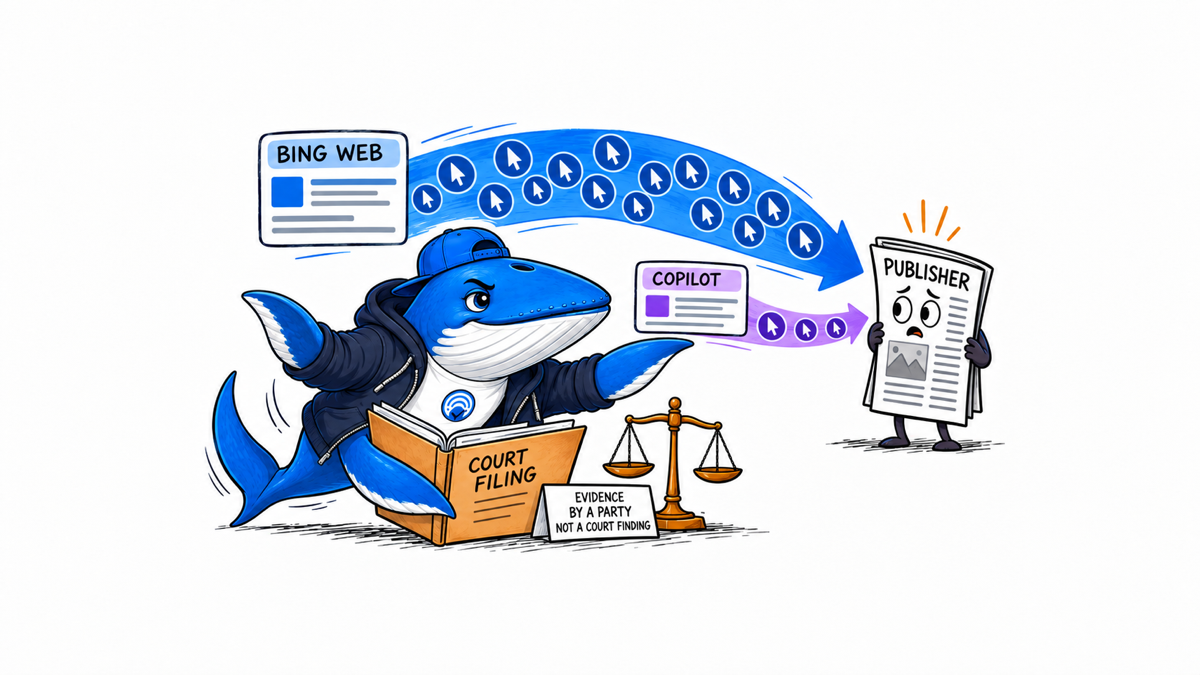
A plaintiffs’ court filing says links to several publisher groups drew 51% to 94% lower click-through rates in Microsoft Copilot than in traditional Bing Web Search. The figures are unusually specific, but they are not a court finding and the public filing does not disclose the underlying query rows, sample sizes or test windows.
The filing reports three publisher ranges
The September 17 combined summary-judgment brief filed by news plaintiffs describes Microsoft representative data comparing Bing Chat, now Copilot, with Bing Web Search. It defines click-through rate as clicks to a publisher URL divided by appearances of that URL in a search result page or chatbot response.
| Publisher group | Range in the filing | What can be said |
|---|---|---|
| The New York Times sites | 87% to 93% lower | The comparison is attributed to Microsoft representative data in the plaintiffs’ brief. |
| Daily News plaintiffs | 83% to 91% lower | The range describes relative CTR, not a disclosed loss in total visits. |
| Ziff Davis sites | 51% to 94% lower | The wide interval indicates that the effect was not uniform across the grouped properties or observations. |
Translate the percentage into a click example
A relative reduction can sound more complete than it is. Suppose a publisher URL received 100 clicks per 10,000 qualifying appearances in Bing Web Search. That is a 1% CTR. The reported ranges would imply the following Copilot outcomes if the denominator and traffic mix were otherwise comparable:
- A 51% reduction would leave 49 clicks and a 0.49% CTR.
- An 87% reduction would leave 13 clicks and a 0.13% CTR.
- A 94% reduction would leave 6 clicks and a 0.06% CTR.
This is an illustrative translation, not a reconstruction of Microsoft’s undisclosed rows. A product can show the same publisher URL more often, less often or for different queries. Total referral traffic therefore depends on both exposure and CTR:
referral visits = eligible source appearances × click-through rate
If Copilot created twice as many appearances but delivered an 87% lower CTR, the example would still produce only 26 clicks rather than 100. If appearances changed in the other direction, the result would change again. The filing supplies relative CTR ranges, not enough information to calculate total traffic.
Five missing fields control the interpretation
The public brief gives a consequential comparison, but not a reusable publisher benchmark. A defensible analysis still needs:
- Sample size: the number of appearances and clicks behind each percentage.
- Query mix: whether navigational, breaking-news, evergreen and commercial queries were represented similarly.
- Observation window: dates, product versions and whether Bing Chat and Copilot results were pooled.
- Placement detail: whether a link was inline, in a source tray, below an expansion or otherwise visible without another interaction.
- Uncertainty: property-level results, confidence intervals and the rule used to combine sites into each reported range.
The 51% to 94% Ziff Davis interval is itself a warning against replacing a distribution with one average. A publisher at one end would face a very different commercial problem from a publisher at the other.
The filing and a Google field test point in the same direction
A separate randomized field experiment on Google AI Mode reported a fall from a 23.1% control CTR to 4.3% when AI Mode appeared, a difference of 18.8 percentage points. The products, sites, samples and metric presentations differ, so the figures should not be merged.
They do support one operational conclusion: an answer interface can preserve publisher visibility while substantially weakening the path from exposure to a site visit. That makes citation count an incomplete success measure.
| Evidence | Comparison | Main limitation |
|---|---|---|
| Microsoft data described in the filing | Copilot versus Bing Web Search CTR for named publisher groups | Underlying rows and design details are not public in the brief. |
| Google AI Mode field experiment | AI Mode shown versus control for participating publisher traffic | A different product and study population; it cannot validate Microsoft’s ranges. |
Read the Google AI Mode publisher-click analysis for that study’s design, calculations and limitations.
Build a publisher test around four denominators
A publisher cannot reproduce Microsoft internal data from ordinary analytics, but it can stop using one blended AI-traffic number. For each answer surface, retain four denominators:
- Eligible prompts: prompts for which the page could reasonably answer the need.
- Source appearances: completed answers in which the page or domain is visibly cited.
- Detected visits: sessions with the platform referrer or documented campaign parameter.
- Qualified outcomes: subscriptions, leads, sales or another declared result.
Then calculate citation presence per completed prompt, detected visits per source appearance where that exposure is available, and qualified outcomes per detected visit. Do not infer the middle ratio when the platform does not expose source appearances.
Run the comparison by query family and landing-page role. A breaking-news story, a product review and a reference guide have different reasons to earn a click after the answer has already summarized them. One sitewide number can hide those differences.
If the source set itself changes between repeated answers or interfaces, use the citation-drift protocol before attributing a referral change to page quality.
Three decisions publishers can make now
Protect the value that begins after the click. A page should offer inspectable evidence, tools, original data, a downloadable asset, community knowledge or another reason to leave the answer interface. Repeating the answer in more words is not a durable click proposition.
Negotiate with the correct metric. Citation volume, source appearances, CTR, total referrals and licensed-content payments describe different value transfers. A contract or policy discussion that uses only citations can miss the traffic effect described in the filing.
Preserve pre-change baselines. Save search and referral data by landing page, platform, query class where available and date. Product changes are difficult to evaluate after the old comparison window has disappeared.
For reporting, use the AI visibility ledger model to keep mentions, citations, referrals and business outcomes separate.
Source and evidence boundary
The primary source is the news plaintiffs’ combined summary-judgment brief filed September 17, 2026. The CTR ranges and definition above are attributed to the filing. SearchEngineAnswer did not receive Microsoft’s underlying dataset and did not independently reproduce the product comparison.
Secondary reporting from Search Engine Watch and Bloomberg Law helped locate and contextualize the filing. The analysis and worked examples in this article are SearchEngineAnswer’s.
Keep learning
Continue this topic
Next in this topic
Google Tests ‘Dive Deeper’ Overviews Inside Discover Video Cards
Earlier in this topic
Claude in Chrome Compliance API: What Browser-Agent Transcripts Capture
AEO & AI Search
Ask a question or join the discussion