Google AI Mode Travel: The Booking and Publisher Handoff Map
Google AI Mode now handles more travel tasks, but alerts, redemptions, hotel payment and customer service cross different completion boundaries.
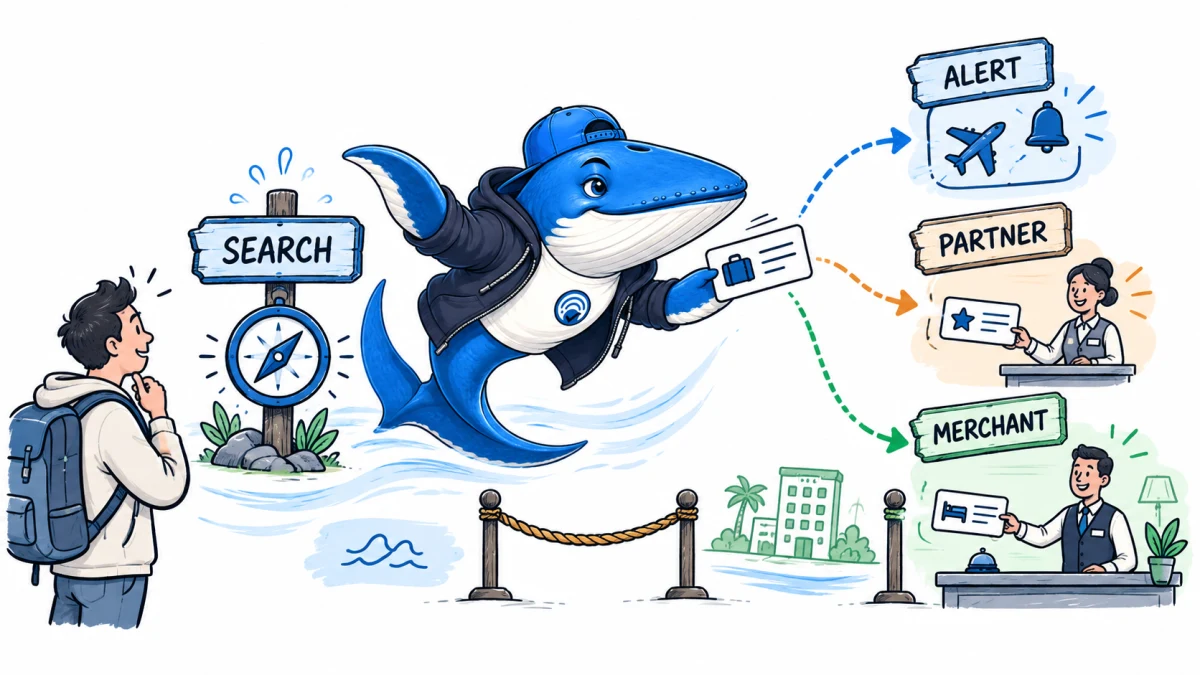
Direct answer: Google AI Mode supports more travel tasks, but the completion boundary depends on the task. Flight-price alerts can be created in AI Mode; flight purchases and points redemptions hand off to providers; eligible U.S.-English hotel bookings can continue on Google, while the hotel or booking platform remains the merchant of record and handles service.
For publishers, the useful question is not whether “Google books travel.” It is which step stays on Google, where the merchant handoff occurs and which referral, booking or revenue event remains observable.
What Google announced
Google’s August 27 announcement adds flight-price tracking in AI Mode in more than 180 countries and territories, excluding EEA countries and territories under the stated footnote. Google says the flight results use current prices from more than 300 partner airlines and travel sites.
Points and miles rates are described as globally available, with some EEA limitations. Hotel booking began rolling out in U.S. English with Booking.com, Choice Hotels International, Expedia, Hilton, Hotels.com, IHG Hotels & Resorts, Marriott International, Priceline, Trip.com and Wyndham Hotels & Resorts.
The completion-boundary map
| Task | Google-side step | Handoff or owner |
|---|---|---|
| Flight discovery | Conversational comparison | Airline or booking provider for purchase |
| Price tracking | Create and manage an alert in eligible AI Mode | Provider handles any later purchase |
| Points or miles | Show eligible reward rates | Loyalty or travel partner for redemption |
| Hotel comparison | Explore properties and rooms | Depends on eligibility and partner |
| Eligible hotel payment | Can continue on Google with Google Pay | Hotel or booking platform is merchant of record |
| Service or cancellation | Not the merchant relationship | Hotel or booking platform handles support |
Merchant of record matters more than the screen
A checkout can appear inside a Google surface without making Google the seller. Google’s announcement says the hotel or booking platform remains merchant of record. That party owns the charge, confirmation and customer-service relationship described by the booking.
Any flow diagram should name three actors: interface, inventory provider and merchant. Combining them into “Google booking” obscures accountability and makes analytics comparisons unreliable.
Map ownership before measuring performance
| Stage | Owner to record | Evidence |
|---|---|---|
| Discovery | Interface showing the result | Surface, query and screenshot |
| Availability | Inventory or rewards provider | Provider label and timestamp |
| Click or continue | Destination receiving the user | URL, referrer and campaign parameters |
| Payment | Merchant of record | Checkout disclosure and confirmation |
| Commission | Affiliate network or commercial partner | Network event and reporting status |
| Cancellation or support | Hotel, airline or booking platform | Policy and service destination |
A publisher measurement contract
- Record country, language, signed-in state and observed surface.
- Name the travel task: inspiration, comparison, alert, reward search, room selection or payment.
- Capture the first external destination, referrer and campaign parameters when visible.
- Separate a click, booking start, completed reservation and later cancellation.
- Identify the merchant of record from the actual flow.
- Mark steps completed on Google as measurement blind spots unless a partner report exposes them.
Use an event taxonomy that survives a changing interface
Button labels and card designs can change while the commercial event stays the same. Track the event’s role rather than copying interface text into a permanent analytics definition.
| Event | Minimum fields | Do not count it as |
|---|---|---|
| Result exposure | Surface, task, provider, time | A click or referral |
| External handoff | Destination, referrer, parameters | A completed booking |
| Booking start | Merchant, product, session source | Payment |
| Confirmed booking | Order state, value, currency | Settled commission |
| Cancellation | Order reference, time, refund state | Net revenue |
| Commission settled | Network, amount, approval date | Gross booking value |
What affiliate and travel publishers can defend
Basic comparison pages face more task compression when AI Mode can collect preferences, watch prices and narrow options. A defensible publisher experience adds information that a price card cannot supply: first-hand property inspection, route-specific constraints, accessible-room detail, cancellation comparisons, regional expertise and post-booking help.
Do not claim traffic loss from the product announcement alone. Match an observed AI Mode result with Search Console, analytics and affiliate-network data for the same market and period before attributing a change.
Choose content by the decision it improves
| Reader decision | Useful publisher evidence | Weak substitute |
|---|---|---|
| Can I make this connection? | Terminal transfer, immigration and realistic buffer | Generic airport description |
| Is this room accessible? | Measured access details and direct confirmation | Filter badge without room evidence |
| What will cancellation cost? | Side-by-side terms tied to the quoted rate | “Flexible” without a deadline or fee |
| Is the points redemption good? | Cash comparison, fees and transfer constraints | Points total alone |
| Who helps after purchase? | Merchant, support route and escalation path | Checkout screenshot |
Eligibility is part of the result
A missing feature can mean the task, country, language, account or rollout is ineligible. Record “not observed under these conditions,” not “Google removed it.” The same discipline applies when a hotel flow stays on Google for one partner but hands off for another.
| Field | Example value type | Why retain it |
|---|---|---|
| Market | Country or territory | Availability differs. |
| Language | Interface language | Hotel rollout is described as U.S. English. |
| Account | Signed in or out, eligible plan | Alerts and payments require account context. |
| Provider | Airline, loyalty, hotel or OTA | The handoff and merchant vary. |
| Timestamp | Date and local time | Inventory and rollouts change. |
Diagnose a missing conversion without guessing
- If no external click is recorded, check whether the task finished on Google or whether tracking was stripped.
- If a click exists but no booking starts, check destination load, inventory continuity and campaign parameters.
- If a booking appears but no commission does, check attribution windows, merchant mapping, cancellation and network approval.
- If one market drops while another does not, check feature eligibility before blaming a sitewide ranking change.
Download the travel handoff audit
Download the CSV matrix. Its example rows are marked EXAMPLE-REMOVE. Replace them with your own observed routes, partner terms and analytics evidence.
Official reference
Current product and partner details come from Google’s AI Mode travel announcement, checked September 9, 2026.
Keep learning
Continue this topic
Next in this topic
Perplexity Premium Data Sources: Included and Licensed Access
Earlier in this topic
Google Election Answers Across Search and Gemini: Source Audit
AEO & AI Search
Ask a question or join the discussion