
← Tool directory
Source documentation ↗
TOOL PROFILE
Protego
Test how a robots.txt file applies to a specified user agent and URL.
Open source
Community support
0 upvotesSign in to upvote
Upvotes come from SearchEngineAnswer members. GitHub stars and reader reviews are counted separately.
Claim this tool if you maintain it.
- Best for
- Crawling
- Setup required
- Python and a copy of the robots.txt text you want to evaluate.
- Costs to check
- The library is open source and runs locally against the rules you provide.
- License in catalog
- BSD-3-Clause
Project screenshot
GitHub repository
- GitHub stars
- 97
- Forks
- 39
- Last push
- 2026-11-01
- Primary language
- DIGITAL Command Language
GitHub snapshot from . Stars count GitHub bookmarks. Reader ratings appear separately below.
How to install Protego
-
Create and activate a Python virtual environment.
python -m pip install protego - Install Protego and import the Protego class.
First tutorial for Protego
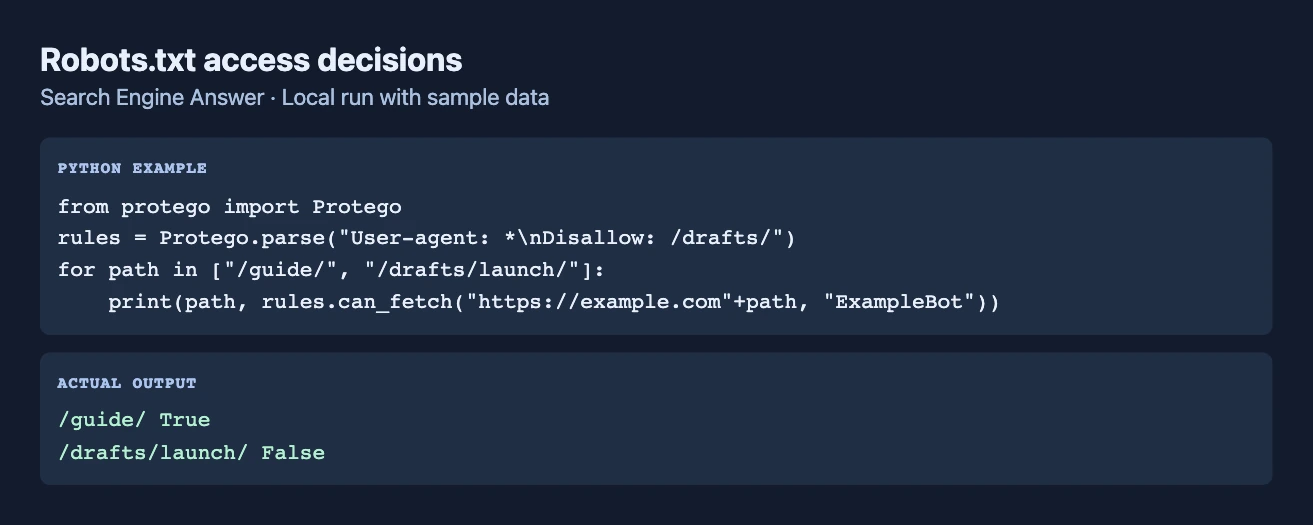
- Pass the fixture text to Protego.parse to create a parser.
- Call can_fetch with each staging URL and the same crawler user agent.
- Compare the returned decisions with your expected allow and block cases.
Where Protego fits
Use it to regression-test robots.txt rules before releasing a revised configuration.
- When to choose another tool
- Use verified server logs when you need to establish what a particular crawler actually requested.
- First evaluation
- Create a fixture with a blocked path and a more specific allowed path, then evaluate both for the same user agent.
- How to interpret the result
- Record the parser decision alongside the exact fixture and user agent. Check the live response after deployment.
Reviews and discussion
Reader reviews
Be the first to share your experience with this tool.
Discussion
Ask a question or share a setup tip.
Flag an outdated detail
Include the field that needs updating and a source link. Copy your draft, then use the corrections policy to contact the editorial team.
Write a review or join the discussion